
Humanity is the miracle of this world. It is what society is built on. Although the society on surface looks like a functional altruistic community, humanity in reality is actually egoistic. Throughout American literature, multiple famous pieces point to the egotism in humanity. Egoism is shown in people manipulating others, people’s will to survive, and in fact, altruistic acts are based on egoism.
“Egoism is shown in people manipulating others, people’s will to survive, and in fact, altruistic acts are based on egoism”
One of the best examples of egoism in humanity is the manipulation between people. People often try to control others in the interest of their own good. In the novel, Maggie, Girl of The Streets, the main character Maggie’s life is led to a decline as a direct result of Pete’s manipulation. Pete uses the fact that Maggie falls in love with him to control her. When they are at the bar, “the sound of the music which, by the efforts of the frowsy-headed leader, drifted to her ears through the smoke-filled atmosphere, made the girl dream. She thought of her former Rum Alley environment and turned to regard Pete’s strong protecting fists. She thought of the collar and cuff anufactory and the eternal moan of the proprietor” (Crane 58). In the nasty night club full of smoke, sits Pete and Maggie. Many might think it is Maggie’s fault that she trusted and fell in love with Pete, but the truth is Maggie knows no better. Pete used Maggie’s innocence to his own advantage, extremely egoistic. Pete just wants to take advantage of Maggie, he does not have the slightest thought of giving anything back to Maggie. However, Maggie is not in love with Pete for no reason, in fact, she is egotistic too. Maggie wants to, eventually, marry Pete, so she can get out of Rum Alley. She idolizes Pete and thinks that Pete is powerful and is able to benefit her if she treats him well.
Just like Pete, Lady Brett Ashley in the famous novel The Sun Also Rises by Ernest Hemingway, is also a manipulative character. The entire story revolves around her egoism because she has control over all the characters. At the end of the novel, Brett wants Jake to help her. Even though it was interrupting his vacation, he still decided to go. But later, he thinks to himself: “That seemed to handle it. That was it. Send a girl off with one man, Introduce her to another to go off with him. Now go and bring her back. And sign the wire with love. That was it all right” (Hemingway 243). Brett manipulates Jake into helping her all the time. After all the drama Jake has been through, Brett still wants him to help her out. The most ridiculous thing is that by the time Jake gets there, Brett has already gotten the ‘problem’ solved’, Jake’s vacation is ruined for nothing. So how did Brett feel about all this? She did not even apologize to Jake, because she knows that Jake is attached to her. Jake realizes that he is being used, but still chooses to go help Brett because he can not do anything else, he will not allow himself to do so. After so many years, it is more about himself than Brett. Jake is attached to Brett, to a point that he helps her just for his own satisfaction. He is already used to being manipulated by Brett, and she knows it. Brett’s actions are the egoistic nature of humans.
Manipulation is a great example of the egoistic nature of humans, however, down to the basics, the will to survive, the most important will that every human has, is egoistical. The Road explores the human nature of survival by putting characters in a post apocalyptic world where there is no hope, yet, everyone still strives to survive, even if that means at the cost of others. A thief has stolen the man and the boy’s supplies. When the man and the boy finally found the thief that stole their supplies, they threatened the thief and got all of their belongings back. The man says:
“You tried to kill us
I’m starving, man. You’d have done the same.
You took everything.
Come on, man. I’ll die.
I’m going to leave you the way you left us.
Come on. I’m begging you” (McCarthy 257).
The thief steals their supplies because he needs it to survive, even if that would cause the death of the man and the boy. The man takes everything back, even if that means the certain death of the thief, because he and the boy need it to survive. The will to survive is the strongest will in humanity, and it is egotistic. The man directly caused other’s death to save themselves, the rest of humanity would do the same if they were in this situation.
The will to survive is one of the most important aspects of The Road, some are more explicit than others. Cannibalism is unfortunately one of the aspects. Cannibalism brings the life of others to save themselves to another level. Not only does the person die because of others’ survival, but their body is the direct food source to survive. When the man and the boy came across an abandoned camp, they explored, and what the boy sees “was a charred human infant headless and gutted and blackening on the spit. He bent and picked the boy up and started for the road with him” (McCarthy 198). Cannibalism is no doubt, one of the worst act a human can do. When the post-apocalyptic setting strips humanity to the basics, people will do anything to survive, even if that means eating other humans. The fact that cannibalism is commonly seen throughout the story is scary, yet shows how low of a standard most people will hold themselves to when it comes down to survival. In the modern world, the real nature of humanity might horrify people, but it is terrifyingly egotistic.
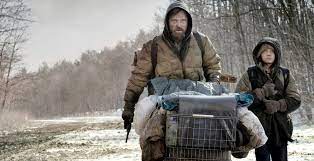
Egotistic behaviors like manipulation and the will to survive are easy to identify. However, the best proof of egotism in humanity is hard to see. They are, on the surface, altruistic behaviors. Altruistic acts are based on egotism, and The Road is also a good example. The relationship between the man and the boy is the most important aspect of the story. Most people think that the man is very altruistic, especially towards the boy, but in reality, the reason why the man is good to the boy is because he is the man’s son. This might be confusing in the argument of egotism in humanity, in spite of that, it actually makes sense. The one and only actual purpose of all lives on earth is to reproduce. The boy is a part of the man, a part of the man’s density is the survival of his offspring. The boy’s survival is the man’s success, and leads to the higher biological fitness of the man.
Just like The Road, The Things They Carried also put characters in a cruel environment, the Vietnam War. Tim going to the war is a big aspect of the book, however, the decision of going to war is egoistic. Unlike The Road, The Things They Carried gave the main character Tim O’Brien a choice to go or not. Tim was drafted to the Vietnam War. He ran to the border between The U.S. and Canada. He had the choice to either escape from his life, to Canada, or stay and fight in the Vietnam War for his country. Eventually, he chose to fight in the war. Fighting for his country seems altruistic on surface, but Tim did not go to war for his country. Rather, he went to war because of his ego. Tim reflected: “I would go to the war – I would kill and maybe die – because I was embarrassed not to” (O’Brien 57). The chapter “On The Rainy River ” is Tim’s confession on his ego driving him to war. Going to war for Tim is not a glorious thing to do, but not going to war and escaping however, is an embarrassing thing to do. Tim thinks that if he did not go to war, the public would make fun of him, and thinks that he is a coward. What he does not realize is that he would feel like a coward if he went to war. “I survived, but it’s not a happy ending. I was a coward. I went to war” (O’Brien 58). This is a short and clean statement that includes all of his emotions towards war. By giving up to his egoistic thoughts, he betrayed himself. Tim was never meant to be a soldier, he went to war simply because his ego forced him to. It is the egotism that drives the seemingly altruistic acts.
Egoism is in every human on earth, the American Literature is a great reflection of it. Egoism is greatly portrayed through the acts of manipulation and the will to survive. Many things might even appear altruistic, but its foundation is often egoistic.
Works Cited
Fitzgerald, F. Scott. The Great Gatsby. Scribner.
Hemingway, Ernest. The Sun Also Rises. Scribner, 2006.
McCarthy, Cormac. The road. Vintage Books, 2006.
O’Brien, Tim. The Things They Carried: A Work of Fiction. Houghton Mifflin Harcourt, 2009.
This is the most recent essay that I have written. I liked this essay, because it is well structured and I took inspirations from TTTC essay. I would like to do research and back up my claim about offspring relating to the fitness, but I thought it was unessesary.