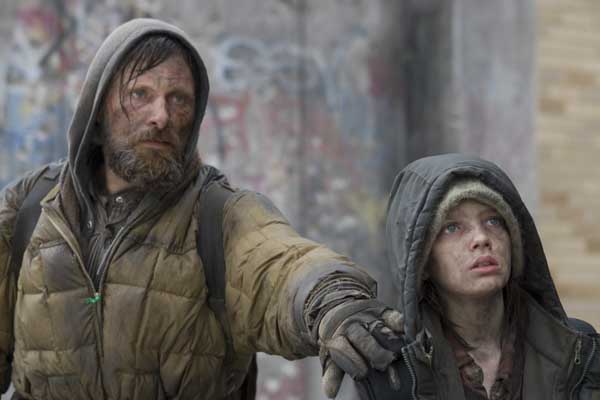
In today’s world, we see and hear news around the world that makes us, as humans, lose faith in humanity. Long time back, Robert Browning said: “I see humans but no humanity” and shared his expression about the end of humanity in today’s world. Moreover, The Road by Cormac McCarthy portrays a journey of a father and a boy in a post- apocalypse world and their struggle in a world with no humanity. Although McCarthy illustrates a terrible world with humans but no humanity, just like Browning’s ideology, over the course of the novel, McCarthy finds himself contrasting his own ideas by portraying the boy as the human figure whose selfless actions makes it hard for McCarthy to demonstrate the brutal world and leads to bringing hope to both the man and readers. This contrast in portraying no humanity to humanity is what changes the readers’ knowledge about the father and son’s world and gives hope even in those terrible situations.
McCarthy from the start of the novel describes the unusual world the father and the son were living in. The earth is portrayed as a haunted place with no where to go, no happiness, and no peace: “Nights dark beyond darkness and the days more gray each one than what had gone before. Like the onset of some cold glaucoma dimming away the world” (McCarthy 01). In the post apocalypse world, the father discovers himself around darkness. The color gray symbolizes their surroundings and how everything is destroyed and getting worse day after day. The journey consisted of abandoned houses, roads, shops, and lives. There was nothing left to live for- except for each other, but there were times when there was no hope for living as well: “the city was burned. No signs of life. Cars in the street caked with ash, everything covered with ash and dust,” (McCarthy 12). Through the days, they feared for bad guys, but what scared them the most were darkness and loneliness. No matter where they went, they felt the need to be aware. The man remembers the old world and talks about how different it was from now, but he knows there will be a day when either him or the boy has to die, and while some days he does not want to think about death but most days during their struggle for survival, he feels like dying is their best option: “That goodluck might not be no such thing. There were few nights lying in the ark that he did not envy the dead” (McCarthy 230). As much as he wanted to protect his son and himself from the danger, the man knew that living in this world was a torture to oneself. Surviving everyday was a blessing but the father himself did not know what to trust. Some days he found himself questioning his decision of staying alive and wonders if it would have been better if he had killed himself and the son with his wife rather than not trusting her about the world was his biggest mistake: “No, I am speaking the truth. Sooner or later they will catch us and kill us. They will rape us and kill us and eat us and you won’t face it. You’d rather wait for it to happen” (McCarthy 56). Being alone in the world with corpses and people who eat others was something that haunted both of them. They knew humanity was gone, but they never imagined a world so brutal that being alive was so disgusting. Everyday for them felt like a lifetime, but even in that lifetime both the father and the son were alone because they were so different from the remaining survivors: “behind them came wagons drawn by slaves in harness and piled with goods of war and after that the women, perhaps a dozen in number, some of them pregnant, and lastly a supplementary consort of catamites ill clothed against the cold and fitted in dog collars and yoked each to each” (McCarthy 92). The world they were in was so much different than the one the man was used to before. The father sensed they were not alone, but seeing people who did survive like that, made him wonder where humanity went. Furthermore, there were times when the father questioned himself and if he even have to live like a good man anymore? But because of his son, he was forced to be the good guy even in the bad days and because of their good deeds one can argue that they survived longer than anyone ever imagined.
From the beginning of the novel, the son has played an unique role in differentiating the difference between good guys and the bad guys. The boy often finds himself questioning his father about their actions and making sure that even in the world with no humanity, both him and his father are doing the right thing: “Are we still the good guys? He said. Yes. We’re still the good guys. And we always will be. Yes. we always will be. Okay” (McCarthy 77). The boy’s constant questioning about who they were in this world shows how small of the line was between being the good ones and being the bad ones. Somewhere, the boy knew that the situations they were in could change anyone but he did not want it to be them, especially after all they have been through together. Furthermore, the boy knows that they have to put themselves first and not care about others but because of his innocence being the major quality, he finds himself caring way too much for the others: “You’re not the only one who has to worry about everything. The boy said something but he couldn’t understand him. What? He said. He looked up, his wet and grimy face. Yes, I am, he said. I am the one” (McCarthy 259). The boy finds himself thinking about others no matter how hard he tries. In the novel, McCarthy more than once shines the connection of the boy being a spiritual figure, more like the son of God, and because of his selfless deeds, the man finds himself questioning his faith in humanity and if survival is the only thing necessary or being more of yourself is. Over the course of the novel, the boy gives readers hope through his innocence and act of selflessness. He states: “We would never eat anybody, would we? Cause we are the good guys. And we’re carrying the fire” (McCarthy 129). His questioning is more assurance to himself and to his father that it is not as difficult as they are assuming to do the right thing and even if both the father and the son feel like the world is falling apart they can be the good people and help others And because of the boy, the man finds peace in death and the boy finds peace with good people, which was all he ever wanted.
Moreover, McCarthy mentions death throughout the novel and emphasizes the scary part which death leads up to. The father, who gives up everything for his son, even takes up his own death, is what Fassler, identifies as the father’s selfless deed: “Reading this book around that time put me in a mindset that made me particularly vulnerable to the subject matter. The Road is ultimately about a father sacrificing everything for his son—keeping on and surviving despite a nightmare landscape, and only for his son’s sake. I felt plugged into that current in a way that I don’t know I would have if not a father” (Fassler). Fassler, being a father reboots the idea of the man pushing the idea of humanity by doing everything he can for his son, even dying. Overall, McCarthy does a great job in balancing between the larger themes of the novel and showing how different readers can take different road through the course of the novel just like William Kennedy states: “The overarching theme in McCarthy’s work has been the face-off of good and evil with evil invariably triumphant the bloodiest possible slaughter. Had this novel continued his pattern, that band of marching thugs would have been the focus” (Kennedy). This again supports the idea that the man and the son keeps fighting against the evil and being the good guys, and in their journey the man finds himself giving up on humanity but because of the son, and his faith for humanity is what helps the man keeps finding peace and the son finding his journey towards the goodness with his fire.
WORK CITATION
Kennedy, William. “Left Behind.” The New York Times, The New York Times, 8 Oct. 2006, www.nytimes.com/2006/10/08/books/review/Kennedy.t.html.
Fassler, Joe. “Cormac McCarthy’s The Road May Have the Scariest Passage in All of Literature”. The Atlantic, 2019. Online. Internet. 20 May 2019. . Available: https://www.theatlantic.com/entertainment/archive/2013/05/cormac-mccarthys-i-the-road-i-may-have-the-scariest-passage-in-all-of-literature/275834/.
McCarthy, Cormac. The Road. pp. 7-200.
Hello. this was the final critical essay for the class. I am very proud of this piece as The Road was one of my fav books for this class and I enjoyed writing my perspective about the book. I could’ve done it better if I had more time. This piece was by far my best piece.
Thanks for reading. Enjoy!