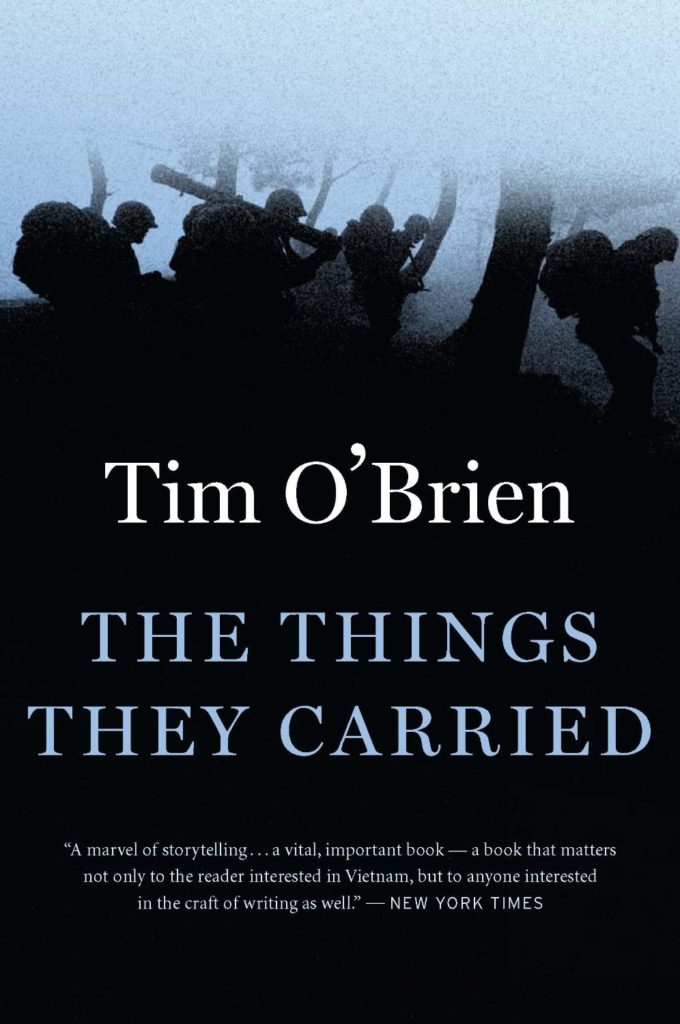
Throughout Tim O’Brien’s novel, The Things They Carried, various gory, graphic, and disturbing images are described. But parallel to these horrors, O’Brien describes beauty: beauty in the mountains or the jungle, beauty in the relationships between his friends, beauty in the villagers, beauty in the memories they carry. O’Brien shows us the hell of war, but he also shows us the less hellish parts. War may be hell, yes, but war is not only hell. Nothing is just one thing, and O’Brien uses these contrasts in his writing to demonstrate the ambiguity of war and of life as a whole.
Tim’s memories of Vietnam are scattered. He remembers the pain, but also the milder moments. Though Vietnam was a war, it was also his life.
“I remember these things, too. The damp, fungal scent of an empty body bag. A quarter moon rising over the nighttime paddies. Henry Dobbins sitting in the twilight, sewing on his new buck-sergeant stripes, quietly singing, “A tisket, a tasket, a green and yellow basket.” A field of elephant grass weighted with wind, bowing under the stir of a helicopter’s blades, the grass dark and servile, bending low, but then rising straight again when the chopper went away. A red clay trail outside the village of My Khe. A hand grenade. A slim, dead, dainty young man of about twenty. Kiowa saying, “No choice, Tim. What else could you do?” Kiowa saying, “Right?” Kiowa saying, “Talk to me””(O’Brien, 35).
This list-like format shows some of how his memories work. Everything is blended together, and there is no separation of the good and the bad. The dead man is right there by Dobbin’s singing, the grass swaying in the wind is complemented by the foreboding of the helicopter blades. His memories are ambiguous, just as the idea of the Vietnam war was.
As he moves deeper into the book, the bad gets worse. There is more death, more gore, more pain, but also more beauty. He starts to point out the flowers in the trees, the sunlight, the butterflies, the natural beauty that surrounds him. As the horror comes into clearer focus, so does everything else. When Curt Lemon, Rat Kiley’s best friend and a member of the platoon, dies, O’Brien’s description is layered.
“There was a noise, I suppose, which must’ve been the detonator, so I glanced behind me and watched Lemon step from the shade into bright sunlight. His face was suddenly brown and shining. A handsome kid, really. Sharp gray eyes, lean and narrow-waisted, and when he died it was almost beautiful, the way the sunlight came around him and lifted him up and sucked him high into a tree full of moss and vines and white blossoms”(O’Brien 67).
As he describes the death of a friend that the reader later on learns to be quite violent, his mind is drawn towards the beauty of his surroundings. He sees the sunlight, in this religious comparison of Lemon being drawn up towards the heaven in a beam of light, and lush greenery of the tree above him. Throughout the book, O’Brien talks a lot about the necessity of showing these beautiful things, too.
He once states that a true story is one that you feel in your stomach. By using these ideas of beauty and horror together, he brings the war closer to the reader. Readers may not be able to identify with the violence, but they can identify with the beauty. This normalization and demonstration that even though the soldiers are in horrific situations, life goes on shows the readers that soldiers are learning to live like that, and that their lives don’t stop just because they are at war. War is hell, but it also everything else in their lives. War is as multifaceted and layered as peace is, and nothing can be put into such simple boxes so easily.
In this same vein, in the chapter “The Man I Killed”, he describes the body of the young man.
“His jaw was in his throat, his upper lip and teeth were gone, his one eye was shut, his other eye was a star-shaped hole, his eyebrows were thin and arched like a woman’s, his nose was undamaged, there was a slight tear at the lobe of one ear, his clean black hair was swept upward into a cowlick at the rear of the skull, his forehead was lightly freckled, his fingernails were clean, the skin at his left cheek was peeled back in three ragged strips, his right cheek was smooth and hairless, there was a butterfly on his chin, his neck was open to the spinal cord and the blood there was thick and shiny and it was this wound that had killed him”(O’Brien 119).
As his mind reels from the panic of killing a man (in story truth, at least), he doesn’t just see the gore. His eyes are drawn to everything about the man, and that doesn’t stop at just the injuries. The truth of this man is not only death. If O’Brien were to just describe that, he would be betraying the emotion and the story-truth. This man is more than death. This man has a history, a life. This man is a metaphor for war as a whole.
Throughout this entire story, Tim O’Brien uses contrasts of beauty and horror to bring the reader closer to the truth.
“War is hell, but that’s not the half of it, because war is also mystery and terror and adventure and courage and discovery and holiness and pity and despair and longing and love. War is nasty; war is fun. War is thrilling; war is drudgery. War makes you a man; war makes you dead. The truths are contradictory. It can be argued, for instance, that war is grotesque. But in truth war is also beauty”(O’Brien 77).
He is showing us the reality of war- war is just as multifaceted and layered as peace is, and the use of these contrasts make us feel, make us believe, and make us understand the reality as much as possible as readers.
This is by far my least favorite essay I wrote all year. It feels sloppy and disorganized and I’m not quite sure why- I’d like to re write this topic sometime and try and flesh it out a bit better, it just feels kind of rushed.