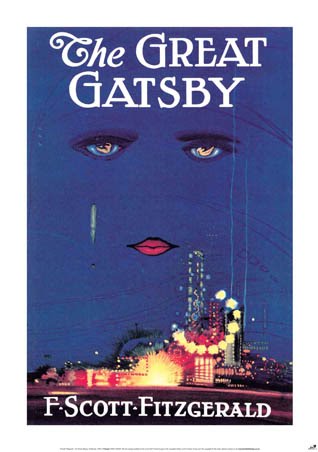
I love Nick Carraway, the narrator of F. Scott Fitzgerald’s The Great Gatsby, very dearly. But even though he is a character I hold very close to my heart, one thing can not be denied: his passivity as a person. Though some people may say that Nick’s passivity was willful, and that he chose to ignore the lives of his friends crashing down around him, Nick really didn’t have the ability to stop it. His passivity was so ingrained into his being that he didn’t ever have the chance to change anything, and can not be held any more responsible than anyone else for the tragedies that occurred.
Nick Carraway, at his very core, is a doormat. Though Nick tends to mean well, he rarely has the courage to speak his mind, nevermind contradict someone. He rarely even has the contradictory thoughts at all- he is so conditioned to follow along that it doesn’t occur to him to think differently than the people he cares about.
Through all he said, even through his appalling sentimentality, I was reminded of something- an elusive rhythm, a fragment of lost words, that I had heard somewhere a long time ago. For a moment a phrase tried to take shape in my mouth and my lips parted like a dumb man’s, as though there was more struggling upon them than a wisp of startled air. But they made no sound, and what I had almost remembered was uncommunicable forever(Fitzgerald 112).
Nick has this one moment, as Gatsby tells him about his past with Daisy, where he may have had the means to stop this. The warning is there, at the tip of his tongue, before it is ‘uncommunicable forever’- his moment is gone, and he longer has the physical or emotional ability to hold responsibility for everything that comes after. If one does not have the means to stop something, how could we hold them responsible? His relative inexperience with the gaudy wealth and fast pace of the city leave him feeling like he needs to take a backseat to those who are more experienced, namely Daisy and Gatsby, which leads him into many a situation. One example of this is when he goes out to eat lunch with Gatsby. Together they interact with a shady man named Meyer Wolfsheim. During this lunch, Wolfsheim points out his cufflinks. “‘Finest specimens of human molars,’ he informed me. ‘Well!’ I inspected them. ‘That’s a very interesting idea’”(Fitzgerald 73). Nick’s passivity is immediately clear. Even though a very suspicious person has shown him jewelry composed of parts of a human body, no shock or horror is apparent in Nick’s outward appearance, and more importantly, in his head. Nowhere in this situation does Nick have any opposition in his mind to literal human teeth, and this attitude is telling of his character as a whole. When Daisy and Gatsby do something that may seem jarring or off-putting to the reader, Nick is too far gone in his world of passivity to even consider challenging them.
This attitude is magnified when it concerns someone that Nick truly cares about. While at rare moments he may silently, or even more rarely, openly disagree with Tom Buchanan, Daisy’s husband, he strongly dislikes Tom. In the world that Nick presents to the reader, Daisy and Gatsby are the shining stars. Nick has an intense dislike for the money around him, except for Gatsby. “I wanted no more riotous excursions with privileged glimpses into the human heart. Only Gatsby, the man who gives his name to this book, was exempt from my reaction-Gatsby, who represented everything for which I have an unaffected scorn”(Fitzgerald 2). This shows Nick’s hatred for the wealth, but how even though Gatsby embodied it, he had respect and strong affection for him. Gatsby embodied everything he hated, and Nick loved him anyways. This is important because it shows Nick’s desperation for human connection, and how Gatsby gives it to him. With this reliance on Gatsby, Nick is terribly afraid of offending or hurting him, and never even considers contradiction. In Nick’s eyes, the way to keep his friend happy is to agree with everything he says or does, and support him in it.
Though Nick has a fierce love of Gatsby, his feelings for Daisy are more complicated. He admires her- he oftens talks about the beauty of her voice, the strikingness of her person- but he also resents her. He sees her with the disdain that Gatsby escapes in his eyes. In many instances, he refers to her wealth with snark and clear dislike of it- but it doesn’t stop him from loving her as a cousin, and as a force to be reckoned with.
With all of this combined- his love for Gatsby and admiration blurring his judgement, his people pleasing personality, and a physical inability to contradict people due to a life of agreeability, Nick can not be held accountable for the contents of this novel. Nick is trapped in a world of ‘uncommunicable’ truths- If one does not have the means to stop a tragedy, how can we blame them for it?
This is not a paper I’m particularly proud of- it just felt kind of bleh as I wrote it, even though I really have strong feelings about Nick as a character. (You’re all welcome to join the Sad Boys Club by the way- current members are Nick Carraway, Jake Barnes, Logan Arseneau, and me)