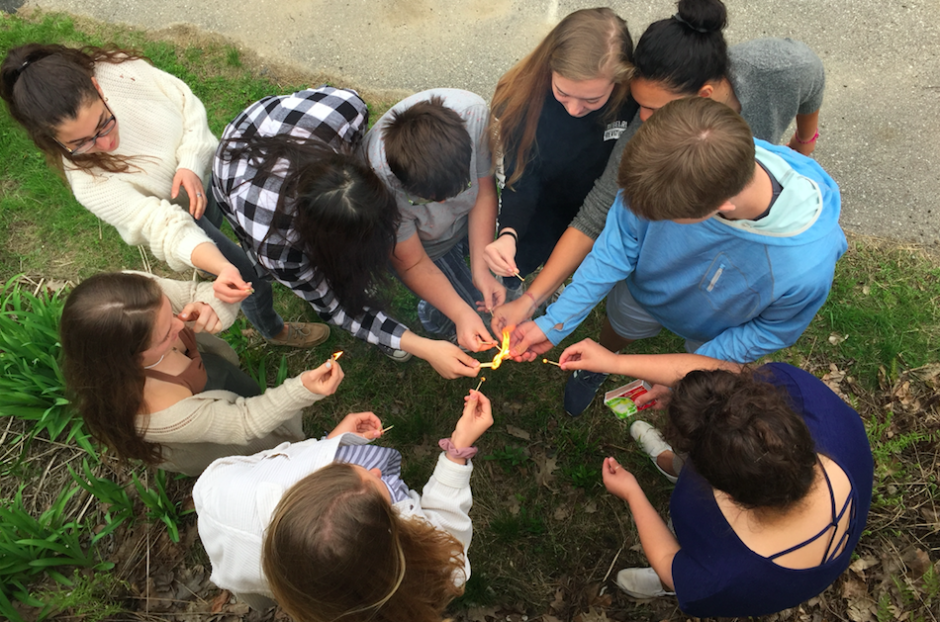
There was a soft and gentle light escaping the kind uninhabited cottage. In the moonlight, there seemed to be shadows that danced on the walls to a quiet lullaby, as the light grew brighter the desolate cabin came to life. On the yellow walls, still, silhouettes came alive flying in the light searching for their lovers’ shadow passing by, the spinning shadows connected with a vulnerable touch only human emotion could convey. By the shining moon sat the dark night, it watched the isolated cottage shin with its bright yellow light and dancing shadows that had come to life rejoicing in their new found comfort of each others love, they whirled around the now glowing cottage as if pushed by the wind, so effortlessly. And on the rise of the sun sat the cabin alone and asleep, it’s performance the night before completely gone with the moon, hiding behind the light of day, the shadows, stationary, shifting along with the sun as it makes it’s journey over the hilltop, till the quiet cabin is alone in its own shadow, with no light but with no moon the shadows gone with the ibis, they must wait for night to fall to continue their dance.
Every short summer night leaves a longing and desire to an unfinished dance, an unreached moment left untouched as the moon says goodbye with an apathetic slanted grin. As days on the hill got colder the moonlit dances got longer, but as these cold nights surround the cottage the warm yellow walls and the bright glow kept them flushed while they moved along the walls unconstrained by the earth.
At least once a night the shadows joined hands just as the sun rises and the light filled the hills waking everything from its sleep. In the small cabin, they said goodbyes until next time as they parted slowly returning to their places on the yellow walls. On these sunny days, they moved solemnly around the cottage and hoped to touch each other as the light shifted from each shinning window to the next.
By dusk, the shadows have waited with an impatience trembling inside. Waiting for the sun to finish falling behind the hill, drearily dragging all the light with it as the moon wakes from its slumber. The moonlight began to bleed through the sky like a crystal glass full of white wine with fine bubbles that spilt across the sky illuminating the cottage with a warm drunk light.
The lights in the cottage dance around the yellow walls, the cabin was brighter than any other night, as the shadows came to life there was no audience tonight. There were no bystanders yet everything stopped to watch the tiny cabin filled with lights. This night they danced longer, and with more emotion than any other night, the lights brighter and the tensions higher, there was no reason for this, it was the longest night of any other.
Suddenly the night was over, the sun rose and as the lights faded the shadows held on refusing to go without each other, determined to remain connected, eventually the light through the windows won. Their love had grown as old as the hills and soon they would rejoice again, shifting with the sun as it was pulled out of view the crystal cup spilled once more. The yellow lit dance has begun.
In the F. Scott Fitzgerald novel The Great Gatsby, the relationship between East Egg and West Egg is shown in many different ways, one being the use of color. Specifically, the color most often used to represent this relationship is yellow. The color yellow signifies wealth in all forms, and its meaning changes for each character. The color yellow is an imitation of gold and shows West Egg’s desire to be gold, to be like the East Egg. To characters such as Gatsby, Daisy, and Tom, yellow signifies wealth or the lack thereof. To characters such as Nick, the color yellow can be used to show his desire to belong and his wish to have people, his own people, to call his family. Whether it signifies literal wealth or belonging, the color yellow and variations of it represent what is found to be most valuable to each character.
The relationship between old money and new money, West Egg and East Egg, is shown through the use of the colors yellow and gold. Yellow is representative of new money, its imitation of old money, its gaudy attention seeking properties. Gold represents old money, class, and sophistication. New money wants to imitate old money and reach their level of status and elegance but does not have the same understanding of class. The imitation of gold shows the desire, in the same way, that Gatsby has to be like Daisy and have her. Gatsby, not coming from old money, does not know that the flamboyant and loud lifestyle is not what she wants. She wishes to have the lavish life of class and sophistication that is given by old money, that is given by gold. Gold is old money, it is lavish and beautiful without the loud and attention seeking qualities that yellow possesses. Gold shows its wealth without effort. As seen when Daisy absentmindedly would give up a something so rich in value that is yet so subtle to the recipient, “‘Go ahead,’ answered Daisy generally, ‘and if you want to take down any addresses here’s my little gold pencil’” (Fitzgerald 105). Daisy’s ‘gold pencil’ signifies her wealth without trying, it’s a small and elegant pencil, one that is not flamboyant. Daisy is better than yellow greed, yellow is gaudy, not quite rich, gold is the yellow of those who come from old money. Each one of these characters desires material wealth in some way, whether it be gaudy and showy wealth in new money or classy and elegant in terms of old money.
Nick wishes not money and gold; he sees the lavish lifestyle those of his comrades’ life and wishes to be a part of that life, to be included by them. He remains a character who never truly belongs in that life, he is continuously out of place but has a desire to belong. As seen here when Nick is looking up at Gatsby’s mansion emitting a bright yellow light “Yet high over the city our line of yellow windows must have contributed their share of human secrecy to the casual watcher in the darkening streets, and I was him too, looking up and wondering. I was within and without, simultaneously enchanted and repelled by the inexhaustible variety of life” (Fitzgerald 35). Here Nick has become part of the life with Gatsby, he is right in the middle, yet not involved or engaged by his surroundings. Nick who begins a relationship with a wealthy pro golfer does not only wish for her status. Nick seems to fall for his pro golfer girlfriend for his desire to be with her. Nick feels a real connection to Jordan and likes her genuinely. He does not care if she is wealthy but he is aware it is a part of Jordan. Nick is connected to wealth and money but is not obsessive about it. Nick is genuine and cares for Jordan with real emotions “I put my arm around Jordan’s ‘golden shoulder’ and drew her towards me and asked her to dinner” (Fitzgerald 79). Jordan’s golden shoulder represents interest or some sort of goal as Nick is intrigued by her. This intriguing feature develops a perspective of Jordan that is fascinated and yearning for. He wants Jordan, and the romantic chemistry between one another is represented by what he sees in her. Furthermore, Jordan’s ‘golden shoulder’ secures her as a member of wealthy old money; thus making her socially acceptable.
Yellow is attention seeking, it grabbed attention with its gaudy and extreme lavishness. Yellow is imitating gold and is focussed on being showy and having a lot to show off. The girls in the yellow dresses at Gatsby’s ostentatious West Egg carnival took Jordan’s attention away from Nick: “She held my hand impersonally, as a promise that she’d take care of me in a minute, and gave ear to two girls in twin yellow dresses, who stopped at the foot of the steps” (Fitzgerald 42). The yellow dresses are gaudy and attention-grabbing, they take Jordan’s attention away from Nick and draws her towards them. They try to be classy like gold but new money isn’t class, it is a show. Gatsby’s whole party is a show, one put on to impress Daisy who sees through the charade. Daisy is the original golden girl in the rich white castle.
Yellow and Gold are the two colors of New York City, when Nick crosses the bridge there is a whole new world, “As we crossed the Blackwell‘s Island a limousine passed us, driven by a white chauffeur, in which sat three modest negroes, two bucks and a girl. I laughed aloud as the yolks of their eyeballs rolled toward us in the haughty rivalry. ‘anything can happen now that we’ve slid over this bridge,’ I thought; ‘anything at all….’ Even Gatsby could happen, without a particular wonder” (Fitzgerald 69) a world where blacks can have the same pleasures and luxuries as wealthy whites, one where anything is possible including Gatsby. New York is Yellow, and every variation of it, anything is possible once in the City. New York is rich, there is old money and new money, there is color and life, New York City is alive and this idea of endless opportunity is what makes it possible for Nick to believe Gatsby is real.In The Great Gatsby yellow signifies Gatsby’s wealth but it also shows how all his earning are superficial. Gatsby is from West Egg and has new money, and the conception that new money does not undertand class and respectability can be seen with Gatsby’s gaudy wealth. The significance of yellow and gold and their symbolic relationship to the two worlds that coincide with one another in the world of new york also symbolize the relationship and struggle between Gatsby and Daisy. Daisy carries a gold pencil and Gatsby has an expensive car. “‘It was a big yellow car,’ he said, ‘big yellow car, new’” (Fitzgerald 139). A large yellow lavish car that is extravagant and ornate. This lavish and eye-catching life is what separates Gatsby and Daisy, the same thing that separates yellow and gold. Yellow is the color of New York City- it is the color of possibility, as well as desire, the color yellow and all its variations, are symbolic to what is most desired by each character. Gatsby did not understand Daisy was gold, he did not perceive that his yellow lifestyle is not what she wished for, Gatsby built his yellow life for a girl that was made of gold.
My people are my home. There is a quote hanging on the wall of my dorm room that reads, “What I Love Most About My Home is who I share it With.” For me it does not matter where I am, as long as I have my people, I am home. Peterborough New Hampshire is where I grew up and is where my foundation comes from. My family is the foundation of my life and continue to be the rock of my existence. They are the people put on this earth that have to love me no matter what. They are the people that can be 100% honest with me and I to them with no hard feelings. They are the people that annoy me so much but make up for it by being the sweetest, most loving people in my life. Being away from my three younger siblings who all look up to me in different ways is hard, but the random FaceTime calls and cute little messages they send remind me who I am. They are a big part of my life and I would not be the same person I am today if they weren’t a part of my journey. This makes them my home.
Since I decided to go to school in Hebron Maine, it has become my home away from home. The lifelong friends and connections I have made at this place define it as my home.
My roomie, my best friend, my partner in crime, Aarti Singh. She is one of the few people I trust enough to tell everything to. She and I met last year and instantly had a connection, that frankly, I do not think will ever be broken. We have seen each other at our worst and at our best, and are always there to give each other a reality check when needed, but also reassurance about different situations and decisions. Aarti is my soul sister and she is my home.
Alice Dang, my best friend, the person I can always rely on to give me comfort when I need a shoulder to rest on, or when I need to spill my thought onto someone. Although I have only known her for a year and a few months now, she is one of the most important people in my life. She is someone I can trust and know that no matter what happens, she is not going anywhere. She is my baby, and she is my home.
The last person that symbolizes home for me is Thekla Jubinville. Before this year I honestly never thought I would say that, but she has become someone that I truly appreciate and care for. I have grown to realize how similar we really are and how very caring and genuine she is. She has become someone I can rely on for advice and support about any matter that could possibly come up. Hebron has been a place where we have both grown and matured, bringing us together and I am very grateful to have her in my life. Because of this, she is my home.
Home does not have to be a physical place, symbol or feeling, it can also be people, and for me, my people are my home. I do not believe you need to have a whole orchestra of people to have a well-constructed base, I think it is more beneficial to have a small handful of people that you truly trust and care for and who can honestly say they feel the same towards you. These people in my life symbolize what home is for me, and I would not have it any other way.
Older siblings from the moment we are born, set a standard for the rest of the family. You are the person that your younger brothers look up to, you are the one that your parents use as an example “because you are their first child.” “From the moment you are born, your life is full of setting standards” and it is something that I have carried around forever. Being an older brother brings so much responsibility because setting a high standard is not easy, but maintaining that high standard is even harder. As of now, my brothers look up to me. My high school days have brought much athletic success but academics have needed work. I have worked at showing my brothers that perseverance and hard work are the key aspects into growing and progressing as a man. Showing these essential qualities and being a role model for them is hard, but necessary. My parents raise me to be the best absolute person I can be and one slip off the wrong track can lead to losing that high standard that I have held for so long. The pressure is intense but carrying around high standards is something I try to maintain. Support and guidance may help but ultimately if we don’t hold yourself accountable to high standards then you are the one who is at fault and not reaching your maximum potential.
My family is full of laughter, joy, and sports. Now as much as my parents may disagree with this statement because school is extremely important, the nights when we are sitting down talking to each other it is almost always about sports. Our love and passion for sports comes from a long line of athletic men and women in past generations of our family. My parents and their siblings all participated in many varieties of sports and caused my brothers and I to pursue the same passions. Setting a high standard encapsulates a large variety of things. You are the one who has to build a strong personality that people like because your parents never meant to raise an inconsiderate boy. You have to develop yourself to become the best athletic and academic kid you can be. You have to work hard, in the classroom, on the fields, in extracurriculars, and most importantly you have to develop yourself into a boy that your parents look back at and say, “I am proud of him”. These are all examples of standards that make a role model.
Setting a high standard is not a requirement in modern day society, despite this, being in a family that provides limitless opportunities carries some pressure. Balancing a 30 pound round ball on your head is impossible, just like being a perfect human being. You are allowed to live your life with pressure and weight on your head. But say you put that same 30 pound ball on your head, but you use your hands to hold it. You’ve increased the support but the chance for dropping that ball is still there. Everyone lives life on the edge of failure and success, but not everyone lives life with endless opportunities. Having constant support from your parents and them always trying to make me the best person I can be is the most valuable thing I can hold; and in spite of this pressure, and in spite of these hardships, in the end the result is much more valuable than the process leading up to it. High standards is what I carry.
In the novel, The Road, by Cormac McCarthy, the boy goes from being the one protected to being the protector. In the beginning of the book we meet a young impressionable and innocent little boy who is completely dependent on his father for survival. As we follow the man and the boy through their journey, the boy is growing up and understanding the man is sick. He starts to take more responsibility for their survival and safety. Imagine you are the boy traveling with your father through this post apocalyptic world trying to stay alive, would you be able to handle that?
The boy, when we first meet him is very innocent and relies a lot on the man for emotional support and is just a normal young child. We see the fading of his innocence throughout the book with his willingness to share his dreams and fears with his father. In the beginning he has a bad dream about a penguin, “He woke whimpering in the night and the man held him. ‘Shh, he said. Shh. It’s okay.’ ‘I had a bad dream.’ ‘Should I tell you what it was?’ ‘If you want to.’” The boy then goes on to tell his father about a wind up penguin that was working without the winder spinning. (A very innocent dream) “‘okay’ ‘It was a lot scarier in the dream.’ ‘I know. Dreams can be really scary.’ ‘Why did I have that scary dream?’ ‘I dont know. But it’s okay now’” (McCarthy 36). Later on in their journey the boy has another bad dream, “The boy was sitting up wrapped in his blanket. ‘What is it?’ ‘Nothing. I had a bad dream.’ ‘What did you dream about?’ ‘Nothing.’ ‘Are you okay?’ ‘No’” (McCarthy 183). In contrast to the boys first bad dream, this time he is hesitant to tell the man about his nightmare. His answers to the mans questions are very short and to the point and it is clear he does not want to share his fears.
As the story goes on and the boy is a witness to some pretty terrible sights, we see some of his innocence slip away. The way the boy progressively talks about death throughout the novel demonstrates his mental growth. We initially meet a very optimistic boy, but as we continue to observe his journey he becomes more aware of reality. He starts by asking “We’re going to be okay, arent we Papa? (McCarthy 83)” Then when the man asks, “‘Do you want to die?’” The boy responds, “‘I dont care.’ (McCarthy 85)” eventually the boy says that he wants to die. He is slowly losing the will to keep going on their journey because they aren’t going toward anything and the boy is more in tune with reality.
Throughout the book the man holds the nurturing role in their relationship, but towards the end, the boy takes over that role. This is partly because he knows the man is becoming progressively more sick, he is also getting older. “‘What are we going to do Papa?’ he said. ‘Well what are we’, said the boy” (McCarthy 275). The first person talking was the man; however, he addressed the boy as Papa. This is a clear representation of the reversal of roles in their relationship. In the past the boy would have been the one unsure of how they would keep going, but we now see the man asking the boy for reassurance that they will be able to continue. Another place we see the boy take the man’s place is when he says grace, “Dear people, thank you for all this food and stuff. We know that you saved it for yourself and if you were here we wouldnt eat it no matter how hungry we were and we’re sorry that you didnt get to eat it and we hope that you’re safe in heaven with God” (McCarthy 146). The boy saying grace for him and the man is representative of the reversal of their roles because it shows how he has developed confidence and maturity.
William Kennedy briefly makes reference to the boy telling the man he is the one who has to worry about everything. “‘You’re not the one who has to worry about everything,’ And then the 10-year-old messiah, who is compassionate incarnate, and carrying the fire, gives up his seacret. He says to his father: ‘Yes I am. I am the one.’” William Kennedy directly says the boy is the one carrying the fire, and I completely agree. Even in the beginning of the book the boy is the one reason the man is trying to survive as long as he can. The boy is the one keeping them both alive. Even as he is coming to terms with reality, he carries the fire for the two of them. The boy stating that he is the one who has to worry about everything instead of the man represents how he is losing his sense of innocence. He knows the reality of his father’s illness and recognizes that he has to step up if they are going to survive.
To sum up, the progression of the boy taking the man’s role throughout the book is seen in various aspects of their daily conversation. We see evidence in his willingness to talk about his dreams, the way he talks about death, and the boy acknowledging that the man is sick and will die soon. He notices that he has to step up and take responsibility for their survival.
Sources:
Kennedy, William. “Left Behind”. The New York Times, 2006, Accessed 20 May 2019.
McCarthy, Cormac. The Road. The Random House Inc, 2006, pp. 1-287.
The warm embrace, the loving touch, the endearing words, and sweet caress. This safe space, this loving corner of the world, is home. A mother’s arms that provide the protective touch that she will never be capable of maturing out of, as she did with the small crib that consisted of a small stuffed burlap bean bag, the burgundy and deep shades of gin that outlined her childhood.
The crib she matured out of, growing quickly and without hesitation the bright-eyed child’s eyes mellowed just as quickly, their spark and innocence dissipating being replaced with intelligence and the unfortunate truth of the world. Seeing made her real, made her raw. She felt she knew too much to be happy, she knew the truth she saw the world for what it is and wished to turn back but the knowledge made her cold; it made her strong, independent, but distant. Away from home people are just faces, blurred features that do not notice that she separates herself. Nobody cares to look, to pay attention to the signs when she slowly builds a wall. Laying each brick using the unforgiven lies and abandonment of those she loved as glue she builds till a hand pulls her to her feet and takes her in a tight embrace. Each looking down at the partially constructed wall a sense of shame, embarrassment, and sorrow come over her, but this quickly dissipates when she is reassured that there is no shame in being angry with the world, there should be no embarrassment in being imperfect. Maybe we are just human.
Her safe space saves her, feeling distant for so long with artificial communication keeping them connected her safe space feels so far. Her distance and separation cannot be conveyed in any way other than real connection. The safe space opens and accepts her, her breaking self and can feel she is broken, no words are needed, nothing must be said. It is all said when her soft childlike eyes return the sparkle and innocence is recaptured this moment is short but seems to last forever it stitches her broken pieces back together. Arms extended forward her small strong shoulders in hand, the eyes looking at her wish to understand her pain her struggle and her mind that seem so restless but all the loving arms can do is hold her, little does she know her home has saved her.
The intelligence and harsh thoughts of the world returned, but they are no longer a painful presence there, a simple reminder to be cautious when giving others your trust and love, but you cannot fear love or lock it away. After going home she knows there is such thing as love. She proceeds back into the world, still and calm. Her home has fixed her broken parts bringing some light back into her crystal eyes that had grown grey. She parts way with her home knowing one day she will soon return.
The American dream is a literary cliche that is often overused in storytelling. This idea of coming to the “promise land” was once seen by so many immigrants and America has been a safe haven for so many, but it no longer seems like that same accepting place. The American dream promised so many things such as being able to start a new life and build your way up to a comfortable lifestyle. In the Stephen Crane novella Maggie: A Girl of the Streets, the American dream is portrayed in a much more realistic manner. Through this different perspective, Crane gives a new version of the American dream, one that depicts the opportunities of immigrants accurately.
The ideas and concepts present in the American dream have the misconception that people can immigrate to America and make a bearable life for themselves and often their family as well. In Maggie: A GIrl of the Streets this poverty-stricken city of immigrants makes this cliche idea of the American dream apparent. Maggie, the daughter of Irish immigrants, living in a minuscule, dilapidated tenement house in the crude slums of New York, leaves an entirely new perspective of the American dream with the reader. Her parents are portrayed as drunk and unfit parents who have left their children to care for themselves and provide for the entire family. With poor treatment, discrimination, and unfit living circumstances immigrants of all kinds were unable to live out the desired American dream. With all the discrimination in areas such as the workplace, it made creating a life for themselves extremely difficult.
Not only did all immigrants face discrimination in their everyday lives but to receive an education was also something seen as impossible. This is another example of the sham that is the American dream; a world full of opportunities. Education did exist but it was seen as solely a male privilege, but even then most could not attend school. All children were needed to work to make ends meet in families, and those who did go to school usually did not last very long due to needing to eventually help provide for their families. If young girls were not working in a dangerous factory their mothers were and girls were needed at home to care for younger siblings or to take care of household chores. Instead of attending school, masses of children served in the workforce, in all kinds of different factories. Children often worked dangerous jobs, that could easily coast them their fingers or health. These dangerous jobs were common and work accidents were regular. This lifestyle for children was not something included in the description of the American dream.
Children as young as ten and twelve had to work dangerous jobs to help support their families, and those who did not have families often had to turn to much more extreme measures. In Crane’s novella, it is implied the protagonist Maggie has turned to the streets to make money; becoming a prostitute. After her family had abandoned her and shut her out, “Where kin I go?” (Crane 78) Maggie had no other choice than to find some way to provide for herself. Prostitution which was heavily frowned upon in society became a very common practice with young women. Women who work on the streets are often described as someone who has gone to the devil “She’s gon to de devil” (Crane 43). This was used to describe someone who has turned to prostitution they were considered to have committed an awful sin. As this practice was not uncommon many women resorted to prostitution in order to survive. Selling your body was not something expected in the American dream. Young women were forced to extreme measures of selling their bodies in order to survive. This abandonment of self-respect and dignity is not a choice people make willingly but one someone does when all outside hop is lost. The American dream at this point is gone, it has been demolished by the dark power that comes from these women who have given up their honor due to the lack of opportunities and the death of the American dream.
The American dream is not a realistic concept for those who are considered immigrants or an unwanted race. The concept is over-romanticized by storytelling and has become a literary embarrassment and overdone idea. Crane showed a new side to the over-romanticized idea that is the American dream. This new representation was daring for Crane who gave the world an eye opener of the society they lived in. One that forced children into dangerous jobs and neglected to educate their youth as well as such an unstable and unfair economy that left so many unsupported women on the streets with no option but to turn to prostitution. A society such as this does not offer the all-praised American dream.
“There is no one perfect way to be a good mother. Each situation is unique. Each mother has different challenges, different skills, and abilities, and certainly different children… what matters is that a mother loves her children deeply.” (Elder M Russel Ballard) In the novel, The Scarlet Letter, by Nathaniel Hawthorne, Pearl, Hester Prynne’s daughter, is thought to be sent from hell by the devil; however, she is actually what saved Hester from going to hell herself. Hester is not a perfect mother, but her love for her daughter is what keeps her sane. Although Pearl may seem like the devil’s child, she is actually the opposite. She represents freedom.
This is shown in the novel when Pearl is walking through the woods with Hester and she has a moment with the nature. “Pearl set forth, at a great pace, and, as Hester smiled to perceive, did actually catch the sunshine, and stood laughing in the midst of it, all brightened by its splendor, and scintillating with the vivacity excited by rapid motion. The light lingered about the lonely child, as if glad of such a playmate…” (Hawthorne 275). Hawthorne’s narrator mentions that the sunlight lingered around Pearl, indicating that she is a holy being and full of goodness and joy.
When Hester was convicted of her crime, Pearl gave her a purpose and some form of happiness. If Hester had not had Pearl in her life she would have joined Mistress Hibbins in the woods and acquainted with the devil. When Mistress Hibbins asked Hester to join her in the woods Hester told her that she had to stay and take care of her daughter.
When she was born, Pearl gave her mother, Hester, a purpose, something to live for. Cast out by everyone else around her, Hester needed to have someone who would be with her all the time and give her a reason to keep going. As one could probably imagine, being outcast by everyone around them would be extremely diminishing and for Hester, having Pearl there to keep her company was what kept her true, and kept her moving forward.
Although she may seem evil and wicked, Pearl, is actually what saved Hester from ultimately going to Hell. When Hester is walking in the woods one day, she comes across Mistress Hibbins who asks, “Hist, hist!…Wilt thou go with us to-night? There will be a merry company in the forest; and I wellnigh promised the Black Man that comely Hester Prynne should make one.” To this Hester responded, “Make my excuse to him, so please you! I must tarry at home, and keep watch over my little Pearl, had they taken her from me, I would willingly have gone with thee into the forest, and signed my name in the Black Man’s book too, and that with my own blood!” (Hawthorne 174). Pearl is Hester’s reason to go on with her life and not fall into a hole of despair, despite all the pressure from the townspeople. Pearl is Hester’s saving grace, saving her from the pits of Hell.
To sum up, Pearl is a blessing for Hester and has saved Hester from going to Hell. Pearl is one with nature and this shows that she is a representation of light in Hester’s now dark life. Although some say Pearl was sent from hell by the devil, she is actually what saved Hester from going to hell herself. Hester is not a perfect mother; however, she does all she can to help her daughter became the person she knows she can be. Throughout Hester’s dark, and mostly lonely life, Pearl was the fuel to her fire.
As I look back on the events of my junior year and the various relationships I have formed with the people around me, there is one that sticks out when I think about people I have hurt with my words and actions. Throughout my life I have always said that I would never regret anything because at the time, that’s what I wanted or needed; however, I have quickly come to the realization that this can not apply to the words that roll of your lips because what you say is not always what you truly feel or want to express. In this specific situation, my words and actions that went along with them were taken from a place of blindness.
If I had to choose a phrase to represent my year thus far it would be ‘self improvement’. I came into this year with two close friends and the mindset of whatever happens, happens. I was kind of timid at first because I knew that it was going to be challenging, but at the same time I was ready for it. I made a point to push myself to talk to, and meet as many people as possible during orientation, and was able to make a couple friends that I now consider to be my go to people.
The first month and a half were a whirlwind and this person was at the center of it, they became someone that I could rely on and I pretty much spent all my time with them. When you talk to someone all the time, you sometimes start to take advantage of their feelings and this is exactly what I was doing. It took me some time to realize that this is what I was doing, but now that I look back I can see how it had an effect. As I’m writing this paper, I am feeling guilt and remorse for what I did and how it affected them. My actions and words hurt this person and made them feel down on themselves and I wish I never said or did any of it. No one should be made to feel this way by anyone, ever, especially when it is the person you trust the most.
Unfortunately, you can not take back your words or actions. Trying to fix something broken is realistically close to impossible. The dynamic will never be the same, and the cracks will always show through all the glue you used to try to fix it, no matter how hard you try to mend them back together. Between us lies a giant gaping hole in the broken friendship we built, that will be there, possibly, forever.
The difference between me at this moment and me at the start of this year, in my opinion, is noticeable. Many of the aspects of the changes relate to how I treat the people I deeply care for and how I treat myself. My views of myself have never really been super positive; however, that has started to change this year, naturally changing how I talk to and treat the people I hold closest to my heart. If only I had come to this realization sooner, maybe our friendship would have lasted longer.
In the book, Maggie: A Girl if the Streets, by Stephen Crane, Jimmie, the brother of Maggie, and Pete, the boyfriend of Maggie get into a heated fight in the bar at which Pete works. Jimmie goes to the bar to confront Pete because he recognizes that Pete is not good for Maggie and is hurting her emotionally. Throughout this scene the readers are shown the growing conflict and tension through the actions of a man referred to as ‘the quiet stranger’, along with the well articulated dialogue and description told from the narrator’s perspective. ‘The quiet stranger’ is only given a couple of mentions in very brief sentences, but his presence is very effective in the way Crane uses him to show the progression of the fight scene. The way Crane places these sentences throughout the text, we are able to see a direct correlation between the actions of ‘the quiet stranger’ and the description of the fight given by the narrator.
Crane uses ‘the quiet stranger’ as a way to describe how the fight between Jimmie and Pete is escalates. Crane uses short, but potent lines to express this to his readers. In the beginning of the chapter he starts by introducing ‘the quiet stranger’ ordering a drink at the bar, “Pete, in a white jacket, was behind the bar bending expectantly toward a quiet stranger. ‘A beeh,’ said the man. Pete drew a foam-topped glassful and set it dripping upon the bar.” (Crane 50) As one might notice in this quote everything is very calm, there is no conflict and there is no sense of tension. As the scene goes on, Jimmie enters the bar and confronts Pete, during which, we get a glimpse of ‘the quiet stranger’ for a second time, “The quiet stranger moved himself and his glass a trifle further away and maintained an attitude of oblivion.” (Crane 51) We can now recognize that the tension in the room is building, but it is not completely out of control. This is evident because ‘the quiet stranger’ is described to be oblivious to the altercation between the two men. A short while later we hear about ‘the quiet stranger’ again, “The quiet stranger looked at the door calculatingly.” (Crane 52) Because he has now not only noticed the conflict, but began to look toward the door, thinking about leaving, we can assume the tension between Jimmie and Pete is rising at a rapid rate. The next we hear from ‘the quiet stranger’ he has gotten out of his seat and started moving toward the door, “The quiet stranger moved modestly toward the door.” (Crane 52) Now that he has actually gotten up out of his seat tells us he is nervous of what might happen. This helps to suggest that the fight between Jimmie and Pete is becoming dangerous to be around. In the chaos of the fight, ‘the quiet stranger’ suddenly disappears from the scene, “The quiet stranger suddenly vanished.” (Crane 54) Because he ‘suddenly vanished’ we can infer that the fight was so intense the two men did not even realize ‘the quiet stranger’ left the building because they were so caught up with their frustration and anger for the situation. The last we hear about ‘the quiet stranger’ is when the fight has gotten so out of hand that the man is thrown out onto the sidewalk. “The quiet stranger had sprawled very pyrotechnically out on the sidewalk.” (Crane 55) The use of the word ‘pyrotechnically’ alone gives us all the information we need about the results of this fight. The word refers to fireworks which are contraptions that explode in the sky. We can infer that the intensity of the fight, for lack of better words, exploded out onto the streets.
Along with using ‘the quiet stranger’ to describe the progressive fight between Jimmie and Pete, Crane also uses detailed description and dialogue told through the perspective of the narrator. We are told about Jimmie and Pete’s movements and how they respond to one another. Between the combination of ‘the quiet stranger’ and the narrator’s descriptions, we see the same event through two different viewpoints. ‘The quiet stranger’ is an outsider looking in and the narrator is a more direct lense to the situation, however, the reactions of ‘the quiet stranger’ and the descriptions of the narrator coincide with each other. This helps give readers a broader understanding of how the scene played out.
To sum up, Crane uses ‘the quiet stranger’ and the narrator to tell of the same event, even though ‘the quiet stranger’ was an outsider looking in and the narrator was told from a direct view point. Crane told ‘the quiet stranger’s’ part using one line at a time, each describing an action that was representative of what the narrator was telling us about the fight between Jimmie and Pete.