Many famed classics have been built around the literary element of a tragic hero. Characters such as Oedipus Rex and Hamlet have risen to the top of their aspirations only to fall back to the depths of death due to their own faulty characteristics or the intervention of someone else. In Maggie: A Girl of the Streets, by Stephen Crane, one of the main characters falls into this misfortuned category. Maggie is a tragic hero because she is depicted as innocent in the beginning of the book; however, Pete, who represents all things bad in the book, takes her in and introduces her to the cheap and crummy life of his. Eventually the awful environment that Maggie is in turns her into a prostitute, until her dark death.
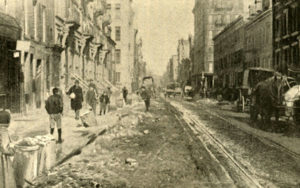
Maggie starts out as a naive and innocent girl in the beginning of the book. In fact the first sentence of the fifth chapter states “The Girl, Maggie, blossomed in a mud puddle” and then shortly after, Crane says that “none of the dirt of Rum Alley seemed to be in her veins” (Crane 23). Crane brilliantly depicts the environment that Maggie is growing up in as ‘a mud puddle’ and by saying that Maggie ‘blossomed’ in the puddle goes to show how special and unique it was for a girl to grow up and have good qualities that ‘none of the dirt’ of her environment could get into. The latter shows why Maggie was innocent and even on the climb to the top; however, all good things have a turning point.
Pete primarily serves as a antagonist throughout the book, especially towards Maggie by creating and putting ideas of how life is into her mind. After first recognizing her only by her hot body, he brings her to clubs, of which Maggie has utterly no experience with, as well as men. She “perceived that Pete brought forth all his elegance and all his knowledge of high-class customs for her benefit” (Crane 32), and of course because Maggie is innocent and naive, she doesn’t even know what high-class customs are. Before Pete had said “say, what dah hell? Bring deh lady a big glass!” (Crane 32), which in the vast majority of opinions would not appear elegant or high-class at all. However, we can not truly blame Pete for his lack of knowing the propers at that time period, but we can make a strong argument of his choosing to bring Maggie to basically a strip club. We get a glimpse of what type of environment that Maggie is in with a fantastic description by her.
“The usual smoke cloud was present, but so dense that heads and arms seemed entangled in it. The rumble of conversation was replaced by a roar. Plenteous oaths heaved through the air. The room rang with the shrill voices of women bubbling o’er with drink-laughter. The chief element in the music of the orchestra was speed. The musicians played in intent fury. A woman was singing and smiling upon the stage, but no one took notice of her. The rate at which the piano, cornet and violins were going, seemed to impart wildness to the half-drunken crowd. Beer glasses were emptied at a gulp and conversation became a rapid chatter. The smoke eddied and swirled like a shadowy river hurrying toward some unseen fall” (Crane 64).
The ‘smoke cloud’, the ‘roar’ of conversation, the ‘fury’ of the music and its effect on the ‘half-drunken’ crowd, and the smoke rushing like a ‘shadowy river hurrying toward some unseen fall’ all contribute to an overarching ridiculousness of madness. It goes without a doubt that anyone placed in this club would turn into a some sort of fiend within a few days. So it is no wonder why Pete was the reason for the beginning of the fall of Maggie.
Crane makes it clear at the end of the book that Maggie was a tragic hero by turning her into a prostitute. Crane depicts Maggie’s downfall by describing “A girl of the painted cohorts of the city went along the street. She threw changing glaces at men who passed her, giving smiling invitations to men…” (Crane 78). The level of respect that Crane creates through this quote and the rest of the chapter is extraordinary. He makes sure not to mention her name at all, and refers to her as ‘a girl of the painted cohorts’, meaning a prostitute. By not saying her name, Crane is implying that she has become something completely different than what Maggie was. Maggie’s downfall is sealed at the end of the chapter with her death, where she vanishes into the depths of dark river, far from any nightlife.
Maggie’s life as a tragic hero is epitomized by her innocence early in the book, and then the cruel downfall through Pete, and ultimately her dark and lonely prostitution and death. Maggie ‘blossomed in a mud puddle’ and it seemed that she would make it out of her horrid childhood. Yet, by meeting Pete, his first impressions made a lasting impact on her, and she took a turn for the worse. Her eventual prostitution and death symbolizes the effect that Pete and the club had made on her.