
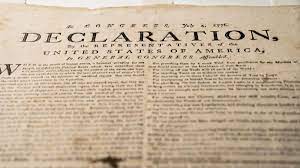
What does it mean to have morals? The dictionary defines them as “a person’s standards of behavior or beliefs concerning what is and is not acceptable for them to do.” In reality, though, it is not that simple—not even close. Morality is not black and white, good and evil. Every society around the world is founded on different ideas, different values; every person is guided by different principles. Morality is unique to each individual, but that does not mean there are not certain spoken, or unspoken, standards guiding the behavior of humanity. In a perfect world, every single person would be treated equally, provided with healthy living conditions, and allowed the same opportunities. This is not a perfect world. America in particular was founded on ideas of liberty and representation, aiming to present itself as a land of opportunity and freedom. These ideas came from the Puritans, but so did many other, less positive influences that we still see today, whether we choose to acknowledge them or not. The preamble of the Declaration of Independence, the country’s beginning, states: “We hold these truths to be self-evident, that all men are created equal, that they are endowed by their Creator with certain unalienable Rights, that among these are Life, Liberty, and the Pursuit of Happiness.” Everyone knows that this statement was meant for white men, yet society still likes to hang on to the idea of America as a superior country, “the free world,” ignoring the large percentage of the population that the preamble blatantly ignores. The truth is, America is not as great as some would like to believe. The truth is, it does not have as much of a moral high-ground as it thinks, incredibly far from it, actually. Our modern society clings to the idea that it has progressed further than anyone else, that it has overcome prejudices and practices from Puritan times, but the ideas surrounding our nation’s founding continue to slip slowly down the drain. The Scarlet Letter by Nathaniel Hawthorne and The Crucible by Arthur Miller are prime points of comparison between the two periods. America claims that it has only improved upon Puritan ideas, but the government is still deeply flawed, the country is more divided than ever, violence and bigotry run rampant, and no lessons have been taken from the past the country claims to have risen above.
As one of the nation’s first major civilizations, the Puritans had an incredible impact on the present day America, that fact is unavoidable. Aspects of the government they created hundreds of years ago are still present today, but society has not risen above its blemishes as much as it thinks; the government and structure of the country are still deeply flawed and biased. David Hall examines the beginnings of modern government in his article “Peace, Love and Puritanism”:
“The most far-reaching of these Puritan reforms concerned the civil law and the workings of justice. In 1648, Massachusetts became the first place in the Anglo-American world to publish a code of laws—and make it accessible to everyone. Believing that the rule of law protected against arbitrary or unjust authority, the civil courts practiced speedy justice, empowered local juries and encouraged reconciliation and restitution. Overnight, most of the cruelties of the English justice system vanished. Marriage became secularized, divorce a possibility, meetinghouses (churches) town property” (Hall).
The similarities between the early Puritan government and modern government are clear, yet the contrasts are even more telling. According to the description, the Puritans “protected against arbitrary or unjust authority,” but when a country has increased incarceration rates by 500% over a period of forty years, and Black people are sentenced five times more than white people for lesser crimes (“Incarceration”), how can it claim that it protects against unjust authority? The injustice in these statistics is clear.
Not only has the American justice system proven its prejudice, but the government as a whole has shown that, at times, it no longer accurately reflects the views of the nation and its people. The electoral college may have been put in place with good intentions, meant to balance out state power, but when it begins to elect presidents that lose the popular vote, is it still fair and relevant? An article written by The Washington Post states: “It is alarming that a candidate came so close to winning while polling more than 5 million votes fewer than his opponent nationwide. The electoral college, whatever virtues it may have had for the Founding Fathers, is no longer tenable for American Democracy” (“Opinion: Abolish the Electoral College”). In 2016, Donald Trump was elected president, despite losing the popular vote to Hilary Clinton. In 2000, George W. Bush lost the popular vote to Al Gore. Two additional presidents have won under the same circumstances (Law). Four times the American voting system has elected a president that the people do not want. Has the system really been properly adapted from Puritan times if that continues to occur?
There is no doubt that the Puritans labored under highly questionable beliefs. That fact though, does not diminish the truth that they were guided by strong principles. Their God, their religion, guided every word and action, and they knew where to go because of that. Today, though, what does America believe? The country is so divided that the separation is hindering real progress. In Nathaniel Hawthorne’s Puritan novel The Scarlet Letter, the idea of religion as a motivating force is illustrated perfectly in a conversation between the main characters, Hester Prynne and Arthur Dimmesdale: “‘The conscience of God is on me,’ answered the conscience-stricken priest. ‘It is too mighty for me to struggle with!’ ‘Heaven would show mercy,’ rejoined Hester, ‘hadst thou but the strength to take advantage of it’” (Hawthorne 180). These two characters have been victimized by religion; it has allowed the town to take actions against their adultery that are insane and out of proportion. Despite that, though, they still cling to God as their savior. Their religion is what keeps them going, but also what motivates the town’s legal actions.
The question now is: what drives America today? What do we want to achieve, what motivates our legal decisions? It is not religion, but it would be difficult to argue that it is equal rights and opportunity. There is no single answer, as no one feels the same. As the Associated Press explains,
“The question now is: what drives America today?”
“It’s no longer just Republican vs. Democrat, or liberal vs. conservative. It’s the 1 percent vs. the 99 percent, rural vs. urban, white men against the world. Climate doubters clash with believers. Bathrooms have become battlefields, borders are battle lines. Sex and race, faith and ethnicity… the melting pot seems to be boiling over” (“DIVIDED AMERICA”).
With the size of America’s population, the differences in race, ethnicity, sexual orientation, and other identities, it would be impossible to get everyone to agree. Our differences should be celebrated, but they cannot be allowed to result in negative outcomes for certain groups of people. There is nothing unifying the population, nothing holding us together long enough to create significant positive change. And in this, the Puritans succeeded where America has failed.
America has made many positive changes, especially in recent years. Steps towards equal rights and the legalization of same-sex marriage, for example. Certainly, these should not be discredited nor forgotten about. However, these advancements do not outweigh the violence and bigotry that is persistent in American culture. In order for the United States to claim goodness and morality, to support the idea that it has grown in the hundreds of years since Puritan times, everyone must be treated equally. In Arthur Miller’s play, The Crucible, Reverend Hale is a secondary character. Yet, he seems to grasp the importance of life and freedom more than many of the other Puritans in Salem. This is illustrated in his frantic warning to Elizabeth Proctor: “‘Beware, Goody Proctor—cleave to no faith when faith brings blood. It is mistaken law that leads you to sacrifice. Life, woman, life is God’s most precious gift; no principle, however glorious, may justify the taking of it’” (Miller 132). In this message, Hale conveys an ideal that America seems to have lost sight of today: the importance of human life, no matter the identity or appearance. For it is modern laws that allow for the death penalty, the murder of Black people and people of color by police officers, and allow hate crimes to persist. ‘Mistaken law,’ as Hale states.
“For it is modern laws that allow for the death penalty, the murder of Black people and people of color by police officers, and allow hate crimes to persist.”
Not only does the country’s flawed justice system allow for murder and violence, but bigotry has, at this point, become a part of America’s national identity. This has been suggested not just by observation, but by concrete studies. In his article, “Still Puritan After All These Years,” Matthew Hutson describes the results of several studies comparing modern times to Puritan times, and one result in particular stands out:
“Studies since the ‘70s have also found that Americans who score high on a Protestant Ethic Scale (emphasizing self-reliance and self-discipline) or similar metric show marked prejudice against racial minorities and the poor; hostility toward social welfare efforts; and, among obese women, self-denigration” (Hutson).
Not only do the results of one study link the beliefs of modern Americans to those of the Puritans, but several. The Puritans were guided by their Protestant ideals, both a blessing and a curse. Clearly, though, those ideals live on. They encourage bigotry and hate, and have real, physical consequences for people they consider “different.” Americans want to believe that they are better, that they have improved their country and widened their beliefs. Where is the evidence to back that up? Where is the action and the real, substantial, systemic change?
Why do we study history? The answer to that question is always the same: to learn from it, to avoid repeating the mistakes of those long dead. There is no doubt that this is an extremely valuable point, yet America continues to fail in showing what lessons it has learned. An excerpt from the introduction to The Crucible explains:
“The language of The Crucible is not authentic in the sense of reproducing archaisms or reconstructing a seventeenth-century lexis. It is authentic in that it makes fully believable the words of those who speak out of a different time and place but whose human dilemmas are recognizably our own” (Bigsby xxii).
The Crucible is a valuable read, if not for the story then for the true essence of humanity it explores. The characters are, in general, not good people. They kill, manipulate, and accuse innocent people. Ultimately, though, as Bigsby states, the problems they face, the guilt and need for power that drive them to do what they do, can still be witnessed today. There are always going to be some elements of human nature that do not disappear, but when we fail to act, fail to make changes despite researching similar events in the past, those elements can no longer be used as an excuse.
A particularly relevant example of this focuses on reproductive rights. In Puritan times, the white men in control of society chose to label women as inferior, refusing to allow them lives of their own. As embodied in The Crucible by the character Abigail Williams, when those who are refused rights are given a taste of power they, understandably, use it to their advantage. In Abby’s case, this ended in the death of far too many people in what we now know as the Salem Witch Trials. Today, 329 years later, the state of Texas has just passed a law removing rights from thousands of people:
“The law bars abortions once cardiac activity can be detected in the embryo. This typically occurs around the sixth week of pregnancy. That is very early in a pregnancy, and many women do not know they are pregnant at that point… The cardiac activity detected on ultrasound is not a true heartbeat… It results from electrical activity, but the valves of the heart have not yet formed. And the sound does not indicate the pregnancy is viable” (Rabin).
History has illustrated, time and time again, that attacking people’s basic human rights never ends well. The Puritans chose to declare women subservient to men, controlling their lives, their bodies, and their autonomy. Modern America claims to be better, but how is that possible if they make the same mistakes as the society they condemn? America has not learned from their mistakes; they continue to attempt to strip people of their basic rights and goad them into rebellion, yet still blame them for the consequences of those rebellions. In case they had not noticed, this has never once ended well.
This is not a perfect world, and America is not a perfect country. That fact has been made abundantly clear over the past centuries. However much America would like to claim morality, claim superiority and positive change from Puritan times; the truth does not back those claims up. The Puritans were far from perfect, no one is denying that. America, though, insists that it is better, that it has left those times behind. This is misleading. Many positive changes have been made, but the remnants of past societies are still obvious in the leadership and rampant bigotry. America does not have the moral high-ground it would like to believe. Rather, the country boasts a deeply flawed government, a divided population, violence and prejudice that are not outweighed by the positives, and repeated Puritan mistakes. America could still improve, it has not lost its chance. To do that, though, it must first acknowledge the truth of its lackluster morality.
Works Cited
“DIVIDED AMERICA.” Associated Press, https://www.ap.org/explore/divided-america/ideology.html#about-contact.
Bigsby, Christopher. Introduction. The Crucible. Penguin Books, 2003.
Caryn Rabin, Roni. “Answers to Questions About the Texas Abortion Law.” The New York Times, https://www.nytimes.com/2021/09/01/health/texas-abortion-law-facts.html.
Hall, David D. “Peace, Love and Puritanism.” The New York Times, https://www.nytimes.com/2010/11/24/opinion/24hall.html.
Hawthorne, Nathaniel. The Scarlet Letter. Modern Library, 2000.
Hutson, Matthew. “Still Puritan After All These Years.” The New York Times, https://www.nytimes.com/2012/08/05/opinion/sunday/are-americans-still-puritan.html.
Law, Tara. “These Presidents Won the Electoral College—But Not the Popular Vote.” Time, https://time.com/5579161/presidents-elected-electoral-college/.
Miller, Arthur. The Crucible. Penguin Books, 1976.
“Opinion: Abolish the Electoral College.” The Washington Post, https://www.washingtonpost.com/opinions/abolish-the-electoral-college/2020/11/15/c40367d8-2441-11eb-a688-5298ad5d580a_story.html.
“Incarceration.” The Sentencing Project, https://www.sentencingproject.org/.
I really enjoyed writing this piece and finding the sources for it; it was interesting to connect The Scarlet Letter and The Crucible. I can honestly understand both sides of the argument, but I’m glad I picked the maybe less obvious one. I was pretty happy with my points and quotes, though if I went back I think I would want to add a counterargument.