
Women have for a long time occupied a strange place not only in wartime, but in literature. Typical femininity denotes dependence on a masculine figure, or a divine female figure upon which the masculine looks as an object (emphasis on object, as opposed to person) of desire. Nevertheless, in The Things They Carried, images of the feminine are complicated. Women in Tim O’Brien’s novel are only spoken about, remembered, or idealized by the men, never seen; however, they represent the conflict of war and love and the dangers in between, as well as hope and home.
For a lot of soldiers, one specific female person in their life helps them emotionally in war as that woman helps them mentally. They connect that person to love, home, and hope, so they have something to hold on to. Many of the men carry mementos of women they love or hold affections for; however, very few of these mementos are of women who actually reciprocate those emotions. Jimmy Cross, Henry Dobbins, and the nameless soldier all carry photographs (or, in Dobbins’ case, panties) of women who do not love them back. Even O’Brien himself carries in memory Linda, the girl he loved when he was nine years old and who died of brain cancer. This gives Tim O’Brien the inspiration to write about love and death. His love for Linda saved him during and after the war. It is not that Timmy loves Linda and then she dies, rather that he loves her because she dies — love and death are the same. It is his love for Linda that allows an older “O’Brien” to go to war, and later to write about it. The whole novel, then, is about love and death, about Timmy and Linda. To summarize, even though they were not physically in the war with the soldiers, women helped them to survive because the soldiers fought for love, even though some of them knew that they were not loved back.
The novel shows how complicated love connected to war is. Women could also make a soldier’s life in the war more difficult. In the first chapter, Lieutenant Jimmy Cross talks about his obsession with a girl called Martha, who he knows back from college. He is carrying letters from her which he reads carefully, and decides her letters are “chatty.” Each night, he checks on his men after reading her letters and then returns to his foxhole to think about her. He also carries a pebble of Martha around in his mouth, which makes Jimmy Cross create a false hope of them being together, knowingly distracting him from his duties as leader of his platoon. While being distracted by the pebble, one of his platoon mates, Ted Lavender, his fellow soldier, dies. Lieutenant Jimmy Cross feels guilty, so he burns Martha’s letters in his foxhole. Then he burns two photographs that he had of her. He decides he hates her. “Love, too, but it was a hard, hating kind of love” (O’Brien 23). From then on, he decides to become a stricter Lieutenant, and to bring his platoon in line. “He had loved Martha more than his men, and as a consequence Lavender was now dead, and this was something he would have to carry like a stone in his stomach for the rest of the war” (O’Brien 22). Martha shaped Cross’ character. He decided to see his love for her as a weakness, and he blames her for Lavender’s death. Yet, Jimmy Cross is not the only member of the platoon that loses his girlfriend to war.
O’Brien uses one female character to explain the mental threat that anyone who experiences the war carries: Mary Anne in “Sweetheart of the Song Tra Bong” is a naïve but curious and quick-learning teenager who ‘goes primal’ as she forsakes her home of America and loses herself in the Vietnamese mountains. When she first comes to Vietnam to visit her boyfriend, Mark Fossie, Mary Anne is described as an idealized “American Girl”, which makes what happens to her come to symbolize what’s happening to all of America in Vietnam, just in a kind of stylized way that makes it less easy to overlook. The war changes Mary Anne and what she wants. It gives her a taste for new things in life, removes her innocence, liberates her in certain ways. One soldier even confesses to loving Mary Anne because she is the only woman he knows of who could ever understand what Vietnam does to a soldier because she lived it. Mary Anne was insatiable about the war and the rush of terror and joy it gave her. She explains that “Sometimes I want to eat this place. The whole country—the dirt, the death—I just want to swallow it and have it there inside me. That’s how I feel. It’s like this appetite” (O’Brien 106). Mary Anne wanted to be a part of the land and be completely lost in it, like she had already become lost in herself. She was calm when under attack, and she was fine with going off alone. The Greenies believed she was still alive, but not in a physical way—there was a spiritual element to it. She had achieved her goal in becoming a part of the land—but it swallowed her whole instead of her swallowing it. Mary Anne is used in the novel to describe the war and what it does to people that experience it. Thereby, expressing this through a female character, O’Brien mentions that the war impacts women and men equally, and that both genders can become obsessed with the violence and dehumanization. Mary Anne symbolizes a common phenomenon for Americans fighting in any war – the transformation from innocence to savage experience. She arrives as a person happily conforming to the norms of society and ends up more like an animal, living without regard to custom or appearance.
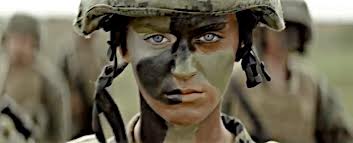
Finally, Mary Anne is the most real example of love in the novel. Although Lt. Cross and Henry Dobbins carry keepsakes that remind them of love, Mark Fossie is the only soldier who brings his girl to him. Mary Anne’s rapid descent from girlfriend and lover to warrior is the most blatant example in the novel of O’Brien linking love and war. Truth, to O’Brien, is an emotion, like Alpha Company believing in the story of Mary Anne when they knew they could not fully trust its storyteller, Rat Kiley. To O’Brien, love and war are not just connected; love and war are the same in that both refuse to let life interfere with emotion. Mary Anne is one of the “truest” characters in the novel because she lives off of her emotions and slips so easily between a posture of love and one of war.
“A strong woman builds her own world. She is one who is wise enough to know that it will attract the man she will gladly share it with” .
Ellen J. Barrier
All of these female figures, while still not given a prominent voice of their own, nonetheless tend to eschew archetypal femininity: those who are objects of male love do not love back simply by virtue of the soldiers’ participation in the war, and those who come to Vietnam and start off with a protected status soon become more gruesome than even the most sadistic of American soldiers. In general, all the stories around women in the novel have a special significance. Love, guilt, innocence, and mental damages of the war are symbols that are expressed through female characters. While Linda helps O’Brien to hold on to something, Martha makes Jimmy Cross feel guilty, and Mary Anne perfectly symbolizes the addiction to the war and the land that most soldiers had to carry. O’Brien shows how the war made it difficult to have a love relationship in the war and outside of the war. All the stories of women have one significance in common: they express the difficulties of the soldiers to live a life outside the war.
I was really hyped to write this essay as women do not have a big representation in the novel. The paragraph about Mary Ann turned out well and is thoughtful, but I think I could have written more about the representation of women in general.
I really like the way you pictured feminism in this essay, and I think that you have very good ideas to structure your essay. I think something that could make your essay very interesting would be a comparison between the role of women now as opposed to in the novel. Overall, I really like the quotes you used and the way you analyzed them.