
The American Dream is defined by the Oxford Dictionary as “the ideal that every citizen of the United States should have an equal opportunity to achieve success and prosperity through hard work, determination, and initiative.” On the other hand, James Truslow Adams, an American writer and historian considered the Father of the American Dream, described it in 1931 as “that dream of a land in which life should be better and richer and fuller for everyone, with opportunity for each according to ability or achievement.” Taking both definitions into consideration, we can conclude that the American Dream is the aspiration of all citizens of the United States without exception, to achieve success and own prosperity through audacity, in search of the illusion or the promise of a land where life should improve for everyone increasingly. Is this American Dream truly being fulfilled according to the declarations presented above? The novel The Great Gatsby by the notorious Fitzgerald is the perfect tool to use in order to answer this question. The main character of the novel, who even through his name conveys the title of the novel, Gatsby as representing the green color of hope, that is to say the promise of the American Dream, we can determined that due to his outcome that the promises of the American Dream were left unfulfilled, halfway. Prosperity and success are the fundamental promises of the American Dream. Gatsby ONLY achieved success, and perhaps he achieved partial prosperity. Nevertheless, in order to achieve the American Dream as a whole, Gatsby should have achieved not only a rich and full life of luxuries, but also a sense of happiness. This is where our inscrutable character failed; he NEVER achieved happiness, but instead, he created a movie where he pretended to be happy, when he really had no one but himself. Consequently, Gatsby did NOT accomplish the promises of the American Dream, even after putting everything at risk, including his own life. He did NOT reach the green light of prosperity, he was completely alone, and he never managed to recover the woman he loved the most.
First of all, we see how Gatsby, despite being that exuberant millionaire who offers extravagant and luxurious parties every weekend, really has no one. He does not have any real friends, other than Nick. Of course he does not have Daisy, and he does not even have his family near him. We can see how he really meant nothing to almost anyone when he threw his extravagant parties every weekend, hardly any of the guests really showed their appreciation to Gatsby. Even on his funeral, only Nick, Mr. Gatz, and some other servants, along with the man with the owl-eyes, attend the funeral. This is shown in the following line: “The minister glanced several times at his watch, so [Nick] took him aside and asked him to wait for half an hour. But it wasn’t any use. Nobody came” (Fitzgerald 106). This sad but true line illustrates that he was all alone, and although he could breathe victory for a moment, that dream vanished after a few seconds and he lost Daisy forever.
This is further illustrated when we see how Nick expresses his disgust at knowing that Daisy has not even bothered to send a letter or a flower, to show her condolences: ‘[Nick] tried to think about Gatsby then for a moment, but he was already too far away, and [Nick] could only remember, without resentment, that Daisy hadn’t sent a message or flowers’ (Fitzgerlad 106). Furthermore, Daisy and Tom only care about themselves, and they are not interested in damaging third parties as long as they benefit themselves. In addition, these two characters represent the decadence of society. Only material things are of importance to them. Even this lack of morality corrupts the American Dream simultaneously. Daisy, for example, fulfilled her dream by being part of high society and being married to a billionaire, but really that is not the main promise of the American Dream; she is only materialistic and has not achieved prosperity and success by herself as dictated by the American Dream. We can observe this factor in the following quote said by Nick: “Tom and Daisy were careless people –they smashed up things and creatures and then retreated back into their vast carelessness, or whatever it was that kept them together, and let other people clean up the mess they had made …” (Fitzgerald 109). Evidently we can see how Daisy is a materialistic person, very selfish, and that she is even unattainable, because after everything that Gatsby achieved, she continues to go the easy way.
Having already earned his incredible mansion and all its luxuries, Gatsby’s behavior does nothing to win Daisy back. We see how in several instances Gatsby’s worst enemy is himself, since he is the one who puts up barriers. In the end, the only thing his behavior helps him with is becoming that tragic hero who dies trying to achieve his dreams.
In this second point, the bad strategy that Gatsby used to get Daisy back is being emphasized. In it we see how he is demanding her, because really as much as the reader thinks that he has been patient for waiting five years, in which he put together large amounts of money to get Daisy back, really when dealing with the situation, he acts very desperate, and demanding towards Daisy. Gatsby wants her to choose him without a doubt, and he wants her to do it right away. Consequently, this gives Daisy a desperate impression on Gatsby’s behalf, and then she obviously ends up rejecting Gatsby. Gatsby’s despair is shown in the lines of the book presented below: “‘Just tell him the truth –that you never loved him –and it’s all wiped out forever’ ‘I love you now isn’t that enough? I can’t help what’s past. I did love him once –but I loved you too’” (Fitzgerald 82). Clearly we can see the pressure that Gatsby is putting on Daisy, and that it is also in vain, because she ends up rejecting him in any way.
Furthermore, we see how Gatsby can finally perceive that his attempt to get Daisy has failed. He acknowledges that his plan was ambitious, but he never gets to the task of analyzing his behavior when trying to win Daisy back. Just as in the previous lines it is presented, Gatsby is to blame for having pushed Daisy away just at the moment when he was already savoring victory. Gatsby is his own enemy when dealing with Tom and Daisy at the same time, so this circumstance makes him a tragic hero who dies trying to achieve his dream. Gatsby realizes that his dream has vanished as he implies, “I can’t describe to you how surprised I was to find out I loved her, old sport. I even hoped for a while that she’d throw me over, but she didn’t […] I was way off my ambitions getting deeper in love every minute” (Fitzgerald 92). At this point in the narrative is where Gatsby’s dream seems to fly away, even after the great determination and hope that he had.
Gatsby was determined, ambitious, and above all he tried never to lose hope to make his dream come true; “He was a fervent believer in the gospel of self improvement” (Cohen 1), a very optimistic person. These qualities are the right ones that any individual needs to achieve his American Dream. However, although Gatsby has seen that emerald green light that symbolizes hope, and his undoubted thirst for victory, in the end we see that everything that Gatsby put into play did not serve at all to succeed in his true American Dream; Gatsby NEVER recovered Daisy, and in the attempt he lost his life. He even used to throw extravagant parties every weekend so that one day his lover would show up, and worked hard to raise huge amounts of money so he could buy a house just across the bay from Daisy’s house. Gatsby was counting on this gigantic longing for Daisy, and even he had a tremendous willingness “to sell his soul” (Cohen 2) to get her back. Unfortunately, all hope reaches its maximum point, and this happens at the end of chapter seven when after the confrontation between Tom and Gatsby to win over Daisy, Daisy ends up choosing Tom, and thus making Gatsby’s dream fade away.
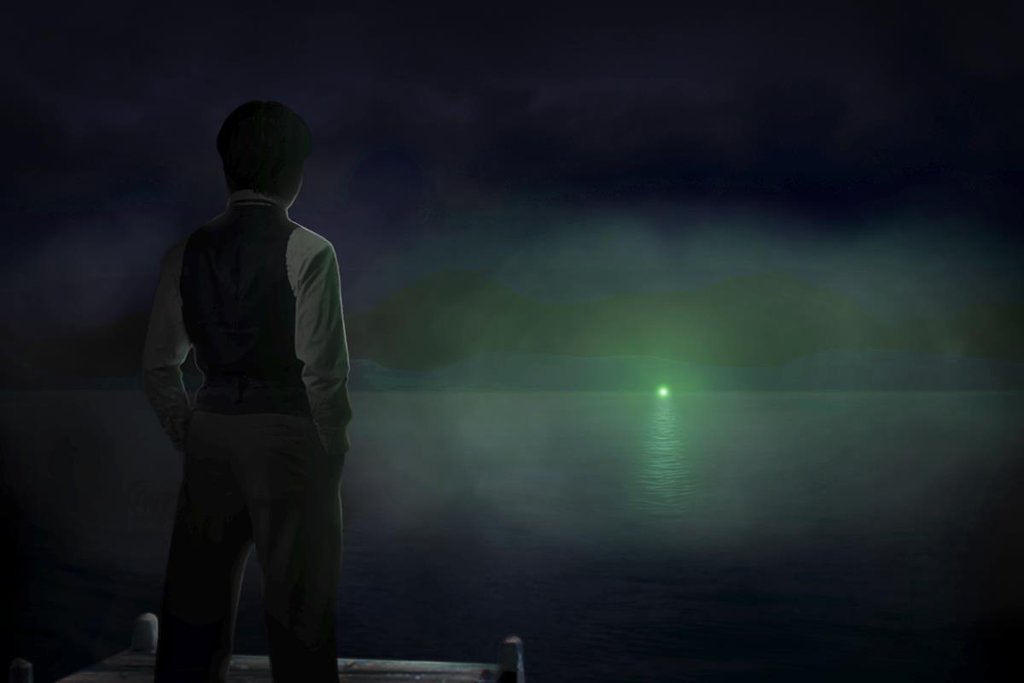
The last point represents a parallelism between the end of the first chapter and the end of the seventh chapter of the novel, where at the beginning Gatsby extends his arms towards the green light in search of his dream, towards Daisy, very optimistic: “He stretched out his arms toward the dark water in a curious way, and, far as I was from him, I could have sworn he was trembling. Involuntarily I glanced seaward –and distinguished nothing except a single green light” (Fitzgerald 18). However, at the end of the seventh chapter we see how again Nick Carraway describes a similar scene where Gatsby is again on his balcony standing alone in the moonlight, but this time the green light has faded: “So I walked away and left him standing there in the moonlight –watching over nothing” (Fitzgerald 90). Ultimately, Gatsby’s hopes to win Daisy back are gone, and his American Dream has come to an end. Gatsby is left alone with himself; there is no green light to drive him to continue fighting.In the same way we see how Fitzgerald shows the decline of the original American Dream, where people became selfish as their wealth increased and they did not care at all what they did to other people, always with the purpose of being the ones who received a benefit. Fitzgerald portrays through Daisy and Tom how people who had sudden wealth became materialistic and had no morals. These reasons caused The American Dream to be corrupted because people put their main focus on materialistic things. Therefore, The Great Gatsby is not only an excellent example of the great cost to pursue the American Dream which is reflected in Gatsby, but it also demonstrates how society began in the 1920s to corrupt the main promises of the American Dream. In conclusion, this novel demonstrates with a language rich in lexicon, structure, and narrative, the decline of the American Dream with respect to society, along with the high sacrifices that go hand in hand to achieve said dream; Gatsby bet everything to pursue his promise, he was determined, and ambitious, but in the end, despite conquering all of New York with all the great riches he got over the years, he NEVER managed to conquer what he really wanted, the girl from his dreams. Gatsby is an example of an individual who sacrificed even his life and failed to achieve his deepest desire due to the search for the American Dream.
“Gatsby’s dream vanished as simply as if a lantern went out.”
The American Dream has played a key role within the American Literature, and The Great Gatsby by Scott Fitzgerald is no exception. This idea of pursuing a dream is represented through Gatsby throughout the novel. In particular his dream is depicted through a ‘green light’. This critical essay entails Gatsby’s American Dream through the green light, and puts its maximum focus on wether he achieved said dream or not. I really delight in writing this essay since I could challenge my critical thinking. This essay definitely made me to question a lot of aspects related to The American Dream making it one of my favorite critical essays that I have ever write.
You did a fantastic job with this essay, Dana. Your analysis and organization are very sophisticated and effective. Well done!