
Corruption of Yesterday
In The Scarlet Letter, by Nathaniel Hawthorne and The Crucible, by Arthur Miller the absence of morality and discipline ring true. In The Scarlet Letter the main character Hester Prynne commits the ultimate sin of adultery, and lives under a dark cloud for the rest of her life. In The Crucible hundreds of innocent women are falsely accused of witchcraft, killed, hung, and tormented for a crime they didn’t commit. In both books the response from the society is fallacious and full of hate. The male authority of Boston tries to take Hester’s child from her, while in Salem the lack of discipline devastates the town. Hester questions the life of her child, while John Proctor is killed for confession and honesty. In both The Scarlet Letter and The Crucible the citizens in Salem and Boston experience the mistreatment of children, society’s poor influence on its people, and the makeup of such dark societal elements, showing to be less moral than today’s society.
In talking about society’s poor influence on its people, the malicious words of the authority and citizens in Salem prove that morality was of no importance in the late 1600s. In today’s society we stress the importance of making mistakes and learning from them. When making mistakes we are told that we need to “be able to govern our behavior in the near term so as not to injure ourselves or our community” (Nygren, 1996). Abigail Williams, an orphan in the town of Salem, is the girl who had been fooling with witchcraft. She and a bunch of daughters of the town are hiding the secret of guilt towards witchcraft. In hopes to not reveal their illegal acts in the woods she yells at the other girls saying, “Let either of you breathe a word, or the edge of a word about the other things, and I will come to you in the black of some terrible night and I will bring you a pointy reckoning that will shudder you” (Miller, 19). 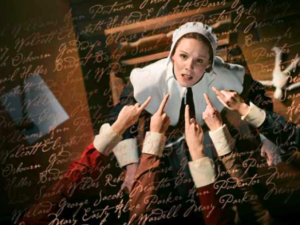 Her words are hurtful, but the real hurt is the souls of the girls that she will ‘shudder.’ Abigail is threatening to kill any of the girls that speak a word of truth about their “dancing in the woods.” The influence of the shaming in the town is what causes the fear in her to say these words to feel protected. In comparison to today’s society she is not ‘governing her behavior’ in a way that won’t ‘injure’ the community. The society is being affected because of her inability to confess, therefore innocent people are being killed instead. The lack of morality in her character prevents her to see that she is wrong, something today’s society stresses.
The morality and treatment of children today is something taken seriously within our society, we as people cherish the existence of children. In The Scarlet Letter the existence of Pearl is often times questioned to the point of life and death. Hester struggled to forgive herself of her sin, even after others had given her forgiveness. In questioning the evil she possessed she questioned the life of her child Pearl. Unsure about the purpose of being a mother Hester says, “If little Pearl were entertained with the faith and trust, as a spirit-messenger no less than an earthy child, might it not be her errand to soothe away the sorrow that lay cold in her mother’s heart, and converted it into tomb” (Hawthorne, 124)? Hester is expressing the wish of her own daughter being dead. The ‘tomb’ signifies the want of death Hester has for her little Pearl. Hester believes the influence she has on little Pearl is not acceptable to the point where she wishes death on her own child. Wishing death upon your own child is not allowed in today’s society, that idea is not at all moral. Children in today’s society must be given attention and guidance. “To be successful in shaping socially acceptable, law-abiding behavior, positive reinforcement must become a way of life for parents, teachers, and others. It is a philosophy of rearing children — your own and others as well — that must be taught and reinforced by parents and all members of the community to be most effective” (Stephens, 1998). The moral treatment of children today is constructive criticism, and ‘positive reinforcement.’ In today’s society we take care of our children, rather than wish harmful outcomes upon them. In the 1600s it was seen as okay to wish death upon a child, something of no morality.
The immorality of the society in Boston, Massachusetts during the time of The Scarlet Letter was due greatly to the makeup of the town. In the beginning of the book readers are given a description of the town, as well as the character possessed by the citizens who made up Boston at the time.Hawthorne described the scene of the town as “the founders of a new colony, whatever Utopia of human virtue and happiness they might originally project, have invariably recognized it among the earliest practical necessities to allot a portion of the virgin soil as a cemetery, and another portion as the site of a prison” (Hawthorne, 33). The scene of Boston included a ‘prison’ and a ‘cemetery’ the two darkest elements in a society. They resemble the consequences of immorality and wrong doing better than any other societal elements. The ‘utopia’ during this time period was dark and devastating, full of sin and far from moral. In today’s world our societies are made up of schools and churches encouraging moral acts and positive engagement with others. Children go to school to learn and communicate, and people go to church to worship God. With school comes the avenue for a successful job and future, and with the church practices comes a lifetime of forgiveness of sin. The makeup of society today is not dark and devastating, but it influences the utmost of moral acts and discipline. Boston in the late 1600s was the opposite of encouraging learning and forgiveness of sin, but reiterating the dark of society through prisons and cemeteries.
In both novels immorality and lack of discipline are evident through the actions and words of the characters in The Scarlet Letter and The Crucible. Society was distances away from moral in the 1600s, influenced by the prisons and cemeteries in Boston, and the satisfaction of lies by Abigail Williams in Salem. Each society was corrupt unlike societies today, full of new live and rejuvenation. In The Scarlet Letter and The Crucible children are unwanted, people are poorly influenced by society, and the makeup of the town is gloomy, proving that today’s society possess more morality.
Works Cited
Nygren, Erik. “Society of Morality.” Society of Morality, 1996, www.mit.edu/people/nygren/courses/6.868/project/. Accessed 9 Nov. 2016.
Stephens, Gene. “Saving our nation’s most precious resources: our children.” Gale’s Ready Reference Shelf, Gale, May 1998, ic.galegroup.com/ic/uhic/MagazinesDetailsPage/MagazinesDetailsWindow?disableHighlighting=false&displayGroupName=Magazines&currPage=&scanId=&query=&source=&prodId=UHIC&search_within_results=&p=UHIC%3AWHIC&mode=view&catId=&u=heb76203&limiter=&display-query=&displayGroups=&contentModules=&action=e&sortBy=&documentId=GALE%7CA20581458&windowstate=normal&activityType=&failOverType=&commentary=. Accessed 9 Nov. 2016.
Hawthorne, Nathaniel. The Scarlet Letter. New York: Dover Publications, 1994. Print.
Miller, Arthur. The Crucible: A Play in Four Acts. New York, NY: Penguin, 1995. Print.
I think this was one of my weaker essays this year. I struggled with finding quality and supportive outside sources making my argument harder to persuade. I also really struggled with the literature in The Crucible in terms of key themes and points. This essay tested me and I remember working on it for long periods of time and being awarded frustration. I think I had a clear thesis, but reading it over I wish I would have argued the other way because today’s society is just as cruel and wrong at points. I guess my love for The Scarlet Letter and my not so much love for The Crucible can also be seen as a right and wrong in a way, a yin and yang, in this sense a moral and immoral.