
Maggie completely lost control. She was incapable of taking back the reins to return to the beautiful and open minded girl that she used to be. In Stephen Crane’s novella Maggie: A Girl of the Streets, Maggie Johnson goes through a dramatic transformation. Maggie’s partner, Pete, takes her on dates to three different dance halls throughout the novella. Starting with a stunningly magnificent dance hall on their first date, the dance hall hall represents Maggie very well, but as the dates continue the dance halls decay and become worse, while Maggie sadly reflects these halls. 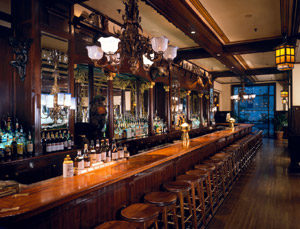
On Maggie and Pete’s first date at the dance hall, the dance hall accurately represents the beautiful young lady that Maggie is. The narrator introduces the hall by having an ‘orchestra of yellow silk women and bald headed men playing a popular waltz’. We also see chefs prancing up and down the aisles offering cake to others, and thin tobacco smoke gently rolled up into the beautiful chandeliers. This dance hall is a place where Maggie enjoys herself and we see Pete’s attraction towards his stunning date: “Pete did not pay much attention to the progress of events upon stage. He was drinking beer and watching Maggie. Her cheeks were blushing with excitement and her eyes glistening. She drew deep breaths of pleasure. No thoughts of the atmosphere of the collar and cuff factory came to her” (Crane 34-35). Although Maggie doesn’t realize it, Pete is trapped in a gaze and completely focused on the beauty of Maggie and could hardly care about the wonderful events on stage. The dance hall is somewhat of a safe haven for Maggie where she leaves all of the haunting thoughts of the collar and cuff factory outside and is able to enjoy herself inside. Although Maggie appears to be enjoying herself and is currently a beautiful woman, the title of the book names her inevitable downfall.
As soon as chapter twelve starts where we are introduced to the dance hall again, the tone is immediately set. The previously lively and beautiful dance hall is now ‘a hall of irregular shape’. The stunning yellow silk orchestra of women and bald headed men is now a ‘submissive orchestra dictated to by a spectacled man with frowsy hair’. The decaying changes that this dance hall has made reflects Maggie’s downfall as well. Differing from her previous self we now see Maggie as follows: “Maggie was pale. From her eyes had plucked all look of self-reliance. She leaned with a dependent air toward her companion. She was timid, as if fearing his anger or displeasure. She seemed to beseech tenderness of him” (Crane 57). Not only is Maggie physically looking worse than before, but she is now feeling and acting different. The previously independent and open minded girl now has eyes that lack ‘self-reliance’. Maggie, like an addict, is now dependent on the love and tenderness that Pete has to give. Crane uses the word ‘beseech’ to show readers that Maggie is doing what she can so that she can attempt to feel Pete’s love more thoroughly. While Maggie and Pete leave the dance hall readers are even hinted towards Maggie’s future. “As they went out Maggie perceived two women seated at a table with some men. They were painted and their cheeks had lost their roundness” (Crane 59). Maggie’s last sight as she leaves the dance hall is two prostitutes who have lost roundness to their cheeks. Their dull cheeks suggest that they are worn out and are incapable of smiling because of the unpleasant life that a prostitute has to live. As the title of the book suggests, this final sight of the dance hall foreshadows the inevitable future that Maggie has as a prostitute.
In Maggie and Pete’s final date together at the dance hall we see the extreme depths that Maggie and that the dance hall have reached. The first dance hall was a marvelous place, the second a hall of irregular shape, and now the third described, “In a hilarious hall there were twenty eight tables and twenty eight women and a crowd of smoking men. Valiant noise was made by an orchestra of men who looked as if they had just happened in. Soiled waiters ran to and from swooping down like hawks on the unwary throng” (Crane 64). This third dance hall is the polar opposite of the first. The marvelous and stunning dance hall where Maggie and Pete had their first date had a soothing orchestra on stage with organized chefs marching down aisles and offering cake to people. Now there is a prostitute at every single table and a fog of smoke covers up a crowd of men unlike the light smoke covering the fine chandeliers in the first hall. Crane uses a simile to compare the soiled waiters to hawks, showing them rapidly and violently swooping through the aisles completely unlike the chefs that Crane previously described. Maggie is a total wreck at this point as the love of her life has left her to be with another girl named Nellie. She has lost her true self at this point and Crane portrays this by writing, “The girl was still staring at the doors. After a time the mere boy began to see cobwebs just in front of his nose. He spurred himself into being agreeable and insisted upon her having a charlotte-russe and a glass of beer. ‘Shay, lil’ girl, we mightily we’ll make the bes’ of it. You ain’t such bad lookin’ girl y’know. Not half bad” (Crane 69). The third dance hall scene was the first time when Maggie was referred to as “girl”. Crane uses this language to show that Maggie has lost her identity and is no longer “Maggie”. Many people now see here as a prostitute similar to the mere boy who was left behind and now he wants to take advantage of Maggie. This final dance hall is nothing compared to the first dance hall that Maggie and Pete went to and shouldn’t even be called a “dance hall”. Just like Maggie, the innocent girl that was in a safe haven without worry at the first dance hall has now lost her name and can’t find the true girl that she used to be.
Maggie was horribly taken advantage of by many characters in the novella. From a beautiful and young girl to a prostitute without a name, Maggie’s decay was reflected through the decaying dance halls. Stephen Crane masterfully described this in his short novella where every detail and every line had a purposeful meaning.
Marvelous, Irregular, Hilarious
This entry was posted in Uncategorized. Bookmark the permalink.