
Many authors use a reoccurring scene or place to show the continuities and changes between times. How a character may grow is easily represented when a place is returned to. In The Sc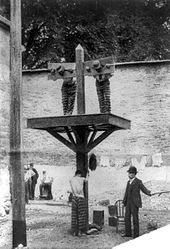 arlet Letter by Nathaniel Hawthorne, one venue, a large pillory, or scaffolding, in the center of the town, is shown on three separate occasions, the four main characters changing tremendously between each scene. Each character evolves throughout the book, changing their perspectives and desires outlined at each distinctive point at the scaffolding.
The first scene in the novel where we are introduced to the characters and setting is, coincidentally, the first scene where we are introduced to the pillory. Hester is being publicly shamed for her sin with her baby, Pearl. Hester is ashamed of the letter on her chest and tries to use Pearl to cover it, “It seemed to be her first impulse to clasp the infant closely to her bosom; not so much by an impulse of motherly affection, as that she might thereby conceal a certain token, which was wrought or fastened into her dress” (Hawthorne 31). While she attempts to cover the letter of her sin, she is also somewhat proud of it, seen by the detail it was made with and a ‘haughty smile’ she flashes to the crowd gathered in front of her. This attitude changes when she recognizes her husband, Roger Chillingworth, in the crowd. Chillingworth watches from a distance, pretending not to know who she is or what she has done. He stays in the shadows, asking people in the crowd what is happening so as to not alert himself as her husband. Hester’s attitude changes once again during this scene when she sees Pearl’s father, Dimmesdale. She relaxes slightly, knowing that at least one person there is on her side. Even Pearl reaches out to where he is standing, as if she knows he is her father. While everyone is ridiculing Hester, he is the one to support her decision to not disclose who the father is in the end. Both Chillingworth and Dimmesdale subtly protect Hester whilst the town is humiliating her.
The second scene in which the scaffolding is used is seven years later, as the torture of Dimmesdale’s sin starts to eat away at his sanity. He returns to the scaffolding in the dark of night to begin to admit to the crimes he has committed. Even though there is no one around to hear him, the act of personally shaming himself punishes him, “He shrieked aloud: an outcry that went pealing through the night . . . as if a company of devils, detecting so much misery and terror in it, had made a plaything of the sound” (Hawthorne 83). He feels a physical pain because of the sin he committed, making a noise sounding as if a ‘company of devils’ would hear it and play with it. Hester and Pearl walk through the town to see Dimmesdale atop the scaffolding, and he invites the two to join him. These emotions differ greatly from those they had at the start of the book, him attempting to hide his true identity and her respecting his wishes. They climb up, all standing together for the first time. Pearl shows her first understanding of who Dimmesdale his while they all hold hands together. Chillingworth appears, as he has been standing watching them on the scaffolding the entire time. He does not make any move to harm or accuse them of anything, but acts normal as he talks to them. Chillingworth’s attitude towards the three appears to dull in intensity, even though it is still threatening.
In the last scaffolding scene, it is Dimmesdale, again atop it by himself, yet this time in front of the entire town. After giving a sermon to the town, he calls Hester and Pearl to come with him on top of the scaffolding. Hester readily does, and Pearl is beyond excited to stand with him. They have nothing else to lose as Hester is no longer ashamed of her sin. Once they do he confesses his misdeeds while everyone watches in awe. After he completes his confession, he falls dead. His last words, those of truth, do the opposite of what he used to want. He wanted his good name to be left unaffected and to hide, but this is completely paradox to his actions before he died. Chillingworth, from the crowd once more, yells in frustration, “‘Thou hast escaped me!’ he repeated more than once. ‘Thou hast escaped me!’” (Hawthorne 142). His cries illustrate how he believed that he was supposed to reveal Dimmesdale’s secret and punish him, but he is tortured by the fact that he is left without that satisfaction. Chillingworth’s wants never changed from the first scaffolding scene, but the way he demonstrates his intentions evolves from quietly implying them to shouting them in front of the town in anguish.
Throughout the novel each main character evolves and grows, with each step highlighted by scenes on the pillory. Hester is at first ashamed of her letter and attempts to hide it. As she grows she accepts it and eventually embraces it to where she can stand in front of the town with the man she sinned with. The changes that Pearl undergoes are mainly due to her age and growing up, but she begins to understand her past more. Roger Chillingworth has had the same intentions since the first scene, but becomes increasingly forthcoming with these intentions. Arthur Dimmesdale undergoes the largest amount of change. At first he silently protects Hester, keeping her alive, but never publicly supports her. As the grief erodes at his soul, he eventually does publicly stand with Hester and his daughter. The four main characters develop in their own ways, and the pillory creates a framework so we can clearly see the distinctions between each part of their lives.