
Communities strive for acceptance and always aim for utopia, but what would happen if we were to reach utopia? There would be no room for improvement in a utopia, and how could a community thrive without always learning from mistakes? Communities aim for utopia based upon the purpose that utopia doesn’t exist. Having the goal of becoming a perfect community is something great to aim for because although it will never happen, there will always be room to learn and improve. In the novel The Scarlet Letter by Nathaniel Hawthorne and the play The Crucible written by Arthur Miller, the Puritan towns of Salem and Boston in the early 1600s are nowhere near perfect communities. There is a major issue of morality in the towns and a question is addressed as to whether modern society has become more or less moral since the Puritan times of the 1600s. Society today has offered more acceptance and tolerance as there is always an aim to become more moral, because of a modern shift into society with a cultural change, and because of the insecurity of power during the Puritan times. 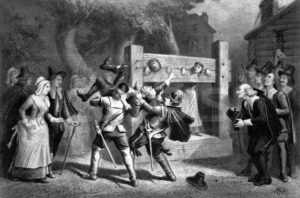
A major shift in morality from the Puritan times of the 1600s and today is that nowadays there is more leeway and more of a chance to redeem yourself in society rather than in the 1600s. Hester Prynne was seen strictly as a sinner in The Scarlet Letter. The narrator through the novel describes Hester as a prisoner: “Measured by the prisoner’s experience, however, it might reckoned a journey of some length; for, haughty as her demeanor was, she perchance underwent an agony from every footstep of those that thronged to see her, as if her heart had been flung in the street for them all to spurn and trample upon” (Hawthorne 78). Hester is referred to as ‘the prisoner’ which is completely dehumanizing and shows that she is not accepted in her community. The entire town sees her as a sinner and they are incapable of finding acceptance and forgiving Hester Prynne. This is a prime example of how the lack of acceptance in the 1600s could prove that society is more moral today because of there being more acceptance and forgiveness.
Society today has developed to become more accepting and forgiving unlike the Puritan times. In Corey Brettschneider’s magazine article “Why do Prisoners Deserve the Right to Vote” published by PoliticoMagazine, Brettschneider outlines that prisoners still should be seen as humane and citizens while obtaining their rights: “If prisoners remain citizens and retain their civic status throughout their sentences, then it follows that prisoners should enjoy the most basic of their civil rights, the right to cast a ballot. Disenfranchising them creates a class of people still subject to the laws of the United States (they were, after all, punished under that law) but without a voice in the way they’re governed—not unlike taxation without representation”. The prisoners are treated completely different than someone who has sinned during the 1600s. For most of the crimes that the criminals committed they would be stripped of their rights and put to death during the Puritan times, but society has developed to recognize that prisoners are human and still should deserve their rights. This goes to show why society today has become more moral but only based on the purpose of acceptance and forgiveness.
During the Puritan times there was a major lack of security within the communities. Throughout The Crucible, a major theme of insecurity is revisited because of the incredibly foolish and false claims of witchcraft. John Proctor seems as if he is the only sane man in as insecure town when he states,
“PROCTOR: I am only wondering how I may prove what she told me, Elizabeth. If the girl’s a saint now, I think it is not easy to prove she’s fraud, and the town gone so silly. She told it to me in a room alone—I have no proof for it. ELIZABETH: You were alone with her? PROCTOR, stubbornly: For a moment alone, aye. ELIZABETH: Why, then, it is not as you told me. PROCTOR, his anger rising: For a moment, I say. The others come in soon after. ELIZABETH, quietly—she has suddenly lost all faith in him: Do as you wish, then. (She starts to turn.) PROCTOR: Woman. (She turns to him.) I’ll not have your suspicion any more. ELIZABETH, a little loftily: I have no— PROCTOR: I’ll not have it! ELIZABETH: Then let you not earn it.” (Miller, Act II 74)
In Proctor’s words the town has gone ‘silly’ which is very accurate. Now, society is much more secure, and it is clear that today nobody would be tried and put to death for witchcraft which is exactly what happened during the insecure times of the 1600s. It is easy to point fingers when there is a lack of security which Hester Prynne also shows.
Hester is seen as a sinner and only a sinner in her town, so people are able to assign her with any blame. The entire community finds her disgusting and sees her as disgrace: “Thus the young and pure would be taught to look at her, with the scarlet letter flaming on her breast,—at her, the child of honorable parents,—at her, the mother of a babe, that would hereafter be a woman, —at her, who had once been innocent, —as the figure, the body, the reality of sin” (Hawthorne 55). Hawthorne mentions how society has been taught to ridicule Hester based on the A that she wears on her chest. Although the A means Able to some, to most it means Adultery, and the Puritan community has nothing but remorse for Hester because of it.
In a modernized cultural shift, there have been many ways that society has become more and less moral. One incredible instance of becoming moal within a modern culture was the acceptance of gay marriage in the United States. In the New York Times newspaper article Supreme Court Ruling Makes Same-Sex Marriage a Right Nationwide written by Adam Liptak, Liptak interviews a Supreme Court Justice to address the great decision: “No longer may this liberty be denied,” Justice Anthony M. Kennedy wrote for the majority in the historic decision. “No union is more profound than marriage, for it embodies the highest ideals of love, fidelity, devotion, sacrifice and family. In forming a marital union, two people become something greater than once they were.” Although there is still ongoing issues with equality and gay rights, this was a huge step forward to becoming more moral as a society.
It is challenging to compare morality from today’s society to a society over 400 years ago. Many question arise like “Would the Puritans react and behave the same way as society does today if they were brought up around the same culture and technology?”. It is clear that there are out outlying issues as to why society in the 1600s was more moral than today, but there are also ways in which society today is more moral. Overall, society today has taken bigger steps towards morality by establishing greater acceptance and leeway as well as being in a more secure position rather than the Puritan times.
Morality
This entry was posted in Uncategorized. Bookmark the permalink.