
The Great Gatsby, a novel by F. Scott Fitzgerald, one of the most famous American books, has a lot of symbolism. One of the very debatable symbols is the eyes of Doctor T.J Eckleburg. In the novel they appear three times and have been used by the author each time, yet a character claims them to be God, but readers may see it as a prediction for something bad, is it necessarily true? Yes, the eyes monitor the action and appear in times where there is an action between characters. Mischief, violence, Truth, and murder are the themes watched by the eyes. When the eyes appear in a chapter, the reader immediately know something is about to happen.
Doctor T. J. Eckleburg is the God and a harbinger.
The main character, Nick Carraway, perceives them as scary, yet doesn’t acknowledge they are there to watch over the other characters: “The eyes of Doctor T. J. Eckleburg are blue and gigantic their retinas are one yard high. … But his eyes, dimmed a little by many paintless days, under sun and rain, brood on over the solemn dumping ground.” (Fitzgerald 19) Nick describes them as ‘dimmed by many paintless days’, what he means by that is they are shady and supervising over the Valley of Ashes. The reasoning behind their appearance is mischief at this point in the book due to Tom introducing his paramour, Myrtle Wilson, to Nick. Tom thinks mischief is okay and doesn’t feel bad. Later in that chapter, Tom punches Myrtle for pointing out she knows Daisy. Eyes of T. J. Eckleburg are used by Fitzgerald to predict something terrible in the novel. They predicted two themes: mischief and violence.
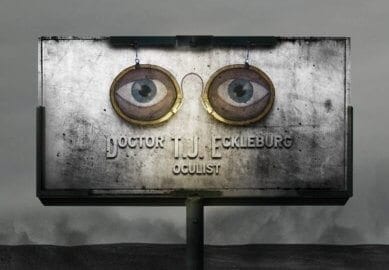
The second time the eyes of T. J. Eckleburg appear is when George Wilson, Myrtle’s husband, finds out his wife is having an affair but doesn’t know with who. Not only that but also Tom gets suspicious of Daisy and Gatsby having an affair. Tom decided to offer a trip to town but things really go crazy there; “Then as Doctor T. J Eckleburg’s faded eyes came into sight down the road, I remembered Gatsby’s caution about gasoline…’Let’s have some gas!’ cried Tom roughly.” (Fitzgerald 76) Nick by looking at the eyes remembered Gatsby warning to fill gas, Tom used this occasion and stopped at the gas station with mr. Wilson. Tom’s tone was angry and wanted to challenge Nick about it. Later after the eyes were mentioned, Tom and Gatsby had a long discussion about who Daisy loves more, unfortunately that’s when Gatsby ruined his chance. After that scene, something goes wrong, again with the appearance of the eyes pre the incident.
The appearance of the eyes for the third time is significant, while it gives out the author’s opinion. George Wilson is having really hard problems with grieving after his wife’s death. and that when the eyes make the fourth final appearance; “Standing behind him, Michaelis saw with a shock that he was looking at the eyes of Doctor T. J, Eckleburg, which had just emerged, pale and enormous, from the dissolving night.’God sees everything,’ repeated Wilson” (Fitzgerald 98). This is the first time a character in this novel is referring to the eyes as the God. Fitzgerald himself wanted the eyes to be God and present a watched and a prediction toward an action, he has shown that through the expression of George; ‘God sees everything,’. Later Wilson kills Gatsby thinking he is the guy Myrtle cheated with on him and the guy that killed Myrtle. He also commits suicide.
Doctor T. J. Eckleburg is the God and a harbinger. The actions after he appears proves this and Fitzgerald expression about them through George Wilson. The debatable question what symbol the eyes complete is not too hard to answer with the right evidence, but with an authors opinion about it is pretty certain what is it.
I should have given more time to look over that essay, when I read it through I thought about a different choice of words I could have used or the facts that I don’t specify the eyes sometimes. I do like the title very much though
You had some great points, however, at a few points, the wording was a little rough.