The Sun Also Rises provides an insightful view into the world of the Lost Generation. It may be filled with anti-Semitism, racism, misogyny, and homophobia that is disgusting but important to acknowledge that it occurs because of the vast impact it has had. In this way, Hemingway’s book can be a good educational resource not just in picking up hidden details but learning about the human character and the fragmented people of its time.
As coined by Gertrude Stein the people of this time are truly a lost generation. They have been broken by their past and hence have found themselves interacting with the world differently. This has led to their rampant alcoholism as well as a feeling of dissatisfaction in various ways by the main characters. The count acts as a point of contrast to Jake and Brett, being totally content with his life and willing to show goodwill to anyone. It begs the question of whether the other characters are unable to be happy because of their past or an unwillingness to find a compromise for their own happiness because of how they are as a person.
Hemingway’s novel, as well as his other works come off as being very simplistic, with little meaning at first glance but having much more to them if you read into it. As a result of this, it is a useful book for teenagers to read as a tool to hone their skills. However, it is a book argued against for its offensive comments against many groups, in such a way that is unhelpful to the plot. But it is arguable that it is important to acknowledge that this hatred existed so it can be used as a source of education rather than leave young people ignorant to the past that in many ways affects the future.
Hemingway’s book The Sun Also Rises is one some may be bored or angered by; however, it is important to be read because of the education it can spur and the insight you can get into a generation of people, changed by their past. It is not a perfect book, and may not be near your list of favorites, however, it is one that can raise your understanding of people in a way that is meaningful.
A dead baby in a woman’s body, obsessed with the mother who killed her in an attempt to protect her. Beloved is a character from Toni Morrison’s novel Beloved who apparates out of the river, fresh like a baby, and heads to 124. Once there it is suggested she is the ghost of Sethe’s child when Sethe instantaneously has to pee as if her water broke. Throughout the book, Beloved is a symbol of the festered wound of Sethe’s guilt and of slavery.
Throughout the book, Beloved is a symbol of the festered wound of Sethe’s guilt and of slavery.
When schoolteacher comes to town in an attempt to take back Sethe and her children, Sethe who does not want them to suffer. Kills her baby daughter and attempts to kill the rest of her children. Beloved comes back as a ghost in human form not to instantly enact revenge, but to embody Sethe’s guilt and bring back up the pushed-down feelings of her mom. This acts to bring Sethe back to an emotional being remembering the horrors of the past and the little joys which have faded away. Sethe is not the only one affected, as Paul D’s tin tobacco can is forcibly ripped open. This ultimately leads to Sethe finding out about Halle seeing her get raped and not being able to do a thing. This memory from back when they were in slavery practically breaks her.
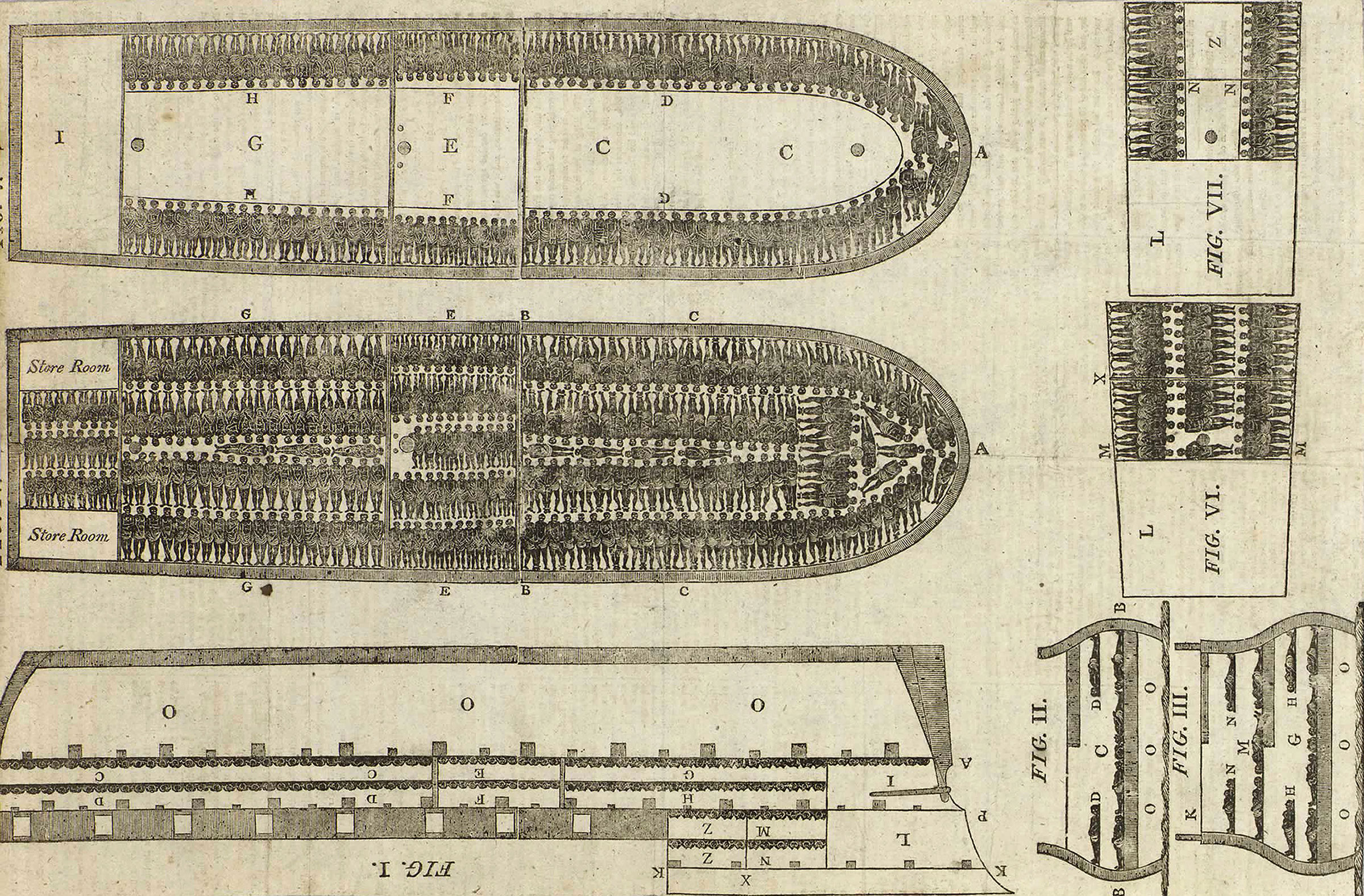
Beloved does not solely represent Sethe’s guilt and also embodies the cruelty of slavery with her violent acts and immense strength over others. As well, she is a passage into understanding the events that occurred such as Beloved’s experience before she became a physical being again “day light comes through the cracks and I can see his locked eyes I am not big, small rats do not wait for us to sleep someone is thrashing but there is no room to do it in if we had more to drink we could make tears we cannot make sweat or morning water so the men without skin bring us theirs one time they bring us sweet rocks to suck we are all trying to leave our bodies behind” (Morrison 248). Beloved describes the horrible conditions on a slave boat from the perspective of a survivor of the trip, she takes the form of another soul who has experienced it like her grandmother did. This occurs later in the book around the time she becomes more cruel like slavery.
Throughout her time in the book Beloved has a vast impact on Sethe, Paul D, and Denver. What she comes to represent varies throughout the book at times being Sethe’s guilt and a reminder to the past and at other times being a remembrance of the atrocities of slavery and the slave trade. Through her symbolism Beloved has a profound effect not only on the characters but on the readers of the book.
Three months ago a huge bill was passed. One that came as a foglight on the ocean to some, but as a watered-down coffee to others. At this point, it has been more than 100 years since the discovery, and thirty since its huge wave of acknowledgment by the news. But still today, we have massive polluters aware of their actions, and petty deniers arguing on the internet.
Many have promised action, and some action has come. But the world has not stopped warming, species are still being taken off the planet by our own actions, and we still put out toxins into the air that we would not want in our homes. But the world has not had a universal effort.
All our actions are not a necessary evil as some have come to suggest, nor were they ever a necessary evil in past events that caused great turmoil. But the more times the cuckoo clock rings, the harder it will become to take back our actions.
I have a dream that one day we can stand united to face an enemy that hates us all. That we can agree on the fundamentals of what must be done, and that we can see past the immediate strife and hardships that will come, to see the clear skies and lush lands of the future.
Two girls, both immigrants, both poor, both growing up in the slums. You could say they are cut from the same cloth, but if that’s the case how come they have been sewn into something much different? Maggie and Nellie from Maggie a Girl of the Streets both grew up in bad conditions that have helped mold them into the people they became. One ended up timid, unsure of herself, and the other ended up a confident survivor through swindling. By showcasing their dramatic differences with similar socioeconomic upbringings, Crane shows how both conditions set you back, but also how much your individual choices can allow you to overcome challenges and survive.
In an attempt to survive Maggie and Nellie have gone down quite different paths.
In an attempt to survive Maggie and Nellie have gone down quite different paths. Nellie has realized her conditions and as a way to keep afloat decided to swindle men. Maggie however has always been a more innocent, naive, and morally good person since childhood. On one such occasion, she helps her brother escape the wrath of Mary, their mother, by breaking a plate. Her naivety is later reflected when she mistakes a puppet for a man “Do dose little men talk?” (Crane 33). As a result of this naivety and innocence, Maggie clings to Pete who offers new experiences and a way out. Nellie is quite the opposite, having been more aware of their outside world she sees that Pete is not anything special, but is a source of profit to survive. This is later confirmed by the final interaction between each girl and Pete.
In the final chapter with Nellie, she and other girls are getting drinks from the ever more drunk Pete. Instead of showing any care for him as he drinks himself into a stupor, they continuously agree with him and shriek as he collapses. Nellie’s lack of care is shown as she leaves the bar. “The woman of brilliance and audacity stayed behind, taking up the bills and stuffing them into a deep, irregularly-shaped pocket. A guttural snore from the recumbent man caused her to turn and look down at him. She laughed. ‘What a damn fool,’ she said, and went” (Crane 86). Nellie knows she must have some sort of income to survive, and at this moment in time, Pete is the way to get it. From the description of the ‘irregularly-shaped pocket,’ it is clear that she has likely done similar stunts before and is well-practiced given her confidence. After Pete leaves Maggie for Nellie, Maggie comes back at a later time to the bar because she still cares for Pete after what he has done. From this, you can infer that Maggie is a more forgiving character, however, she has also become like a lost dog reliant on Pete. “The girl seemed to have a struggle with herself. She was apparently bewildered and could not find speech. Finally, she asked in a low voice: ‘but where can I go’?” (Crane 76). Maggie at the thought of having nowhere to go becomes ‘bewildered and could not find speech’. She has become reliant on Pete as a result of the horrible home conditions that she has been thrown out of and does not have a way to support her financial needs. This ultimately results in her going to the streets, in a way that some could argue was put into place by her upbringing in the slums.
By illustrating the different outcomes of each girl, Crane is trying to illustrate how much each individual decision can make on a person, however, he is not trying to say that anyone can pull themselves up by their bootstraps and be successful by creating this story. Instead, he is showcasing how much a poor socioeconomic background can set you back in life. One good example of this is Nellie. She continuously takes advantage of different opportunities with different men, yet she is not what most people would consider successful by any means. A 2019 study by Georgetown University attempted to quantify these effects by looking at the chance of going to college and getting a good entry-level job in people with different test scores and socioeconomic backgrounds. “One of the more staggering findings from the study was that a child from the bottom quartile of socioeconomic status yet with high test scores in kindergarten only has a 30% chance of obtaining a college education and a good entry-level job. On the contrary, a child in the top quartile of socioeconomic status but with low test scores has a 70% chance of the same.” (Ting 2019). A 40% better chance of a good job is a huge difference that if consistent would affect millions of people. With this specific data, it is important to remember that kindergarten test scores were used which may not express innate talent, however, many similar findings exist so it is not absurd to suggest that socioeconomic upbringing has a huge effect on the potential success of a person.
Stephen Crane was writing Maggie a Girl of the Streets at a time with a huge difference between the poor and the rich and an influx of recently immigrated families. As a result of this, one of his points in writing the book was likely to showcase the massive effect of socioeconomic upbringing. He did this by bringing us into the terrible upbringing of Maggie and contrasting her with Nellie another girl who chose a different path but still ended up stunted. Yet again in our world, this seems to be a growing topic that will hopefully be acknowledged widespread in America.
Wallace Ting Www.schoolrubric.org, Simpson, L., Luce, A. M., Henstridge, N. R., Frangiosa, D., Levin, A., Fritz, A., & McKnight, K. (2022, January 7). Future success depends more upon socioeconomic status as opposed to academic talent, New Georgetown Study suggests. School Rubric. Retrieved February 1, 2022, from https://www.schoolrubric.org/future-success-depends-more-upon-socioeconomic-status-as-opposed-to-academic-talent-new-georgetown-study-suggests/
Money alone doesn’t solve all problems. It doesn’t bring infinite happiness. It doesn’t bring togetherness with friends and family. It just gets you material wealth and a reputation for having money. The American Dream is not solely to gain loads of money with your new opportunities, it’s to be able to have a family and strong social network that you then have the ability to support without worrying about the next paycheck. The Great Gatsby portrays an American Dream that has become distorted and unrealistic. While Gatsby himself has forgotten the important parts of the dream.
The Great Gatsby portrays an American Dream that has become distorted and unrealistic.
Gatsby has not fulfilled the American Dream in its entirety. He may have succeeded in obtaining massive amounts of wealth through his devious bootlegging business, but he ended up all alone. The only people to show up to his funeral were his father, who Gatsby hadn’t talked to in years, a random man who had shown up to a previous party, and, a friend he had just met that summer. That friend, Nick, recalls memories that portray a much more perfect success with the American Dream. “One of my most vivid memories is of coming back West from prep school and late from college at Christmas time. Those who went farther than Chicago would gather in the old dim Union Station at six o’clock of a December evening, with a few Chicago friends, already caught up into their own holiday gayeties, to bid them a hasty good-by. I remember the fur coats of the girls returning from Miss This-or- That’s and the chatter of frozen breath and the hands waving overhead as we caught sight of old acquaintances, and the matchings of invitations: ‘are you going to the Ordways’? The Herseys’? The Schultzes’? And the long green tickets clasped tight in our gloved hands. And last the murky yellow cars of the Chicago, Milwaukee & St. Paul railroad looking cheerful as Christmas itself on the tracks beside the gate.” (Fitzgerald 175). Nick’s recollection of his time traveling home in the West showcases an American Dream that had been much more successful and led to his success. You can feel the vivid joy in Nick as he’s going home with his descriptions of the ‘murky yellow cars of the Chicago, Milwaukee & St. Paul railroad looking cheerful as Christmas itself on the tracks beside the gate’ as well as the cheerful goodbyes and invitations. His family had succeeded in achieving wealth and so there was no worry about the next meal in Nick which left him free to enjoy his surroundings and time with his friends. It brings me back to my own memories of farewells followed by Christmas memories while roasting next to the fire with my family. In our story, however, we see the perspective of two characters who were lucky enough to have the wealth associated with the American Dream, allowing them to have their own special times.
Is the American Dream always possible? Can you truly “pull yourself up from your bootstraps”? It may depend on your background as it appears some groups start out at a disadvantage. “Prior research has shown that immigrants who start out earning less than their US-born peers are unlikely to catch up in their lifetimes.” (Narea 2019). On top of this, it has been shown that your family’s socioeconomic status tends to decrease your chances of financial success. This means that your chances of achieving the financial aspect of the American Dream are significantly lower if you do not come from wealth. However, it does appear that the chances of your children achieving financial success and perhaps enough money to be considered as having new money are not out the window. “But the new study shows that even if immigrants start out with low-income levels, most are not only catching up eventually but surpassing their US-born peers – even if it takes a generation.” (Narea 2019). The focus on wealth in The Great Gatsby has an effect on the American Dream.
The Great Gatsby has twisted the goal of the American Dream. Rather than a focus on building a family and enjoying life, it has taken on a materialistic view. “He presents all this as a perversion of the American Dream, which traditionally has had to do with freedom, opportunity, space to build a life, but which has been replaced by grasping win-at-all costs materialism.” (Foster 146). The characters in TheGreat Gatsby have gained a vast amount of wealth however not one of them seems satisfied with their life. Daisy is abused by Tom and now loves him more for the money and status, Gatsby’s only purpose has just become the goal of getting Daisy who he has fantasized about, Tom cheats on his wife, and Nick is disgusted by most of his friends in New York. The boom in money at the time had affected everyone, even Fitzgerald, especially in cities like New York. If your only goal is to greedily obtain wealth, you lose your purpose once you’ve obtained it. “I see now that this has been a story of the West, after all – Tom and Gatsby, Daisy and Jordan and I were all Westerners, and perhaps we possessed some deficiency in common which made us subtly unadaptable to Eastern life.” (Fitzgerald 176). The transformed idea of the American Dream in this novel has changed the personalities of its characters and has left the idea of the American Dream disfigured.
The Great Gatsby provides a modified form of the American Dream that reflects the lust for money at the time. Nick’s recollection of his time in the West provides a much more accurate view of the American Dream from its original sense, that Gatsby did not manage to achieve. While we saw Gatsby with his new money because of the characters in the book, it is easy to forget that the American Dream from this book’s perspective of achieving wealth is often not possible and many people start from a severe disadvantage. Just like the book has twisted the goal of the American Dream, the American Dream as seen in The Great Gatsby has twisted the personality of its characters into something less palatable by our morals.
Citations:
Fitzgerald, F. Scott. The Great Gatsby. Scribner, 2004.
Foster, Thomas. Twenty-five Books That Shaped America, 2011
Narea, N. (2019, November 1). A new study shows that even the poorest immigrants lift themselves up within a generation. Vox. Retrieved March 2, 2022, from https://www.vox.com/policy-and-politics/2019/11/1/20942642/study-paper-american-dream-economic-mobility-immigrant-income-boustan-abramitzky-jacome-perez
Walking along on a grand adventure! A quick glance up from under the shelter of the canopy of a great pine. Down along with speed around the trickle of a small stream where sticks race off on their grand Prix. Over the ground that was carpeted with brown and green acorns. Hiding in a fort under a fir tree, surrounded by droopy branches. Over the troll bridge encircled by marshy grass and birch trees. Skipping over stones to cross a great chasm, or maybe just mud. Dashing to my family at the picnic table, said hi, and dashed off to the dock to peak at tadpoles the size of a golfball, starting to make their legs.
Tap, tap, tap across the wooden planks. A glimmer of light reflects up into my eyes. I spot a small school of fish! Time to pursue. Tap, tap, tap, slam! Suddenly my body is turning like a hand on a clock. The air sounds a gentle whoosh in my ear. I see the gently lapping water draw near, now darker than before. It begins to look like a wall. Suddenly I’m right on top of it. A smack like a slap slams into my face from the thing that isn’t even moving. Sploosh! I’m into the water, submerged and out of breath. My eyes have slammed shut, it is dark, where have I gone? Am I alright?
Am I alright?
The thing I carry is not guilt, it’s not regret, it’s not anything to do with another person. The thing I carry is a perpetual hatred, not for any group, but for having my head submerged in liquid. It outweighs all common fears for me and has caused me random bouts of stress throughout my life. It has delayed my want to swim, and still forces me to wear a PFD in water above my head, even though I can now swim fine without it. I have not experienced much trauma in my life, but still, this small event holds a piece of me, whenever I see deep water.
The soldiers of the Vietnam War from The Things They Carried bear a massive weight on their backs. This weight is not a heavy backpack, a poncho, or fifteen pounds of ammo. The weight is the trauma they have endured, the heart-wrenching guilt, and the regret that they did not try harder to save their comrade. The Vietnam war was a cruel war, with tactics that would leave soldiers constantly on edge, or burn them to the bone.
There was no shortage of unnecessary deaths, and one such case almost cracked the character of Tim, even if he was not the bringer of death. He watched a man, who he deemed innocent get shot in front of his very eyes. “He was a slim, dead, almost dainty young man of about twenty. He lay with one leg beneath him, his jaw in his throat, his face neither expressive nor inexpressive. One eye was shut. The other was a star-shaped hole. “Talk,” Kiowa said” (O’Brien 124). In recalling the young Vietnamese man that was killed, O’Brien starts to make up the boy’s story in his head. He imagines him as someone studying math, who doesn’t want to go to war and who probably would have gone right by them. In doing this he compounds his own guilt to the point that he is unable to speak about it, even with the pleas by Kiowa to talk about it. He zips up his guilt and instead of trying to process it and numb the pain, he takes it all in deep inside, where it can haunt him forever, or pose the threat of breaking him. While Tim was not broken by his guilt, he did have a comrade who was. Norman Bowker suffered immensely under his guilt of not being able to save Kiowa from the dreadful muck. Kiowa is a character that everyone in the alpha company likes. He acts as a glue that helps to hold the soldiers together, keeping them from breaking as a group and keeping them from tearing themselves apart inside. When he dies, the guilt of his death is carried not just by Norman but by many other soldiers who all feel they caused it or that they could have helped him. However, in the case of Norman, he does not have the support necessary to deal with his regrets when he gets home. The only person he feels he can talk to has drowned to death, leaving him alone with his thoughts as he circles endlessly around the pond. Pondering what he is to do with his life now. Most of us wonder what our point of being here is. What we should pursue. Norman had that purpose figured out during the war. But when the war finished, he had no one left. This led to his downfall and ultimately his killing himself. Norman’s purpose had become the war, but there was another soldier who was willing to risk it all to leave the war, and that was Rat Kiley.
The bleak darkness set off all of the soldier’s nerves, making them imagine things that were not really there.
During the alpha company’s long night treks, all of the soldiers were impacted, but it was Rat Kiley who was broken. The bleak darkness set off all of the soldier’s nerves, making them imagine things that were not really there. The narrator O’Brien channels Rat Kiley’s discomfort in describing how “It made your eyeballs ache. You’d shake your head and blink, except you couldn’t even tell you were blinking. The blackness didn’t change. So pretty soon you’d get jumpy. Your nerves would go. You’d start worrying about getting cut off from the rest of the unit – alone, you’d think – and then the real panic would bang in and you’d reach out and try to touch the guy in front of you, groping for his shirt, hoping to christ he was still there. It made for some bad dreams” (O’Brien 209). The horror of the darkness, not the enemy was what was getting to the soldiers. It was becoming a burden on their shoulders, always fearful of what was hidden in the darkness, imagining the many cruel fates that could await them. This burden was taken a step farther for Rat Kiley, who was constantly exposed to the gore of injured comrades. As the medic in the company Rat Kiley has had to bear an extra burden, seeing the full extent of his friend’s injuries up close and personal, hearing their cries of pain, and imagining who could be next. With the addition of the traumatizing nights, it becomes too much for Rat. He started to hallucinate, imaging horrible things “But at night the pictures get to be a bitch. I start seeing my own body. Chunks of myself. My own heart, my own kidneys. It’s like- I don’t know – it’s like staring into this huge black crystal ball. One of these nights I’ll be lying dead out there in the dark and nobody’ll find me except the bugs – I can see it – I can see the goddamn bugs chewing tunnels through me – I can see the mongooses munching on my bones. I swear, it’s too much. I can’t keep seeing myself dead, ”(O’ Brien 212). As the chapter Night Life progresses you can see Rat Kiley’s descent into madness, up until the point he shoots himself in the foot in order to escape the war. He imagines himself dead on the ground getting torn apart ‘goddamn bugs chewing tunnels through me’ not only this but the dark makes him imagine his own organs on the ground. This all follows his descent into madness. The war has taken Rat Kiley’s sanity from him, the loss of his comrades and eventually his sanity is what he carries.
Not one of the soldiers comes out from the war unscathed, and though these characters may be fictional, the feelings they have are not made up and were quite common in the war. Whether it be guilt, the loss of their sanity, or a feeling of no longer fitting in; each character has taken on a burden from the war, and each character has suffered from its immense weight.
A feminist: a person who advocates for women’s rights on the basis of equality of the sexes. I believe in a world where this term does not become an insult to describe overly “emotional” women. I believe in a world where this term isn’t ridiculed and used in extremely unnecessary ways to label people. Such as “Femi-Nazi”. Something I, and probably every other women’s rights activist, have been called many times before. I believe in a world where not only women will identify as feminists, but men will join in and not be afriad to call themselves one as well. Something men fail to realise is that feminism not only beneifts women, but themselves as well. Instead of being called weak or emasculated for showing signs of emotions, men can live in a world where they are allowed to express their thoughts and feelings without getting hated on. But most importantly, I believe in a world where the term feminism doesn’t have to even be a thing anymore.
Is it foolish to think that the world could ever reach a place of gender equality? At times it feels impossible with endless amounts of women coming forwards with sexual assault charges every day. With countless amounts of women going missing on the streets for simply walking home alone. With all the women getting cut off on their thoughts and theories during business meetings. With little girls growing up thinking their only reason for existence is to appeal to the male gaze. Is it foolish of me to have at least a sliver of hope that one day these habits of our society will be dropped?
Maybe. One thing I know for sure is that if hope is lost, there is a zero percent chance of change. Perhaps the world may not reach a total agreement of gender equality, but maybe, just maybe, enough people will enough for it to change.
Women are strong. Women are smart. And by unpopular belief of men, women are incredibly funny.
I believe in a world where women can walk alone to their home at night without being scared for their lives. I believe in a world where women can speak without being interrupted on important subject matters. I believe in a world where little girls no longer focus their attention on their looks and on their brains instead. I believe in a world where men can express their feelings and are able to partake in what would be perceived as a “feminin activity” without being called “gay”. I believe in a world where the word feminism doesn’t even exist anymore. I believe in gender equality.
There was the sun setting over the large mountains behind the lake. In the afternoon, the sun sank lower and lower through the horizon until there was nothing but stars. Before it got too dark, the stage was set with drums, guitars, and microphones as people gathered around under the outdoor wooden building, waiting for the show to begin. In the mass of people waiting in front of the stage, some wore ripped jeans, tank tops, band shirts, all getting sweaty from the summer heat mixed with the enclosed space of people. And in just a couple more minutes, Rock Night was about to begin.
Every Sunday night for the next three weeks was an absolute treat. Every time this event would roll around, people were rushing to get all the eyeliner and black clothing they could find.
At least ten groups of kids would gather on stage, one at a time, showing off their talent and playing iconic rock songs for the crowd to enjoy. And just about everyone that would attend this event would make many core memories that would last a lifetime. In the midst of the swarm there were friends dancing, taking pictures, and videos of their friends on stage.
By eleven o’clock, the younger children have all gone back to their cabins while the older teens continued to mingle and listen to the last sets of music playing. People started taking their last pictures together for the night and giving each other one last dance of the evening. The performers begin to pack up their instruments and reunite with their friends that go to congratulate them backstage.
The formerly lit-up stage has gotten dimmer as the counselors begin to unplug everything that was plugged backstage. The conversations of people leaving start to grow fainter as the building becomes dark. Everyone heads back to their cabins as the clock reaches midnight and the sky is darker than ever.
Suddenly, the lights from each cabin turn on, indicating that the night has not ended just yet. Pizza is brought in by the counselors of all different varieties and the children each grab slices while gossiping and getting changed into more comfortable clothing. Around two a.m., everyone starts to settle down and head to their bunks after a day of excitement. Summer camp has only just begun.
Humans are inherently selfish, displaying egoism in most of their actions. Although altruism can occur, it is a rare sight to see. The majority of the time it is for the sake of friends, family, or a loved one. Oftentimes humans are altruistic for the sake of an ulterior motive or are doing it to feel good about themselves. As a result, they are not willing to go to extreme measures for their altruism. Egoism is a basic behavior that is necessary to survive. This is seen throughout literature, in works like The Road where the man and boy cannot help the people trapped in the basement, or in others like The Great Gatsby where they must take steps to preserve their reputation, humans often act to save themselves instead of others.
Egoism is forever present in our society as a tactic for survival.
Protecting yourself is a basic biological behavior present in humans. The idea of egoism being the dominant behavior has been around forever. A prime example is the legalist Han Fei Tzu who believed all humans are originally evil and selfish in their actions. As altruism can often be at the expense of oneself it is an uncomfortable thing to do, as a result, it generally takes strong feelings to incite altruistic behavior. An example of this is Nick Carraway from the Great Gatsby. After discovering Tom’s cheating, he chooses not to tell his dear cousin Daisy. This occurs near the beginning of the book before Nick finds out Daisy is confident in her suspicions of Tom cheating. Nick is even shocked about the lies in their relationship “It’s really his wife that’s keeping them apart. She’s a catholic and they don’t believe in divorce. Daisy was not a catholic, and I was a little shocked at the elaborateness of the lie.” (Fitzgerald 33). Yet even with his shock at Tom’s elaborate lie, Nick is unable to try and set things right. It may be argued that Nick wasn’t selfish in not speaking against Tom or informing Daisy out of fear of Tom. This fear is justified by the fact that Tom breaks Myrtle’s nose not long after Nick’s discovery. However, the practice of selfless concern for others is a part of altruism. If people like Nick were truly altruistic in their actions, rather than just their thoughts, he would have set things right with all three of them. Fear of consequences upon oneself is a strong motivator against altruistic behavior.
War is riddled with cases of egoism as well as the occasional romanticized case of altruism. It is often the case that soldiers want to get back home safe and sound to their loved ones. At the same time, they do not want to abandon their comrades in arms who they have grown close to through suffering together. A want for altruism is seen a lot, even in high-stakes cases like war. A prime example is Tim O’Brien from The Things They Carried wanting to rejoin his group after he leaves due to injury, even though he hates the war and has only suffered because of it. Yet when push comes to shove even the closest of soldiers are not willing to risk it all to save their companions, even if they believe them alive “There were bubbles where Kiowa’s head should’ve been. The left hand was curled open; the fingers were filthy; the wristwatch gave off a green phosphorescent shine as it slipped beneath the thick waters. He would’ve talked about this, and how he grabbed Kiowa by the boot and tried to pull him out. He pulled hard but Kiowa was gone, and then suddenly he felt himself going, too. The shit was in his nose and eyes. There were flares and mortar rounds, and the stink was everywhere-it was inside him, in his lungs – and he could no longer tolerate it. Not here, he thought. Not like this. He released Kiowa’s boot and watched it slide away.” (O’Brien 143). Norman Bowker sees the bubbles believing his friend is still alive and attempts to save him. When he starts to get stuck himself however he is unwilling to keep pushing or to rush for aid. Instead, he lets the stink that ‘was everywhere-it was inside him, in his lungs’ get the better of him and he leaves his friend behind.
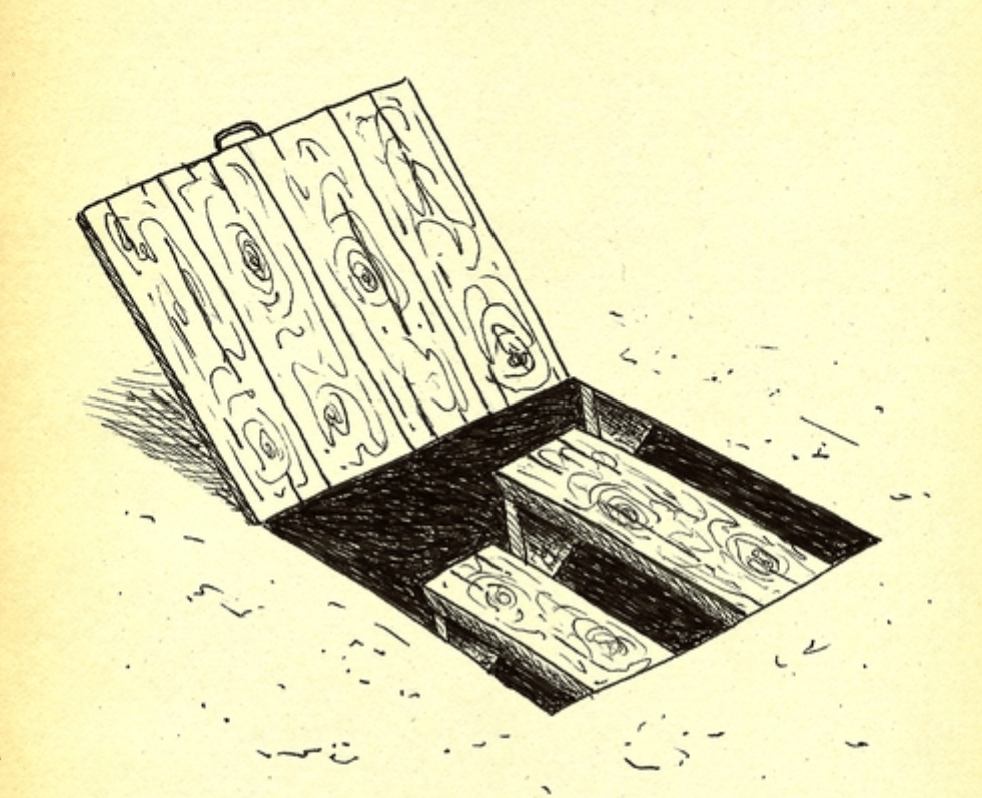
This act of self-preservation by abandoning someone you cannot support occurs similarly in Cormac McCarthy’s The Road. They have little to no food in their post-apocalyptic hellscape of ash and face the constant threat of people who enslave, rape, and cannibalize others. The Man and Boy face a high risk of death for any altruistic behavior they may do. At their discovery of the locked hatch, they think they may have found a place to protect food. Sadly their suspicion is sort of right and they discover the sustenance of cannibals “huddled against the back wall were naked people, male and female, all trying to hide, shielding their faces with their hands. On the mattress lay a man with his legs gone to the hip and the stumps of them blackened and burnt. The smell was hideous.” (McCarthy 110). These unlucky people were in a situation that just as likely could have been the Boy and the Man. They witness the captive’s cruel containment, where they are stuck in a room so dark that they must shield their eyes from the newfound light. Their counterpart has been kept alive with chunks cut off and cauterized. Yet even after witnessing this sight, they do nothing to help, unbeknownst at this point to the threat lurking outside. Instead of even leaving an opportunity for them to escape they put the suffering people back to square one “He stood and got hold of the door and swung it over and let it slam down” (McCarthy 111). They egotistically ignore the suffering of others in order to preserve themselves, not even leaving the opportunity for the captives to rebel against their captors. This is all done with the justification of protecting themselves, and more specifically the boy.
Self-preservation and preservation of one’s own assets is the common thread in cases of egoism. Most people are not okay with others suffering however it is much rarer for them to act against it. This is even the case when they themselves once went through the same hardships as the case of Jay Gatsby from The Great Gatsby. Jay grew up poor himself, being taken under the wing of a more successful and financially secure person. Once Gatsby got to his own level of immense wealth he did not use it to help other less fortunate people. Instead, he used it all to try and get Daisy and manipulate others into helping him. Such was the case when he made Nick’s house just as spectacular as his own “The flowers were unnecessary, for at two o’clock a greenhouse arrived from Gatsby’s, with innumerable receptacles to contain it.” (Fitzgerald 84). Gatsby uses all his money for the sole purpose of impressing Daisy who he is trying to woe, even offering Nick a job to try and bribe him.
Egoism is forever present in our society as a tactic for survival. We are selfish choosing to preserve our own wealth, reputation, and well-being over the benefit of others. This is not due to us lacking humanity or any altruistic drive, it is just a matter of our own deeply ingrained priority of self-preservation.



/GettyImages-1222040206-f0faae8379c54ff58961774f75be3065.jpg)