
To many people, Stephen Crane is considered the father of American realism. American realism is a form of art, music and literature which depicts the daily lives of ordinary people. This claim reigns true in the novella Maggie: Girl of the Streets. Crane’s use of creativity and word choice shows that this is a fictional book, but in the details the reader will notice major themes, places, and feelings that were very potent back in the slums of New York City in the early 1900’s. Stephen Crane’s use of realism in the story directly correlates with the history of that time period, especially Maggie Johnson working in a factory, the poverty that she experiences, and the social issues that exist in her community.
One use of realism in the novella is Crane having Maggie work in a factory. The narrator says that Maggie,
“Got a position in an establishment where they made collars and cuffs, She received a stool and a machine in a room where sat twenty girls of various shades of yellow discontent. She perched on the stool and treadled at her machine all day, turning out collars, the name of whose brand could be noted for its irrelevancy to anything in connection with collars. At night she returned home to her mother” (Crane 23).
While Maggie was reflecting on her time at the factory, she realized that it was “a dreary place of endless grinding” (Crane 28). The long work day was a dangerous grind for all who worked in factories and mills in that time. Many people lost fingers and other limbs because of accidents in the workplace. These people, Maggie included, worked long, grueling days and made very little money. Many Irish and Canadian immigrants worked at Bates Mills in Lewiston, Maine during the late 1800’s. With their work days ranging from twelve to fourteen hours, they still made less than eight dollars per week; furthermore, these long days and low paying jobs led to poverty and poor living conditions in the family lives of these people (Brochu).
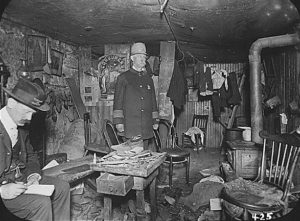 The poverty that Maggie and her family experience directly correlates to the poverty that many Irish immigrants had to live in during the early 20th century. While Maggie is looking around her small living area, “The broken furniture, grimy walls, and general disorder and dirt of her home of a sudden appeared before her” (Crane 26). This shows that the Johnson family has no money left over to buy new furniture or to clean the ’grimy walls, and general disorder and dirt’ that was all throughout the house. Another instance where Maggie notices how disgusting her home is is after she meets Pete. The narrator says, “Maggie contemplated the dark, dust stained walls, and the scant and crude furniture of her home. A clock, in a splintered and bettered oblong box or varnished wood, she suddenly regarded as an abomination” (Crane 28). Crane’s use of vivid adjectives allows the reader really see and experience how horrific her home is. An example of this comes when he describes the furniture as ‘scant and crude.’ Like Maggie and the rest of the Johnson family, Irish immigrants lived in similar situations. They lived in places with multiple families that were meant for only one. Some people even lived in cellars and attics. The lack of sewage and running water also made adequate sanitation almost impossible. These poor living conditions in turn led to diseases such as cholera, and tuberculosis, and typhus (Adaptation and Assimilation). In the novella, Maggie’s brother Tommie dies at a young age. The narrator says, “The babe, Tommie, died. He went away in a white, insignificant coffin, his small waxen hand clutching a flower that the girl, Maggie, had stolen from an Italian” (Crane 18). The tone and language suggests that a short life expectancy was not out of the ordinary. The ‘insignificant coffin’ shows that it was a normal thing for an infant to die. Tommie might have caught one of the many diseases or could have just passed away from malnutrition. These poor living situations also led to a poor social environment for the people as well.
The lives of the people in Maggie: Girl of the Streets and the lives of real Irish immigrants were filled with violence and alcohol. The first scene of the story is a fight. This immediately sets the tone and gives the reader a sense of the environment right from the start of the book. The narrator describes the fight as, “Howls of renewed wrath went up from Devil’s Row throats. Tattered gamins on the right made a furious assault on the gravel heap. On their small, convulsed faces there shone the grins of true assassins. As they charged, they threw stones and cursed” (Crane 4). Crane used the words ‘true assassins’ to show that these kids fight very often. These types of scuffles were common in the streets. Jimmie gets in many fights and must be separated from them by the adults of Devil’s Row. Another problem in society was the drinking. One prime example of an alcoholic is Maggie’s mother Mary. Throughout the novella she is constantly drunk, even when Pete comes over to pick Maggie up for the first time. The narrator said, “Maggie’s red mother, stretched on the floor, blasphemed and gave her daughter a bad name” (Crane 30). Mary is ‘red’ and ‘stretched on the floor’ because she is so drunk she is almost at the point of passing out. She mumbles some bad things about Maggie, but it was just her drunkenness taking over. These problems that occurred in the story also happened in cities crowded with immigrants in the early 1900’s. The large, overpopulated cities were filled with violence, drinking and crime. At times some families who were native to a city moved out when they heard that more immigrants were coming in. The families did not want to deal with all of the issues they brought to society (Adaptation and Assimilation).
In summary, Stephen Crane uses American realism to give the reader a taste of what life was like for a family of Irish immigrants in the early 20th century. There are specific examples in the job that Maggie has, the poverty that her family and the rest of the community experiences, and also the social problems in society at the time. There was a lot of crime, violence and drinking going on. Through the graphic details the reader can really feel like they are living in New York City around the year 1900.
Works Cited
“Adaptation and Assimilation.” Immigration… Irish. Library of Congress, n.d. Web. 23 Jan.
2017.
Brochu, Robin. “Bates Mill Complex.” Walk Through History. N.p., 15 Dec. 2013. Web. 23 Jan.
2017.
Crane, Stephen. Maggie: A Girl of the Streets. Stilwell, KS: Digireads.com, 2000. Print.