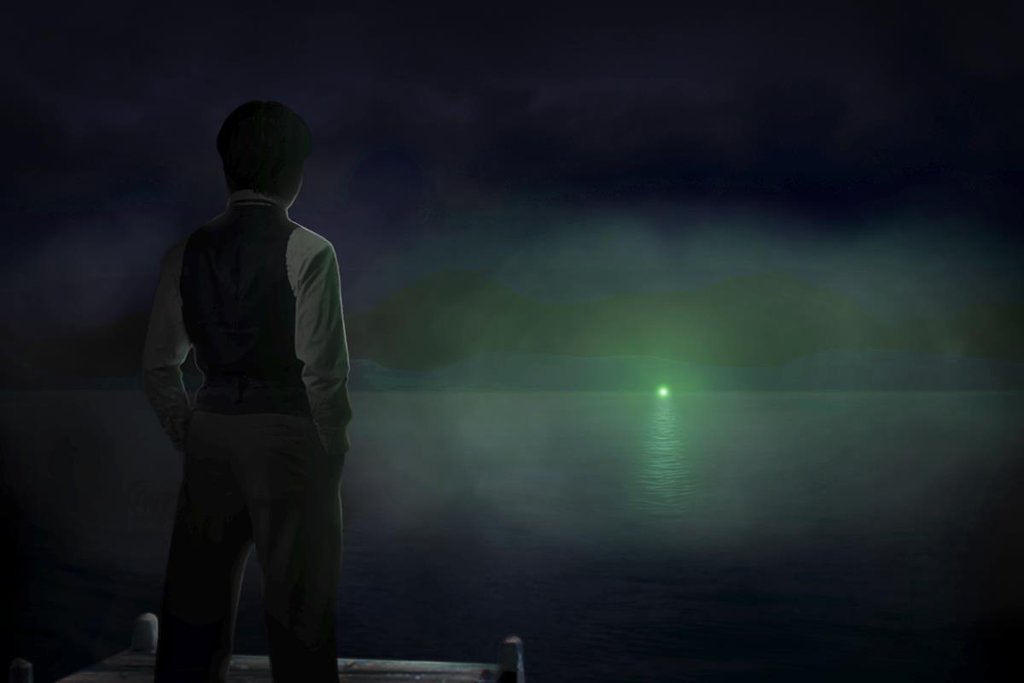
The Impossible Current

Hope: a feeling of trust; trust that things will turn out okay, or just the way one imagined. The comment delivered by Nick at the end of The Great Gatsby, by F. Scott Fitzgerald, represents his feelings, and humanity’s nature towards hope. 

“Gatsby believed in the green light, the orgastic future that year by year recedes before us. It eluded us then, but that’s no matter – tomorrow we will run faster, stretch our arms farther … And one fine morning – So we beat on, boats against the current, borne back ceaselessly into the past” (Fitzgerald 180). 

The enduring influence of this line is meant to reestablish Nick’s astonishment for hope; which is a strong theme that is carried on throughout the book, specifically the hopelessness with which Nick looks at hope, and his appreciation for those that hope heedlessly. For example, for the duration of the book, the reader sees Nick admiring Gatsby because of his ability to hope; as well as, by contrast, Nick’s belief that hope is pointless; and finally, Nick’s understanding that hope is a part of the human condition. 

Each of those points are significantly represented in the last remark that Nick makes. In just the beginning, ‘Gatsby believed in the green light,’ the readers see Nick’s admiration for Gatsby and his willingness to hope. This small line of narration shows the reader just how much importance and wonder Nick places on Gatsby and his belief in this ‘green light;’ which is the greatest symbol of hope to Gatsby, as it represents his connection to Daisy – his dream. In just the next line, Nick’s contempt for hope is exhibited. He believes that the future we fight so hard for ‘recedes before us’ no matter how long, or hard, we fight for it; this idea is continued when he compares dreamers to ‘boats against the current, borne back ceaselessly into the past.’ In these few words the reader comes to understand Nick’s belief that hope is hopeless. Dreamers are pictured as striving for things that are completely unimaginable and out of reach, as if their aspirations are altogether absurd. Finally, the reader discerns Nick’s acceptance of the fact that hoping is part of human nature. He claims that the elution of our dreams is ‘no matter,’ and does not keep us from ‘running faster’ or ‘[stretching] our arms out farther’ in reach of those goals. It is hard wired into our human minds and human heart to ‘beat on.’ 

The Importance of the Green Light in The Great Gatsby – imarreis

Before the reader sees this realization of the necessity for hope, they see Nick’s admiration for Gatsby because he puts so much faith into the idea of hope. This is seen as early as the introduction of the novel: “It was an extraordinary gift for hope, a romantic readiness such as I have never found in any other person and which it is not likely I shall ever find again” (Fitzgerald 2). Nick uses this line to describe his feelings towards Gatsby, most specifically why he carries such an admiration for Gatsby. This ‘gift for hope’ is what Nick finds to be the most ‘extraordinary’; in all things he chooses to say about Gatsby, he decides to comment on his ability to hope over and over again, despite the deficiency he’s met with. Another example of this persistence is when Gatsby still hoped for a chance with Daisy, even after it was obvious that his dream had failed. Nick observes this moment and says, “he was clutching at some last hope and I couldn’t bear to shake him free” (Fitzgerald 148). In this moment, Nick recognizes the failure of Gatsby’s dream, and the perseverance with which Gatsby looked at that dead dream. This causes him to hold some kind of mesmerization, and almost pity for Gatsby; Nick couldn’t ‘bear to shake him free’ of the hold that hope had on him. In this line, the reader begins to see Nick’s contempt towards hope in addition to his admiration for those that hope willingly. 

While Nick finds admiration in Gatby’s hope, in reality it’s merely just an interest; he’s unable to comprehend how, or why, people are able to put so much faith into their dreams. This is another way the theme of hope is tied into the novel. The reader first sees this when Jordan reveals the significance of the green light to Nick. Once Nick knew what Gatsby was wonderingly reaching towards that one night, he says “he came alive to me, delivered suddenly from the womb of his purposeless splendor” (Fitzgerald 78). In this instance, Gatsby is given some kind of new purpose, and yet at the same time he is ‘delivered…from… purposeless splendor.’ The ‘splendor’ being Gatsby’s great dream of Daisy followed by Nick’s disdain towards that ‘purposeless’ dream. Another moment that the reader observes Nick’s scorn is when he expresses an idea of how Gatsby may feel once his dream of Daisy has officially collapsed. He says, “he must have felt that he had lost the old warm world, paid a high price for living too long with a single dream. He must have looked up at an unfamiliar sky through frightening leaves and shivered as he found what a grotesque thing a rose is and how raw the sunlight was upon the scarcely created grass…” (Fitzgerald 161). Not only does the reader understand what kind of loss Gatsby feels and what kind of faith he put into this dream, but they’re also now met with an idea of Nick’s outlook on life and hope. If Nick is able to conjure up such a ‘grotesque’ idea of life, it’s not far off to assume that he always possesses this outlook, and that this stripping of hope has finally exposed Gatsby to the true ‘rawness’ of life. It takes a special disdain for life and hope in order to look at things such as ‘roses,’ ‘leaves,’ and ‘sunlight’ as’ frightening,’ ‘grotesque,’ and ‘raw.’ This line alone tells the reader how Nick looks at life, through a dull lens rather than rose-colored; without hope or dreams to turn a rose into something beautiful or sunlight into a golden beam. Although he looks through these dull lenses, Nick is still able to understand that hope acts as those rose-colored lenses for everyone else. 

“It’s part of human nature to give so willingly to the idea of hope.”

Nick understands that it is part of human nature to give so willingly to the idea of hope. This idea is seen most significantly in the last line of the novel when Nick narrates, “so we beat on, boats against the current, borne back ceaselessly into the past” (Fitzgerald 180). This line alone signifies the feelings Nick holds towards the idea of hope, and the persistence of hope within human nature. Despite everything hope makes us feel – lost, worried, hopeless, insufficient – we still ‘beat on.’ We still push on in reach of those dreams that we hope for. ‘Boats against the current,’ humans against the inevitable, the inevitably of our failing dreams as Nick sees it. It is a part of the human condition to put our faith in hope, to jump so willingly into the idea that things will work out in the end. 

Just as Nick does with Gatsby, “Gatsby turned out alright in the end,” (Fitzgerald 2) he says. Even with each emotion the reader is taken through during the book, with each stab Nick takes towards hope – whether that be his admiration, contempt, or acceptance for it – the reader recognizes that this story of Gatsby leads Nick to eventually believe in hope. Hope: a feeling of trust; trust that things will turn out okay. The book and, most significantly, the comment last delivered by Nick tells the story of Nick’s relationship with hope and dreams, and perhaps the rest of mankind. We recognize its unreliability, and yet crave its promise.


Posted in Uncategorized | 1 Comment

The Weight of Being a Good Daughter

Every parent wants a good daughter, one who loves them unconditionally, one who respects their decisions, and one who is always honest. There is a great weight that drags down a young girl to represent the perfect image to her parents. Everyone makes mistakes, especially daughters when they strive to fit in a perfect little box that their mother and father have decorated with silky ribbons of expectations. Ribbons are light and gentle, used to embellish the prettiest gifts but when double knotted into a bow they are so appealing to unwrap and pry out the contents. This box is weighed down to the ground with intangible hopes. Those hopes are the weight that is placed on every girl to be a good daughter. The ribbons are so tempting to let go, as each girl turns into a woman, but they are imperative to hold on to to maintain a good relationship with your parents. 

Loving your parents unconditionally might not seem apparent on the hardest of nights when you’re screaming and crying about a broken promise. When it feels like you have been tied down to the house unable to leave because your parents have forbidden you to make yet another dumb mistake. Loving your parents unconditionally is easier for some than others as every girl has formed a different relationship with their parents, but it is way harder when you do not see them often. Distance slowly tends to tuck away that box of expectations in a dark corner of a closet and just when the ribbon begins to untie, the weight of the box causes it to fall making a great noise reminding you to love your parents no matter what; and so you do. For once you appreciate that box and tie the ribbon really neatly and hold it for a while. 

Respecting parents’ decisions is hard because every girl reaches an age when they think that they have their mind made up and that they know what is best for them. You’re ready to take a pair of scissors to the delicate ribbon and cut it, you’re eager to watch all the expectations spill out. And, as you reflect on those expectations, you notice that they are not just ideals; they are goals that show unconditional love in reciprocity. So you pick them up and return them into the box. As the expectations are put in one by one the box becomes heavier and heavier. This is when every girl thinks of a time when they did not respect their parents decisions and it did not turn out the way they planned. Like the one time you snuck out and then did not have a ride back home. The feeling of being stranded somewhere you did not recognize made you think that you should’ve respected your mom‘s decision to stay home that night. You continue to pile the expectations into the box until you can barely close it and you need the ribbon to keep it shut.

Being honest induces fear. This fear creeps in from the disappointment that might be placed upon you should you be honest about your mistakes. Honesty has a weight of itself and sometimes it outweighs the box of expectations that you now cherish too much to break. Every daughter has kept secrets from their parents; whether you wish they could have helped you with every problem, sometimes you are scared to deceive them. Sometimes you feel like you lie to protect them and assure them of your safety. Usually most girls manage to sort out their problems, but should something happen, you have to comprehend that the weight of your box will be piled on to your parents and they will be left to carry it or  it will be passed down to your daughter with a bow with frayed edges. Fortunately, part of parenting is forgiveness, just like you will, your father and mother will love you unconditionally making honesty the key to any good relationship. 

“[When] You’re ready to take a pair of scissors to the delicate ribbon and cut it, you’re eager to watch all the expectations spill out. And as you read them you notice that they are not just ideals; they are goals that show unconditional love in reciprocity.”

From loving your parents unconditionally, respecting your parents’ decisions, to being honest, the small box you carry to be the best possible daughter becomes heavy enough to have to drag around. It requires great care as sometimes you break a little bit of it and you have to fix it before it is too late. This pressure of being a good daughter has, however, brought me to where I am today. Had I not had that guidance weighing me down, I would have made countless mistakes. However, some of my mistakes have caused the ribbons to fray little by little over the years. With the distance between my parents and me, being a good daughter, creating a good relationship with them becomes even heavier on both sides as every daughter needs a father and a mother as long as they are fortunate enough to have them. One day I might have a daughter and her box might inherit my frayed ribbon; however her task will be to create a pretty box filled with healthy expectations and make a pretty bow out of my frayed ribbons. Perfection should never be attained but letting go of the box however frayed the ribbons might be is just as damaging, as a french proverb says: “Unstringing the bow does not cure the wound.” “Défaire le nœud ne cure pas la plaie.”

Posted in Uncategorized | 1 Comment

The Land of Aromas, Colors and Flavors

I am from shattered-faded watercolors

From picturesque scenery and Jacaranda Trees.

I am from a place that absorbs the mellow of sadness and replaces it with delight

And fills your face with smiles for its warm sun with a Mariachi playing to the sound of the sunset.

I am from the land of cactus and sea mystery

Whose surface hides the largest and richest temples and cities of legends of Gods and Heroes.

I am from gastronomic spicy and fine-silver Tequila,

From Patino and Valdivia.

I am from people who never give up and would always die for the ones they loved the most

And from anger and anxiety that escape from time to time,

from small and weak people but stronger than what they appear.

I am from parables and psalms.

I am from great warriors and war survivors,

from pears that talk and pumpkins that feel,

From great engineers who started from the bottom and built their way to success

And from tears and drops of blood spilled to love and lose.

From unforgettable little hands making cookie dough to bigger hands flipping through pages of study books.

I am from those moments where you have drunk so much of that platinum liquid that you don’t even remember what happened the night before, but at the same time they are memories that remain forever in your memory.

I am from shattered-faded watercolors . . .

The Best Things to Do, See, and Eat in Mexico City

“Mexico, the land of aromas, colors and flavors.”

Posted in Uncategorized | 2 Comments

Maturity in all its Splendor

In the novel The Road written by Cormac McCarthy, one of the main themes is innocence, which is reflected exclusively in the character of the boy. At the beginning of the novel we see how the boy does not understand this apocalyptic situation, and in the vast majority of the time all his fear is manifested through constant crying throughout the novel. However, as the cusp of the novel builds, we see how the boy adapts new behaviors that give the reader the impression that he is somehow beginning to mature. This change takes shape in section six of the novel (pages 130-161).

The Maturity Of The Boy Through Time - American Literature (G)  PortfolioAmerican Literature (G) Portfolio

In section four of the book, McCarthy describes the boy as still innocent, but gives a foreshadowing of the direction this character would later take with the following quote: “He seemed like a sad and lonely changeling boy heralding the arrival of a show.” walking”. in the county and the town that does not know that behind him all the players have been led away by wolves” (McCarthy 81). Analyzing these lines we see how the author paints the figure of a sad and lonely child, who is heralded by ” the arrival of a traveling show in shire and village”. This first part is the first clue that is given to the reader, since it means that something is going to happen in the future. This situation that is supposed to happen in the future will go unnoticed -perhaps only for the characters in the story but not for the readers – because the words “behind him” are used, obviously indicating something unexpected. Likewise, “the players” refers to his father and his son, in particular the son, and “the wolves” refers to an enemy that both the father, and especially his son, will have to face. As mentioned above, this entire quote gives the reader a hint that a situation will occur in the coming sections where both the father and the son will be involved against a common enemy, which will cause the boy to develop a degree of three hundred and sixty change that will eventually make him lose his innocence, mature and begin to understand the true reality.

In section six we see how the child begins to develop new behaviors: we see how the child adopts different ways of responding to situations and also changes the way he addresses his father. On several occasions we see how the child becomes more demanding with respect to his father; he demands that his father tell him the truth about what he is living little by little. Such is the case when he demands his father to promise under no circumstances to kill other humans to eat and thus survive: ‘We wouldn’t eat anybody, would we?’ and even he demands an answer from her again when he says ‘Even if we are starving?’ (McCarthy 136).

Furthermore, we see how the child begins to pay more attention to his surroundings. At the moment when they are looking for goods in the house and in the bunker, it is noticeable how the boy has learned from his father and begins to pay more attention to the vital things they need to survive. This idea is represented when the child mentions that ‘he saw a gascan in the corner behind the door’, and it is also shown how his rationalist thinking along with his feeling of survival develops when the child mentions that ‘they could use the gasoline and it would burn’ (McCarthy 141).

Later in Section six we see how even after having found so much food, resources, and even mattresses to sleep inside a bunker, basically the paradise that every man would have wanted in an apocalypse to survive, they make the boy question if all that is real: ‘The richness of a vanished world. Why is this here? Is this real?’ (McCarthy 147). This attitude causes the reader to realize that the child is growing on a psychological and individual level when questioning whether something is real. As an effect this makes a great impression of the child who is on the way to maturity.

Another example that reflects the maturity that the child is acquiring is when he tells his father if ‘[he] think[s] [that they] should thank the people’ (McCarthy 154) that they left all the resources in the bunker. Also, the boy is more interested in helping his father develop new ideas that could help them survive. This critical thinking that the child develops is reflected when they are seeing how to best take advantage of everything that the bunker offers them and the child comes up with new ideas saying ‘We could take two of them’ and ‘I could push one’ ( McCarthy 159). Clearly, this predisposition of the child demonstrates a high level of maturity which would initially be a different behavior where perhaps the child would only have observed what his father does, terrified by the apocalypse, instead of helping him and being more involved in the plot.

We even see how the boy begins to observe male behaviors in his father when he shaved himself: ‘[The father] shaved himself with a plastic safety razor. The boy watched’ (McCarthy 161). This example clearly demonstrates how the child begins to show interest in behaviors that an adult male takes on; again a symbol of maturity.

As a conclusion, the boy who was once that boy tormented by terror and fear, is now taking an internal evolution, which clearly marks him as a round character, towards maturity and therefore towards the path of adulthood. This point of the story is critical because finally the evolution that this character is carrying out is perceived more for the readers. In future chapters this change should be even more explicit, and it may perhaps involve tight situations in which the child has to do even the unimaginable.

“The Road to maturity starts when you fave your pain head-on and take responsibility.”

Posted in Uncategorized | 1 Comment

The Fading Light

The American Dream is defined by the Oxford Dictionary as “the ideal that every citizen of the United States should have an equal opportunity to achieve success and prosperity through hard work, determination, and initiative.” On the other hand, James Truslow Adams, an American writer and historian considered the Father of the American Dream, described it in 1931 as “that dream of a land in which life should be better and richer and fuller for everyone, with opportunity for each according to ability or achievement.” Taking both definitions into consideration, we can conclude that the American Dream is the aspiration of all citizens of the United States without exception, to achieve success and own prosperity through audacity, in search of the illusion or the promise of a land where life should improve for everyone increasingly. Is this American Dream truly being fulfilled according to the declarations presented above? The novel The Great Gatsby  by the notorious Fitzgerald is the perfect tool to use in order to answer this question. The main character of the novel, who even through his name conveys the title of the novel, Gatsby as representing the green color of hope, that is to say the promise of the American Dream, we can determined that due to his outcome that the promises of the American Dream were left unfulfilled, halfway. Prosperity and success are the fundamental promises of the American Dream. Gatsby ONLY achieved success, and perhaps he achieved partial prosperity. Nevertheless, in order to achieve the American Dream as a whole, Gatsby should have achieved not only a rich and full life of luxuries, but also a sense of happiness. This is where our inscrutable character failed; he NEVER achieved happiness, but instead, he created a movie where he pretended to be happy, when he really had no one but himself. Consequently, Gatsby did NOT accomplish the promises of the American Dream, even after putting everything at risk, including his own life. He did NOT reach the green light of prosperity, he was completely alone, and he never managed to recover the woman he loved the most.

The Great Gatsby - LANGUAGE AND LITERATURE HL

First of all, we see how Gatsby, despite being that exuberant millionaire who offers extravagant and luxurious parties every weekend, really has no one. He does not have any real friends, other than Nick. Of course he does not have Daisy, and he does not even have his family near him. We can see how he really meant nothing to almost anyone when he threw his extravagant parties every weekend, hardly any of the guests really showed their appreciation to Gatsby. Even on his funeral, only Nick, Mr. Gatz, and some other servants, along with the man with the owl-eyes, attend the funeral. This is shown in the following line: “The minister glanced several times at his watch, so [Nick] took him aside and asked him to wait for half an hour. But it wasn’t any use. Nobody came” (Fitzgerald 106). This sad but true line illustrates that he was all alone, and although he could breathe victory for a moment, that dream vanished after a few seconds and he lost Daisy forever.

This is further illustrated when we see how Nick expresses his disgust at knowing that Daisy has not even bothered to send a letter or a flower, to show her condolences: ‘[Nick] tried to think about Gatsby then for a moment, but he was already too far away, and [Nick] could only remember, without resentment, that Daisy hadn’t sent a message or flowers’ (Fitzgerlad 106).  Furthermore, Daisy and Tom only care about themselves, and they are not interested in damaging third parties as long as they benefit themselves. In addition, these two characters represent the decadence of society. Only material things are of importance to them. Even this lack of morality corrupts the American Dream simultaneously. Daisy, for example, fulfilled her dream by being part of high society and being married to a billionaire, but really that is not the main promise of the American Dream; she is only materialistic and has not achieved prosperity and success by herself as dictated by the American Dream. We can observe this factor in the following quote said by Nick: “Tom and Daisy were careless people –they smashed up things and creatures and then retreated back into their vast carelessness, or whatever it was that kept them together, and let other people clean up the mess they had made …” (Fitzgerald 109). Evidently we can see how Daisy is a materialistic person, very selfish, and that she is even unattainable, because after everything that Gatsby achieved, she continues to go the easy way.

Having already earned his incredible mansion and all its luxuries, Gatsby’s behavior does nothing to win Daisy back. We see how in several instances Gatsby’s worst enemy is himself, since he is the one who puts up barriers. In the end, the only thing his behavior helps him with is becoming that tragic hero who dies trying to achieve his dreams.

In this second point, the bad strategy that Gatsby used to get Daisy back is being emphasized. In it we see how he is demanding her, because really as much as the reader thinks that he has been patient for waiting five years, in which he put together large amounts of money to get Daisy back, really when dealing with the situation, he acts very desperate, and demanding towards Daisy. Gatsby wants her to choose him without a doubt, and he wants her to do it right away. Consequently, this gives Daisy a desperate impression on Gatsby’s behalf, and then she obviously ends up rejecting Gatsby. Gatsby’s despair is shown in the lines of the book presented below: “‘Just tell him the truth –that you never loved him –and it’s all wiped out forever’ ‘I love you now isn’t that enough? I can’t help what’s past. I did love him once –but I loved you too’” (Fitzgerald 82). Clearly we can see the pressure that Gatsby is putting on Daisy, and that it is also in vain, because she ends up rejecting him in any way. 

Furthermore, we see how Gatsby can finally perceive that his attempt to get Daisy has failed. He acknowledges that his plan was ambitious, but he never gets to the task of analyzing his behavior when trying to win Daisy back. Just as in the previous lines it is presented, Gatsby is to blame for having pushed Daisy away just at the moment when he was already savoring victory. Gatsby is his own enemy when dealing with Tom and Daisy at the same time, so this circumstance makes him a tragic hero who dies trying to achieve his dream. Gatsby realizes that his dream has vanished as he implies, “I can’t describe to you how surprised I was to find out I loved her, old sport. I even hoped for a while that she’d throw me over, but she didn’t […] I was way off my ambitions getting deeper in love every minute” (Fitzgerald 92). At this point in the narrative is where Gatsby’s dream seems to fly away, even after the great determination and hope that he had.

Gatsby was determined, ambitious, and above all he tried never to lose hope to make his dream come true; “He was a fervent believer in the gospel of self improvement” (Cohen 1), a very optimistic person. These qualities are the right ones that any individual needs to achieve his American Dream. However, although Gatsby has seen that emerald green light that symbolizes hope, and his undoubted thirst for victory, in the end we see that everything that Gatsby put into play did not serve at all to succeed in his true American Dream; Gatsby NEVER recovered Daisy, and in the attempt he lost his life. He even used to throw extravagant parties every weekend so that one day his lover would show up, and worked hard to raise huge amounts of money so he could buy a house just across the bay from Daisy’s house. Gatsby was counting on this gigantic longing for Daisy, and even he had a tremendous willingness “to sell his soul” (Cohen 2) to get her back. Unfortunately, all hope reaches its maximum point, and this happens at the end of chapter seven when after the confrontation between Tom and Gatsby to win over Daisy, Daisy ends up choosing Tom, and thus making Gatsby’s dream fade away.

The last point represents a parallelism between the end of the first chapter and the end of the seventh chapter of the novel, where at the beginning Gatsby extends his arms towards the green light in search of his dream, towards Daisy, very optimistic: “He stretched out his arms toward the dark water in a curious way, and, far as I was from him, I could have sworn he was trembling. Involuntarily I glanced seaward –and distinguished nothing except a single green light” (Fitzgerald 18). However, at the end of the seventh chapter we see how again Nick Carraway describes a similar scene where Gatsby is again on his balcony standing alone in the moonlight, but this time the green light has faded: “So I walked away and left him standing there in the moonlight –watching over nothing” (Fitzgerald 90). Ultimately, Gatsby’s hopes to win Daisy back are gone, and his American Dream has come to an end. Gatsby is left alone with himself; there is no green light to drive him to continue fighting.In the same way we see how Fitzgerald shows the decline of the original American Dream, where people became selfish as their wealth increased and they did not care at all what they did to other people, always with the purpose of being the ones who received a benefit. Fitzgerald portrays through Daisy and Tom how people who had sudden wealth became materialistic and had no morals. These reasons caused The American Dream to be corrupted because people put their main focus on materialistic things. Therefore, The Great Gatsby is not only an excellent example of the great cost to pursue the American Dream which is reflected in Gatsby, but it also demonstrates how society began in the 1920s to corrupt the main promises of the American Dream. In conclusion, this novel demonstrates with a language rich in lexicon, structure, and narrative, the decline of the American Dream with respect to society, along with the high sacrifices that go hand in hand to achieve said dream; Gatsby bet everything to pursue his promise, he was determined, and ambitious, but in the end, despite conquering all of New York with all the great riches he got over the years, he NEVER managed to conquer what he really wanted, the girl from his dreams. Gatsby is an example of an individual who sacrificed even his life and failed to achieve his deepest desire due to the search for the American Dream.

“Gatsby’s dream vanished as simply as if a lantern went out.”

Posted in Uncategorized | 2 Comments

Nellie Overshadows Maggie

A Dramatization of Maggie: Girl of the Streets

Bertrand Russel, a British Polymath, once said “The secret to happiness is to face the fact that the world is horrible, horrible, horrible.” while Nellie comprehends this Maggie never finds this secret to happiness. Maggie is the protagonist of Maggie: Girl of the Streets, she is a likeable character for whom we all feel compassion and empathy as she takes on the role of fulfilling the realistic personage purposefully sculpted by Stephen Crane. An intentional stylistic device that Stephen Crane takes advantage of to enhance Maggie’s character is a literary foil by the name of Nellie. A literary foil are two characters who have been “cut from the same cloth” ; however, they contain key differences that emphasize each other’s qualities or flaws. In this novel, Maggie’s character is overshadowed by her foil Nellie, described as “a woman of brilliance and audacity”, which dramatizes Maggie’s downfall. This shadow cast on Maggie is evident through the use of Nellie as her foil as they are both dependent on Pete but Nellie takes the advantage; Maggie relies on others as Nellie relies on herself; and, Nellie seems to bring Maggie’s downfall but in reality she represents the realistic consequences of an immigrant in America. 

Nellie and Maggie both long for comfort; Maggie longs for romantic comfort while Nellie longs for financial comfort. Before her downfall, Maggie is a very caring affectionate girl who is concerned about her brother and takes a very romantic interest in a boy named Pete. The match of these two characters is immediately perceived as problematic due to Pete’s characteristics which contrast Maggie’s sweet and innocent character. Maggie’s qualities ultimately make her a tragic hero because she is unable to stick up for herself. Nellie is the opposite, she is very egoistic and only fends for herself, this quality allows her to survive in the conditions she is under in the slums of New York City. This characteristic of hers is very prominent when she steals money from Pete who is still in love with her. She takes advantage of his love for her to manipulate him and steal money from his pocket whilst he is drunk. This instance also ties in how these Maggie and Nellie are very similar, they are both in some way dependent on Pete. They are also from the same city, are around the same age and are described as very beautiful to the point of turning heads.

“Nellie teaches the reader to only rely on oneself; a very realistic portrayal is painted on the life of immigrants coming to America through this lesson of self-reliance. “

Nellie uses her beauty to her advantage as she uses it to make a living attainable for a female immigrant during that period. There is a reason Maggie is brought to an unfortunate ending and Nellie continues to survive. Nellie teaches the reader to only rely on oneself; a very realistic portrayal is painted on the life of immigrants coming to America through this lesson of self-reliance. Maggie’s downfall is caused by her lack of self-reliance making it an important theme of the story. Similarly to this theme the use of Maggie’s foil of Nellie creates a more dramatic effect on her downfall as Crane highlights all the superior qualities that Nellie possesses overshadowing Maggie. Nellie is at first very unlikable in contrast to the caring Maggie; however, as the story progresses Nellie only becomes more popular while Maggie begins to slowly lose her worth. The girl who was once a very caring and innocent girl disperces herself into “the blackness of the final block” (Crane 80). Her life becomes so insignificant that she is overlooked by buildings who envelop her in the darkness of her own life and choices. Maggie used to think prostitutes were worthless as Maggie draws back her skirts as she passes one in the theater. Unfortunately she results in pleasuring disgusting men for money: 

[…]she perceived [a] huge fat man in torn and greasy garments. His grey hair straggled down over his forehead. His small bleared eyes, sparkling from amidst great rolls of red fat, swept eagerly over the girl’s upturned face. He laughed, his brown, disordered teeth gleaming under a grey, grizzled mustache from which beer drops dripped. His whole body gently quivered and shook like that of a dead jelly fish. Chuckling and leering, he followed the girl of the crimson legions. (Crane 81)

The imagery used by Crane emcompasses the great disgust Maggie apprehended from this individual. He is described to be drunk as there is beer dripping from his beer and he is incredibly older than Maggie due to his grey hair and features. The use of ‘crimson’ to describe Maggie and ‘red’ to describe the man’s fat suggest a sexual act due to the man’s flushed complexion and the color red tie to prostitution such as the Moulin Rouge in Paris, France, a famous burlesque theater is entirely based on the color red. Another clue to this grotesque sexual act that takes place between the young girl and this man is the simile that compares the man’s queering body to a jellyfish which suggest the act of ejaculation. Unlike Nellie who uses prostitution to her advantage Maggie slowly begins to lose her own identity and respect; she in turn becomes ‘unapproachable’ (Crane 80).

Nellie represents a shift in the story as she is thought to bring Maggie’s misfortune as she steals Pete’s focus. However Nellie merely magnifies the need of immigrants to rely on themselves. We notice how Nellie has built a comfortable life for herself and Maggie envies her luxurious appearance with which she grasps Pete’s heart and attention:  “She perceived that her black dress fitted her to perfection. Her linen collar and cuffs were spotless. Tan gloves were stretched over her well-shaped hands. A hat of a prevailing fashion perched jauntily upon her dark hair. She wore no jewelry and was painted with no apparent pain. She looked clear-eyed through the stares of the men” (Crane 65). The luxury of the clothes that Nellie is draped in showcases the priority that she has made for herself and how she takes advantage of her job unlike Maggie whose same job is represented in a blatant nature. Crane almost punishes Maggie for her lack of concern for herself and rewards Nellie for her unempathetic behavior. This gives the story a measurable timeline the more Maggie becomes envious and deserted by Pete the more she notices the stares of men that look at her with “calculating eyes” (Crane 76).  This opens Maggie to the same opportunities as Nellie however, Maggie’s fright and vulnerability reverts her ability to be comparable to Nellie. As Nellie stomps on the threats ahead of her, in contrast Maggie lets everything consume her into an eternal darkness.

A dark path was a reality for many immigrants completing this upsetting but realistic novel who understood that the world was horrible. Nellie only more effectively conveys this darkness by showing an alternative perspective to a better life with the same cards that Maggie has been dealt. This likeable and charismatic character slowly progresses from a character the reader sympathizes with to a character whose actions make the reader overcome with anguish. Her incapability to fend for herself due to her lack of self-reliance is magnified by Nellie’s drive to survive which evolves from a dislikeable character to a character whose unfavorable actions are understood in a realistic point of view. Crane’s use of a literary foil is an irreplaceable addition to the story as it is utilized to make Maggie’s concern for others, usually a very favorable quality, a curse. He effectively creates this illusion of the dramatization of Maggie’s character as Nellie is always given a leg up from her with Pete, her ability to fend for herself comes to her advantage and the realistic representation Nellie showcases the reality of an immigrant in that respective time period.The larger perspective Crane effectively paints is the importance of self-reliance which is the reason that Nellie greatly complements Maggie’s character as she represents how what are presumably bad intentions, such as being self-centered were the reality for many immigrants completing his idea of the realistic American Dream.

Posted in Uncategorized | 1 Comment

The Sun Also Rises: More Harm Than Good

The United States of America has long been facing a reckoning. In the wake of hate speech, domestic terrorism, and violent, racially motivated attacks, the people have been faced with a choice: confront the systemic injustices and personal biases that saturate the country, or make the easy choice and hang on to long-standing traditions. Does the former mean reevaluating our own ideas of what life and the government look like, and putting in significant effort? Yes, but is that not worth it? Ultimately, should we not strive for a country in which everyone is allowed to live with the same rights, without fear of death or injury? Literature has an incredible impact on how society is shaped, both today and in the past. Ernest Hemingway may have created a masterpiece with The Sun Also Rises, but it is also an incredible expression of bigotry and hatred. There are so many incredible, diverse books and classics out there that deserve space in our minds and our classrooms—The Sun Also Rises is not one of them. It is high time that society prioritizes novels that will genuinely change perspectives for the better, rather than those that were once viewed as great. Ernest Hemingway’s debut no longer deserves the space that it takes up, and nor does its pervasive bigotry. That does not mean it cannot be read, but it should be thought about much more critically, and be taken out of classrooms altogether. The plot of The Sun Also Rises truly does not work without its prejudices, it does significantly more harm than good, and readers literally cannot separate art from artist, as people are wont to do.

Only Connect: the secret lives of Hemingway's wives - Americas and Oceania  Collections blog

Whether you like The Sun Also Rises or not, there is no questioning the fact that some of the sentiments expressed throughout the novel are truly disgusting. From racism and antisemitism to homophobia and misogyny, Hemingway manages to cover all the bases. This bigotry cannot be ignored, either, as the plot simply would not work without it. The idea of the “lost generation” and mental illness may be an important overarching theme of the novel, the plot, more simply, revolves around Jake, Brett, and their friends traveling through Spain while engaging in excessive drinking and partying. In the midst of all this, Jake, Mike, and Robert Cohn express their love and admiration for Lady Brett Ashley. Saying this causes problems would be an understatement. Specifically, the friends begin to turn on Cohn, and the antisemitism at the heart of the story is revealed. Cohn may be arrogant and obnoxious, presented as the villain of the novel, but he is a true representation of the idea that villains are made not born. His actions do not truly begin to escalate until further into the book, as he suffers more and more bullying and bigotry from his supposed “friends.” Make no mistake, Cohn’s actions are terrible, but the Hemingway makes it absolutely clear that all of it is because of his religion. In fact, this point is almost over-emphasized. For example, before one of the first bullfights begins, Bill says of Cohn: “‘He’s got this Jewish superiority so strong that he thinks the only emotion he’ll get out of the fight will be being bored’” (Hemingway 167). This sentiment expresses the fact that Hemingway, and the characters, believe that Cohn is obnoxious because he is Jewish, not because of his personality. This same idea is shown all throughout the novel, to the point where Cohn’s religion overwhelms the few other facts that readers may know about him. Some may argue that he is the villain because of his attitude, but that begs the question: why not Mike? Why not Jake or Bill? Many of the characters share equally hateable characteristics, but so much attention is drawn to Cohn and how terrible he and his religion are that Hemingway gives the audience little choice but to cast him into the role of villain. If the attention to Robert’s Jewish heritage was removed, the audience would have their attention drawn to the equally terrible actions of the other, “better” characters—Hemingway could not have that.

Throughout The Sun Also Rises, Hemingway explores topics that are most certainly important—the effects of war on the individual, mental illness, and unhealthy coping strategies, for example. However, do the benefits these discussions outweigh the potential harm Hemingway’s work might cause? No—for while a great many classic novels deal with these topics, not all of them rely on bigotry to move their stories forward. The Sun Also Rises is steeped in slurs, stereotypes, and prejudice, and while there is nothing wrong with choosing to read the novel, there are faults in the idea of forcing students to read potentially painful words about themselves and those around them. That is, understandably, uncomfortable. Not only is there a potential for pain, though, but for a promotion of these horrific ideas in reader’s minds. Just as Robert Cohn is a villain because of his Jewish heritage, Jake and his friends are as close to heros as Hemingway’s novel has in spite of their racism and antisemitism. Paired with Hemingway’s writing style, it would be understandable if readers interpreted characters’ comments differently. For example, a passing comment by Bill: “‘It’s enough to make a man join the clan’” (Hemingway 93). Preceded by a conversation in which the n-slur is used in almost every sentence, there are almost no tone indicators around this sentence. Whether or not Bill was being serious, Hemingway gives almost nothing away. No facial expressions, no responses, no descriptions of voice. When other equally—if not more—important novels can provide the exact same lessons and ideas, why should we continue to teach a story that may unintentionally promote bigoted attitudes in still-forming minds?

“When other equally—if not more—important novels can provide the exact same lessons and ideas, why should we continue to teach a story that may unintentionally promote bigoted attitudes in still-forming minds?”

In recent years, conversations surrounding problematic artists, writers, and musicians have become more and more mainstream. These conversations are often uncomfortable and divisive, but ultimately necessary. Many are of the opinion that art and artist can be separated, and while this is the easy choice, it is also irresponsible. Art—in whatever form it takes—is a reflection of the artist. When consuming their content, we must accept both the good and the bad, not just whatever piece suits us best. This is particularly true for The Sun Also Rises, both in terms of Hemingway’s obvious bigotry and the fact that the novel itself is a retelling of true events. The characters—good and bad—are based upon real people. Jake’s prejudice did not come from nowhere. If Hemingway was ashamed of this part of himself, why would he include it? The events may be partially true, but the author still had total control over how his fictional counterpart was portrayed. Similarly, he chose to use his characters—mostly Robert Cohn—as punching bags on which to take out his real-life anger. While this was clearly a coping strategy for him, it was also cruel. The person upon whom Cohn was based, Harold Loeb, is described as seeing Hemingway as “cool and unpretentious, with a ‘shy, disarming smile’ and a ‘zest for living’” (Blume). These are not insults by any means, but Hemingway clearly felt threatened by this person—friend—whom he saw as cooler than him, capable of one-upping him by having an affair with the equivalent of Lady Brett Ashley (Blume). Loeb was Jewish, and Hemingway was jealous and antisemitic—a combo that clearly led to the creation of The Sun Also Rises with Robert Cohn as the villain. Hemingway used his novel to support his personal, bigoted vendetta, and why should modern day readers support that? It was clearly an intentional, destructive, and disgusting use of his views. Readers may feel inclined to give their favorite artists the benefit of the doubt, but when novels are so clearly a reflection of personal views, how does that even work?

There are often a great many elements of literature that are open to interpretation—viewed differently based on the experiences of those reading. Bigotry, however, is not. Prejudice is prejudice, and should be viewed as such. Ernest Hemingway does not get a free pass because he fought in a war, because he suffered from PTSD, because he included a couple important messages in an otherwise incredibly harmful novel. The Sun Also Rises might have incredible writing, but does that really outweigh the destructive messages it sends? The country is, or should be, reassessing their priorities right now. Certain groups of people—almost all of them attacked in this story—are constantly at risk in this unjust society. In a world full of incredible, diverse literature, why does this one deserve the time of day? It is long past time to remove books like this one from our list of required reading. The Sun Also Rises is well-written, sure, but it also does not function without putting people down, causes significantly more harm than good, and uses bigotry to pursue a personal vendetta. If readers want to spend their own time on Hemingway’s debut, they certainly can, but with limited space on classroom reading lists, The Sun Also Rises should not take up a spot.

Posted in Uncategorized | 1 Comment

Scarlet Letter Imitation Paragraphs

It may seem insane, that, with our whole lives before us, -so many places to go and so many things to to do, time the only restriction,- we choose to be envious of others and their lives, always hoping for their beauty, their successes, -trying to look like her, act like him, follow in their footsteps, achieve the same, or better, accomplishments than our friends, family, and neighbors, -it may seem insane that we focus on the feats of those around us rather than our own elegance, our own hopes and wants and wishes. But there is a sense, a feeling so overwhelming and unavoidable that it eclipses all other thoughts, compelling us to give in to our doubt and fear and decide that we are not as perfect as the rest of the world, will never even come close; it creeps over us like a dark cloud, obscuring our own beauty from our minds. Our unease, our vacillation, are the roots of self-loathing. It is as if our minds and our hearts are competing, that which is in our head winning out and converting our thoughts of self-love, still foreign to many people, to wild and cruel, but ultimately unintentional, jealousy. All other ideas- including those of happiness and contentment, knocking patiently on the doors to our subconscious- become distant memories in comparison. The locks on these doors are strong and sturdy and, despite our desperate desire to break free, take effort to pick.

4,000+ Free Lock & Key Images

It might be, too, -assuredly it is, that we hide our discontent with our own lives from ourselves, expressing shock when we catch a glimpse of reason, like we had looked through the peephole of that door,- it might be that we are scared of the truth, that we must take control of our own existence. There, in our subconscious, lies a concealed idea, unperceived by our brain, the idea that we use jealousy to hide from our sins, our failures, rather than taking responsibility. Time and time again, the temper of souls snatches away our hope and joy, and laughs as it puts shame and regret in their place, eager to see us lash out at those around us, assigning blame to others to avoid our own pain. We barely think twice, slamming the door on reason and ambition. What we forget to think about, -what, ultimately, is an unavoidable and painful consequence of our society- is that our deep, personal feelings are often influenced by the people around us. This jealousy we say to ourselves, is proof of our mistakes, our failures in life; but, perchance, this torture we put ourselves through is a result of societal normalities and expectations; we are simply unable to conform to a path meant for someone else.

“We barely think twice, slamming the door on reason and ambition.”

Posted in Uncategorized | 3 Comments

The Faces I Carried

The things they carried were heavy, but they put it on their shoulders, because they kept them going. I carried a lot of things to school. Every year, leave home with a large suitcase and a heavy backpack. I packed everything I need in life in them, necessary, unnecessary, I carried. If I carry life on my shoulders, hope is what I carried in my mind. 

The face of my family when they last saw me is deeply carved into my mind. And I hope the day we meet again can come sooner. Their faces were each different, but so similar in expression. Apart from all that, they were heavy. 

My brother is the most important person in my life, his face, I must carry.  Throughout thirteen years of love and hate, it is hard to say goodbye to him every time.  I was at the airport, traveling back to Beijing as he stayed in Hainan, to prepare for school. By the time he comes back to Beijing, I would have already left to go back to school. I got all my luggages out of the car, my grandparents were going inside the airport with me to make sure everything went smoothly. However, there is no reason for my brother to go. I opened the car’s door again, and told him that I have to leave. My grandma added: “You’re not gonna see your brother for a long time, Sam”. He did not know how to act, maybe he was shocked, maybe he did not know it would come so soon. We both just said bye to each other. I carried my suitcase and he kept on looking at his phone. He looked so young compared to the pictures of him my mom shows me right now. 

“My brother is the most important person in my life, his face, I must carry.  Throughout thirteen years of love and hate, it is hard to say goodbye to him every time”

I always have a soft spot for my grandparents’ faces. With my parents busy all the time ever since I was young, my grandparents are extremely close to me. They have been taking care of me daily for as long as I can remember. After I said goodbye to my brother,my grandparents took me inside of the airport. I have gotten my boarding pass already and the next thing is going through the security check. As we all realized that this is going to be the time for goodbye, we stopped and I turned around. My grandma’s face was serious, she told me to be good at school, and tell her about all the things that will go on in my life. My grandpa’s face was sad, he told me to take care and that he will miss me. I replied: “Don’t worry, I will be back in half a year”. Currently, I have not seen my grandpa in a year and a half. It almost brings me to tears everytime I think of that promise. 

My dad’s face is one that I have to carry. Unfortunately, my dad and I were never close like me and my mom. He comes back everyday late, and ever since my parents’ divorce, I barely see him. But he is still my dad. When I was going to Singapore with my mom. I said goodbye to him at the security check. His face was peaceful. He gave me a hug and said : “I love you”. It meant a lot to me. 

The heaviest face that I carry is my mom’s. I lived with my mom my entire life, she is the most supportive person. Carrying my mom’s face is important to me. I saw my mom again in LA after not seeing her for more than a year. On the way to the flight back to school, we had an argument. When she dropped me off at the airport, I grabbed my bag from her, put it on my shoulder, gave her a hug and left. We were mad at each other, but I can tell that now we both regret it. We did not say anything except goodbye, and even though I hugged her, I do not remember her face. 

These faces that I carry on my mind are what makes me stronger. They are the fuel when I run out of gas, they are the slight crack of light in the infinite darkness, they are the hope. I am looking forward to seeing them again, I wonder what their faces look like now.

Posted in Uncategorized | 3 Comments

A Love Spanning the Decades – The Scarlet Letter Chapter 17 Creative Writing

The wind whipped through the city streets as Hester made her way to the entrance of the park. It had been almost fifty years since she had last seen Arthur Dimmesdale, and every minute of those years showed in his appearance. His skin was withered and he hunched over, looking days- if not minutes- away from death. Hester Prynne, on the other hand, looked exactly the same as she had all those years ago. It was a perk of her lineage.

Hester came from an ancient family of immortal time-travelers, a group of people with no roots, no connections other than those within their circle. She had broken one of their most sacred rules when she fell in love with Dimmesdale, and they had both paid the price. Hester was exiled from her family, her skin branded with a mark visible to everyone like her. Her love, however, was left alone- no word from Hester or their child, who was long since grown- to find his own way in the world. It had been fifty years, and Hester Prynne was finally allowed to reunite with Arthur Dimmesdale. She could only hope that he would be willing to speak to her, forgive her.

Why the Scarlet Letter Remains and How the Church Can Help Mend Broken  Marriages - Lifeway Research

Upon her arrival in the city, Hester had been greeted with a shocking piece of information. It was not the new technology or vast numbers of people that shocked her, no. Hester had traveled far into the future and was well-acquainted with those. Rather, it was the news that Hester’s former lover, a vampire named Bloodworth, had been taken on by Dimmesdale as his caretaker. Bloodworth was seeking revenge, and Hester knew it. She had left him centuries ago in a completely different continent, unhappy with their life together and unwilling to give up her family. Both were immortal, but only Hester was able to jump through time at will. She had lived less than a century in total, but Bloodworth had been waiting much longer than that, biding his time and preparing to exact his revenge when they finally met up. Seeing her attachment to Dimmesdale, Bloodworth seized his chance.

“Arthur! Arthur Dimmesdale!” Hester shouted across the park towards the man on the bench. He turned, recognition- alongside shock- flashing across his eyes. They drifted closer, both staring at the other like they had seen a ghost.

“Hester. Have you found peace in the years we’ve been apart?” he croaked.

“Have you?” she smiled weakly.

“My life has been nothing but misery without you and our child! I have been hopeless, despairing! There was no news of your whereabouts! I have been miserable, and yet here you stand, the cause of my misery. I have spent decades drowning in guilt, under the impression that I drove you away. And now, every day I creep closer and closer to death, my health deteriorating!”

“You have done nothing wrong, my love! It was not your fault I was sent away, and our years apart have been punishment enough. Please, believe me when I say you should free yourself of your guilt!” Hester spoke with passion and love, and yet hesitated when it came time for her to reveal the truth about Bloodworth. How could she tell this poor, broken man that the one person he thought he could trust was in fact a false ally, an enemy, even? Finally, drawing in a deep breath, Hester Prynne spoke the truth into the world.

“Arthur, you must know that an enemy has crept into your life, under your roof. Bloodworth, your trusted companion and caretaker, is a former lover of mine. Fear not, he provided me with no happiness! However, he wishes to exact his revenge on me through you, and I fear your worsening health is a sign of his plan’s progression.” Hester knew this news would be a blow for the old man, and waited for his reaction with bated breath. She could only hope for forgiveness. Dimmesdale stared at her, shock plain on his face. Finally, he sank to his knees on the park grass, sliding off the old wooden bench.

“Finally, drawing in a deep breath, Hester Prynne spoke the truth into the world.”

“I should have expected this! I knew, in my heart of hearts, that something foul was going on, and yet I did nothing! I sat there, defenseless, laying my life in the palm of his hand! This is your fault, time-traveler! I will never be able to forgive you for the pain you have caused me!”

Hester’s heart broke; this was her fault, the result of her actions. She flung her arms around the man on the ground, begging for forgiveness. She has survived her exile, survived the growth and departure of her child, but this would be what killed her. Dimmesdale sighed.

“I forgive you Hester, I do. May the world forgive us both. Truly, that evil Bloodworth is the true sinner here. He has acted worse than both of us combined, committed the greatest sins against us.” The couple embraced under the fall trees, leaves floating gently to the ground. And as they calmed down, reality sunk in. What were they going to do next? Would Bloodworth continue to hunt them? For Hester, there was only one option, which she voiced to Dimmesdale. They must flee.

“I cannot leave, Hester, you know I cannot. I am too old and frail, too tightly bound to this city. I will only drag you down, and your family will exile you again. I must die here, and you must leave me. Besides, there is no place far enough, hidden enough, to properly shield me from Bloodworth’s wrath other than the ground beneath my feet. Leave me to find my place alone, it will be safer for us both,” Dimmesdale cried fervently, the light in his eyes dying out.

You must not speak like that Arthur! Our love has spanned decades, and we have just now been reunited. Know that wherever you go, it will not be alone.”

Posted in Uncategorized | 2 Comments