The Great Gatsby: A Study in Headstrong Women

F. Scott’s Fitzgerald’s novel The Great Gatsby is undeniably iconic. It is a story of excess, opulence, and terrible people avoiding the consequences of their actions. Yet, somehow, those characters burrow their way into the hearts of readers. Nick and Gatsby are, understandably, the center of attention, but the fact remains that their female counterparts are almost criminally undervalued. Is Daisy Buchanan a good person? Absolutely not. But neither is Jay Gatsby, and still we mourn his death.

The modern world is saturated with misogyny, but the New York City of the 1920s was even worse, and women both rich and poor were forced to reckon with it. Daisy’s apathy towards her daughter is immediately villainized, but that apathy is also incredibly revealing: “‘She told me it was a girl, and so I turned my head away and wept. ‘All right,’ I said, ‘I’m glad it’s a girl. And I hope she’ll be a fool—that’s the best thing a girl can be in this world, a beautiful little fool’” (Fitzgerald 17). Men’s misogyny and women’s lack of opportunities make life a living hell—why would Daisy want to watch her daughter suffer as she has? The women of The Great Gatsby—Daisy Buchanan and Jordan Baker—have to live life differently than the men around them. Daisy may believe that life is easier when you are ‘a beautiful little fool,’ but she does not fall into that category in the slightest. Neither does Jordan. Throughout the novel, they use their positions and charms to their advantage, act as driving forces for the story, and flip our idea of the American Dream upside down. They may not be good people, but they are fighting against an oppressive system in the only way they know how.

4 essentials if you want to decorate like Gatsby - Homeology | The great  gatsby 2013, The great gatsby, Gatsby

There is not a single healthy relationship in The Great Gatsby—Daisy and Tom bond solely over their misdeeds, Gatsby’s entire view of his relationship with Daisy is built on an illusion, and Nick only uses Jordan to curb his jealousy of Gatsby’s relationship. Not only that, but the women are held to much higher standards—blamed for the same things the men get away with. Even beyond the scope of the novel, they are treated unjustly during the time period. Women may be gaining more freedoms, but they are still given the bulk of the housework and childcare responsibilities, and lack the opportunities that men do. Money, of course, helps with that. These injustices, though, need not be taken lying down, and Daisy and Jordan are prime examples of this. When faced with a lack of opportunities, they choose to use their skills to get what they want in another way. For example, Daisy married Tom despite knowing that it would be a generally loveless marriage. It was a marriage of convenience; a way to get more money and an easy lifestyle without having to work for it. Not only does she get this money, but she gets a decent amount of control, as well. Throughout the book she is able to stand up to Tom in subtle ways, such as how she makes fun of his racist ideas to her guests: “‘Tom’s getting very profound,’ said Daisy, with an expression of unthoughtful sadness. He reads deep books with long words in them’” (Fitzgerald 13). Tom does everything he can to push Daisy down, but Daisy is more subtle; she embarrasses him to their guests without his noticing. Daisy could not gain money and power by herself, so she gained it over her husband. These actions do not gain her a moral high ground, but they do prove that she has a certain kind of intelligence, and is not foolish in the slightest.

Jordan Baker may not be married as Daisy is, but her own manipulations are still examined throughout the novel. Rather than working towards her goals in the way that many of the men in The Great Gatsby do, namely Jay Gatsby, Jordan abuses the morality of others. She cheats at golf to gain her fame and success, and is unafraid to place the blame for her actions on others. In conversation with Nick, she says: “‘They’ll keep out of my way’… ‘It takes two to make an accident’” (Fitzgerald 58). In this scene, Jordan shows almost complete disregard for her life and the lives of others, stating that she does not have to worry about making mistakes, as there are others involved as well. Her words are a show of the charms she possesses. Why worry about taking responsibility for your actions when you can play dumb and escape the consequences? It is certainly true that a ‘beautiful little fool’ would not have this same awareness of position and fame; an awareness Jordan takes full advantage of. She knows she is a bad person with good looks and charms and is proud of that fact.

Not only do the women of The Great Gatsby consistently prove their social intelligence, but they also have a considerable impact on the story itself. Ultimately, they are the downfalls of both Nick Carraway and Jay Gatsby, the most significant characters in the novel. Obviously, Gatsby’s misguided love for Daisy Buchanan is the major storyline, but she has an incredible impact on each of the characters. It is Daisy who introduces Nick to his love interest, Jordan Baker. It is Daisy who motivates Myrtle’s leap in front of the moving car. Daisy who causes the tension between Tom and Gatsby. As Nick describes her voice, “It was full of money—that was the inexhaustible charm that rose and fell in it, the jingle of it, the cymbal’s song of it…High in a white palace, the king’s daughter, the golden girl…” (Fitzgerald 120). Daisy is not the ‘golden girl’ by accident. Just as Gatsby spent his life working for his money and his house, Daisy spent her life curating this perfect persona, this illusion meant to appeal to all. Could a fool do that with the intention of moving up in the world? Daisy is many things, but she is not a side character in her own story, and considering her one does her an incredible disservice.

Jordan Baker may not appear as often as some of the other characters, but that does not make her any less important. In fact, Jordan is a go-between, an orchestrator of several major events. She and Gatsby conspire to get Daisy over to Nick’s house, leading to the rekindling of her relationship with Gatsby. She shares information about Gatsby with Nick, eventually leading to their first meeting and blossoming friendship. Jordan even indirectly causes Myrtle’s death, as Myrtle mistakes her for Daisy. Perhaps most importantly, though, is the fact that Jordan is the one that reveals Nick to be an unreliable narrator, presenting him with his own worst qualities: “‘You said a bad driver was safe until she met another bad driver? Well, I met another bad driver, didn’t I? I mean it was careless of me to make such a wrong guess. I thought you were rather an honest, straightforward person. I thought it was your secret pride’” (Fitzgerald 177). It is made clear from almost the beginning of the novel that what Nick prides himself on most is his honesty—Jordan throws this right back in his face. She recognizes that she herself is not a good person, hence the ‘bad driver’ analogy, and does not hesitate to call him what he is. Nick stood by and watched as terrible events took place, and still had the gall to act high and mighty. In one fell swoop, Jordan upsets the trust that we have placed in Nick Carraway as the narrator of the story—revealing him for who he truly is. It is safe to say that a fool could not watch from the center of the flames quite like Jordan Baker does.

The Great Gatsby is quite obviously a discussion of the merits of the American Dream—it revolves around the story of a man creating a completely new identity for himself, rebuilding his life from the ground up. Let us be honest here, though—Jay Gatsby is a straight White man. The American Dream was practically made for him. He does not fit into neat little “minority” boxes like Black or female—a clear advantage. Daisy and Jordan, on the other hand, are not given the same opportunities by the United States of America; they are not welcome to try their luck at building a new future for themselves, but encouraged to find a nice husband to do the work instead. Throughout the course of the novel, they flip our idea of the American Dream upside down; redefine it in a way that suits their needs. In his essay “A Whole Heap of Ashes,” Thomas Foster states that the ideas discussed in The Great Gatsby are “a perversion of the American Dream, which traditionally had to do with freedom, opportunity, space to build a life, but which has been replaced by grasping, win-at-all-costs materialism” (Foster 146). Sure, if you are a White man. The women in 1920s America are not provided the same freedoms and opportunities. ‘Win-at-all-costs materialism,’ as Foster describes it, is not a perversion for them, but a reality. If they want to make the same money, the same fame, the same life that the men can, they do not get to go about it in the same way. This is consistently illustrated by Daisy throughout the novel. She married Tom for his money, and stays with him for the same reason. She uses her charms to earn favor and friends, and has a child because it is what is expected of her. Towards the end of the novel, Gatsby is described as being “overwhelmingly aware of the youth and mystery that wealth imprisons and preserves, of the freshness of many clothes, and of Daisy, gleaming like silver, safe and proud above the hot struggles of the poor” (Fitzgerald 150). Daisy cannot get the satisfaction of building a completely new life for herself like Gatsby did, but she is able to assure herself a safe life, away from the struggles of the poor. That took a different kind of intelligence than say building an illegal alcohol business, but it took intelligence nonetheless.

Jordan, like Daisy, is faced with the same struggle of being unable to access the same opportunities as men. Unlike Daisy, though, she does not choose to marry for money. In contrast to the supposedly “honest” pursuit of success that is the American Dream, Jordan is perpetually dishonest, both in life and in her golf career. According to Nick, though, this does not matter as “Dishonesty in a woman is a thing you never blame deeply” (Fitzgerald 58). Casual misogyny runs rampant throughout The Great Gatsby, as this sentiment illustrates. Women are viewed as so inferior to men that their words barely matter. Jordan takes advantage of this, and why should she not? Unlike Nick, Tom, and Gatsby, her opportunities are limited. She would be a fool not to seize this one.

“The question is, though, why are the women villainized but the men adored?”

F. Scott Fitzgerald’s novel The Great Gatsby is a work of art. It is bursting at the seams with tragedy, luxury, and undeniably immoral characters. It is only natural to form attachments to fictional characters, no matter how they act throughout the course of a story. The question is, though, why are the women villainized but the men adored? Daisy Buchanan and Jordan Baker are two of Fitzgerald’s most interesting characters, no matter that Nick is the narrator and Gatsby the main focus. Daisy and Jordan are relegated to side characters and objects of affection, when in reality the story would not be the same without them. Daisy’s quote in chapter one stating that women are better off as ‘beautiful little fools’ is an opinion that makes sense considering the deeply patriarchal society of both the modern world and the 1920s, but it is not, in fact, reality when it comes to Daisy and Jordan. Throughout the novel, they use their positions and charms to their advantage, change how events play out, and force readers to reconsider their opinion on the idea of the American Dream. They are by no means good people, but nor is anyone else. As author and historian Laurel Thatcher Ulrich states, “Well-behaved women seldom make history.” Daisy Buchanan and Jordan Baker may not make the history books, but they will certainly be remembered for their roles in a novel that helped shape literature in America.

Work Cited

Fitzgerald, F. Scott. The Great Gatsby. Scribner, 1925.

Foster, Thomas C.. Twenty-Five Books That Shaped America. Harper Collins, 2011.
Posted in Uncategorized | 1 Comment

The Girl In The Poisoned Glitter Tutu

This story begins with a little girl with two pigtails, who dresses in tutus and colored striped tights. She had barely reached the age of eight, and was just beginning to control her emotions. This girl exploded with fury every time something did not go her way, and she was so capricious that even her parents could not stand her. She was just learning how to write her adventures in her dreams in German at school. She did not really have any friends due to her explosiveness and being terribly proud to dress up, she did not have any real friends at school. Everyone stayed away from her, and she was such a complainer that one day she made her German teacher so angry that her teacher nicknamed her “Dana Trickis Trickis” because that little girl complained for EVERYTHING. Although she really did not intend to be mean to people, getting angry all the time, and being proudly boastful, her behavior at the age of eight was exaggerated anyway. Unfortunately, due to her temper she did several things, including what I am about to tell you. That year of her life gave her several teachings. The eighth year of her life was like a darkness, a storm, which would devastate her entire relationship with her parents, including her grandmother, and especially her older brother.

It was May 2013, by then her brother had already spent almost a year since the accident that he suffered throughout his body during the previous summer. A year before during June 2012, he ran through a glass door causing the entire door to break, and eventually the glass cut her brother’s entire left knee and his hands, and he had several medium cuts around his entire body. That little girl was present when her brother went through all that, and I can tell how her brother’s knee bone could be seen, and how the rest of the knee was lying on the ground. Although at that time that girl was devastated by what had happened to her brother, and she suffered a lot until she was able to see him two days after several reconstructive surgeries on her brother’s knee and hands, the girl returned to smile at the world. It is ironic honestly, because this demonstration of the little girl’s love with respect to her brother would change in the course of the year until May 2013. 

Due to the accident that her brother had suffered, no one in her family was sure if her brother would be able to return to walking. At first the little girl was very distressed by her brother, and she gave him affection on his knee. But in months she fell into the pit of despair, and she felt envy for her brother. Obviously because of her brother’s terrible accident, her parents were very worried about him. They took him to therapies every day, they took him to new doctors to find alternative therapies, and they had to pay a lot of attention to his mental health because he was very depressed from not exercising. I remember that he was the best in his level of Olympic gymnastics. I even remember that he said that he wanted to become the best. After the accident EVERYTHING changed. Obviously my parents, especially my mother, spent much of their time taking care of my brother, and trying to cheer him up. But as the months went by, it began to seem to that girl that it was not right that her parents did not pay the same attention to her. If I could turn back the past, I would NEVER have thought like that. On the contrary, I would have been proud of how dedicated my parents were, how much they care about their children, and how much love they can show. To date they prove it. But back then that girl, blinded by envy, she began to hate her brother; she demanded everything, she did not like him, and for answering her brother in a bad way, her parents obviously corrected her, and that made the girl think even more that her parents only looked out for him, and that they left her alone. 

By May, she had had enough, and her brother had become her worst enemy. She wanted him to disappear from the face of the Earth. She could not take it anymore. She sometimes went to her grandmother for comfort her, but her grandmother told her that her parents loved them both in the same way, and that although they were spending more time with her brother at the moment, it was for the simple fact that they were completely worried about her brother since they did not even know if he was going to be able to walk again, or do what he liked the most, play soccer, and go to his Olympic Gymnastics competitions. Now that the years have passed, if only I could tell that little girl with pigtails that her parents never neglected her, that they were always attentive to her, and even if they had more commitments with her brother, it was because he had had an accident and not for anything else. 

Summer was approaching, and at the end of May. After a long day at the elementary school of the Alexander von Humboldt German School, the brother brought donuts for everyone on the school bus since his birthday was approaching. The girl had already received a glazed donut from her brother but wanted one more. Since there was only one donut left, and her brother had not eaten a single donut, the brother wanted to eat it because at the end of the day he was the one being celebrated, and he had decided so nobly to first give donuts to everyone else. 

Since she, that little girl, me, was desperate, and she could not take it anymore, she yelled at her brother in front of everyone, and began to demand why he did not give her the last donut. The brother, still as cute as ever, told her kindly and with great tenderness that he wanted to at least eat a donut. At that moment, the girl exploded, and all the pink highlights on her tutu turned to darkness. Out of rage, she grabbed the bus belt and hit her brother on the knee.

I think of this part of the story and my heart sinks. The brother, for being so brave, resisted the urge to cry, and did not even say a word to his little sister. By the time we got to our house, my brother burst into tears, and I could feel how much his knee hurt. At that moment, the girl could feel the suffering of her brother, and she knew that there was no remedy, and that she had to face the consequences. 

After a few minutes my brother told between tears what had just happened, and I broke out in the worst tears that I have ever had. My parents obviously talked to me, yes they scolded me, and in the end they told me that they loved me. Honestly now that I think about it, I did deserve all kinds of scolding from my parents. Even my grandmother, who had NEVER seen her angry, scolded me. 

When they told me they loved me, that is when my life came back in color, and that is when I realized that I had to apologize to my brother, and tell him how much I loved him, and how grateful I was to God, that He gave him a second chance after the accident. 

I remember that when I went to his room, he had a swollen knee, it hurt a lot, and I was very sad about what had just happened. I walked in and said “Can you forgive me please?” and instantly my brother told me that yes, no matter why I had done it, that he loved me with all his heart. That feeling has been the most beautiful and the most healing I have ever felt. 

Fortunately, although he did evidently regress in his therapy to be able to wean himself off the splint and crutches, I did not spoil much of his progress in his recovery. That afternoon, I had not only undoubtedly and irreparably damaged my parents, my grandmother, and my brother, but also myself. For eleven months I let myself be poisoned by envy, and I hurt myself so much. From that moment on, my brother became my best friend, and  my confidante. He is currently studying mechanical engineering at the best university in Germany in Munich, so he is my role model. Also, since I know that I want to study Medicine, he is part of my drive, my engine to move forward, to get good grades just like he does, to be responsible and persevering like him, and above all to pursue my dreams and never give up. 

I have to say that I think that before I was not ready to tell this story, but over time I have matured, and although that situation has been my worst sin, now I can say very happily and proudly that my brother is the light of my life. I have not met a nobler and more affectionate person than him. He is my inspiration, and although we live 10,000 km away, that does not prevent us from writing to each other, talking to comfort each other, and showing each other all our love every day of our lives.

“The people that you love the most, are also the people that you hurt the most.”

Posted in Uncategorized | 2 Comments

I Have a Dream Too

One time I was shocked by the world we like in was when I was in Berlin. My grandfather and I were cycling around the city and he was pointing out monuments and buildings he thought were interesting. We passed the embassy building and, of course, the Brandenburg Gate. All these buildings were beautiful and interesting but the one that stood out to me was a synagogue. This synagogue was small but beautiful. It had two towers and a dome, decorated with delicate friezes and pediments. But as I admired this building I noticed two police officers standing outside the gate. I asked my grandfather what they were doing and why they were stationed there. He responded saying they were always there, to him it was obvious that there would be police officers stationed outside a synagogue. But it would not have been obvious to me, there were no police officers stationed outside of the various churches in the city. My grandfather said that there were hate crime attempts on synagogues regularly in Berlin.
This whole experience shocked me, it was almost like I was blinded from the truth of the world up to that point. When the blind fold was taken off I was made aware of the harsh reality of the world and the hate crimes that occur.

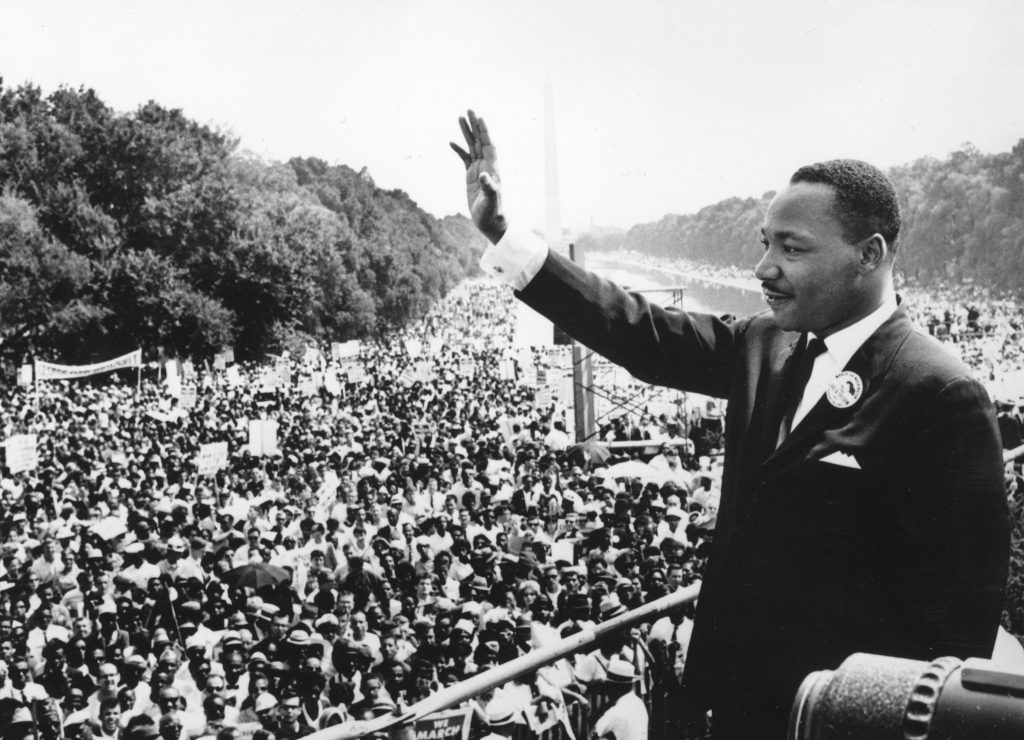
Picture of Martin Luther King Junior at his “I Have a Dream” speech.


The harsh reality is that 8,263 hate crimes against Jewish people took place in America in 2020. Two-thirds of gay people have experienced a hate crime. Sixty-one percent of hate crimes are against black people. In America, 266 transgender people suffered from hate crimes last year. 8,052 hate crimes occured last year in the US. That’s almost a thousand more than in 2019.

Maybe because taking off the blindfold is too hard. It might require too much effort from the majority, it would require them to step out of their comfort zone and actually try to solve the problem.


Our country has a problem. A problem that is bigger than we might realise. A problem that had been going on for years and that people might not realise is a problem because it is not white, straight, christain people that are suffering but the minorities. The minorities are suffering from the problems but the majority is not caring. Maybe because taking off the blindfold is too hard. It might require too much effort from the majority, it would require them to step out of their comfort zone and actually try to solve the problem. It would require the majority to defend the minority. The minority that is already weak since it has been beaten by this problem for days, weeks, months, years and decades. The majority would have to give the minority a leg up. They would have to hold the minority up high and show them off. The majority would have to be proud of the minority, which is not something that they want to do. The problem cannot be solved easily but it is not being solved any faster by the majority ignoring it just because it is not a problem to them.


The problem needs to be solved. I have a dream that one day this problem will be solved. I have a dream that one day the minority will walk hand in hand with the minority. That the majority will not care that the minority is black, Jewish, gay, transgender, disabled or Muslim. I dream that hate crimes will no longer be a problem for minorities. I have a dream that there will be no hate, just peace. In my dream, peace will benefit the minority and the majority. The peace will teach everyone to love, work and hope together. My dream is beautiful but it will stay a dream. It will stay a dream unless we work together, the majority and the minority to make the peace.

Posted in Uncategorized | 2 Comments

Great Gatsby Chapter 3 Imitation

There was music from a packed kitchen most summer nights. On the neatly-trimmed lawn children and teenagers drifted like leaves among the laughter and the songs and the sun low in the sky. At sunset I watched them play guitar on the dock over the lake, or cast fishing lines into the darkly sparkling surface of the water while others danced and jumped around, drawing abstract pictures on the wood with the water dripping from their feet. At dinner the kitchen became a concert hall, filled to bursting with hungry adults and screaming children and gossiping, giggling college kids, while those who had already filled their plates pushed through the masses to look for silverware. And after everyone had eaten, parents, occasionally including one of their well-meaning teenagers, worked with sponges and paper towels and Windex, removing any traces of the mess that had been there only minutes before, and restoring the room to its former glory.

Every warm summer evening, as the stars rose in the sky, teenagers slipped upstairs and gathered in a space just for them, a space where they could stay up late, laughing, playing games, and exchanging stories—every morning these same teenagers rose late and brushed exhaustion from their eyes. There was a certain beauty in existing after everyone else had gone to bed, and their feelings in the morning were well worth experiencing it time and time again.

At least once every summer they were forced to reckon with the mess they had made in their joy, armed with enough brooms and mops and cleaning materials to make the room practically sparkle. On dressers, decorated with long-forgotten articles of clothing someone was probably looking for, empty cans and bottles sat not-so-subtly hidden and cast brilliant shadows as they were uncovered and struck by the light from the windows. To the bathroom one unlucky soul was assigned, resigned to the cleaning of the consequences of their drunken revelry, and yet they still reminisced over the happiness of the night before.

“There was a certain beauty in existing after everyone else had gone to bed, and their feelings in the morning were well worth experiencing it time and time again.”

By mid-July the best days of the summer have arrived, no minor affairs allowed, but a whole month of cannonballs and watermelon and shaken sodas and fireworks at night, and sunburnt backs and faces. The last friends and family members have driven in from out of state now and are quickly settling in; cars with various license plates are parked three deep in driveways, and houses are brimming with dozens of uniquely gorgeous people, and personalities slightly different from the year prior, and music tastes competing for the speaker. Meals and activities run like beautifully unoiled machines, and the kitchen lights permeate the patio outside as the side door swings open and closed on a constant basis, until the air is electric with jokes and hugs, and enthusiastic introductions of new friends and significant others.

The laughter grows louder as the sun sets and neighbors go to bed, and now it is just us alive in this moment, broadcasting our experiences to the rest of the world in the hopes that they see our joy. Interacting with each other is easier day by day as we catch up, relearn the intricacies of each others’ lives. Dynamics between the adults are concrete, ever the same, but relationships in our group of growing young adults are constantly shifting and realigning; already new bonds form and become a source of comfort in a turbulent world; glow, for just a minute, as if nothing could be more important than that connection at that moment.

Suddenly one of us, with a nervous smile, steps out into the spotlight that is the universe, like an astronaut leaping onto the surface of the moon. A momentary hush; they are the first of us to truly leave our precious summer bubble for the real world. Our lives have begun.

Posted in Uncategorized | 2 Comments

Glass Bubble

The day was cloudy and an icy breeze paralyzed my bones. It was barely noticeable a single small ray of light coming from the Sun falling on my right cheek. With two impeccable braids tied to my head, and a tennis racket that was even bigger than half my body, and a tennis ball in my left hand ready to start the point, I was scared to death. The beating of my heart made a symphony to the compass of the cloudy day. I could not stop listening to the negative thoughts that I had trapped in my mind, and in my throat I felt the stuck knot that held the tons of tears that would later run down the same place on my right cheek where a ray of sunshine had welcomed me minutes before. I was only eleven years old, and my back along with my weak legs were letting themselves collapse from the great load that my shoulders supported.

Each individual carries something that, although it seems weightless, is a burden that ends up bringing you down because of how heavy it is. Some carry pain, desire for revenge, responsibility, resentment. Some others even carry someone else’s problems or burdens. In my case, since I can remember, I have been loaded with nerves. They have been my companions throughout my life; they always accompany me wherever I go. Nerves have brought out the best of me, but also the worst of me; I like to think that they are reflected in the way I act in different situations.

Every time I feel a current go through my whole body and stay stuck in my heart, I know it is the nerves visiting me once again. It is a sensation that, far from being satisfactory, makes me sick. A disease that keeps me locked in an unbreakable glass bubble; that does not let me expand my horizons; a disease that keeps me chained prisoner in the deepest corners of my mind, and does not allow me to be free. Due to nerves I have lost great opportunities in my life, because they have never let me break the ties tied to my body, soul, and mind. I must confess that I regret not having fought this disease sooner. But, everything has its time, and apparently, when I was little, I was not ready yet, or I was not strong enough to fight my worst enemy. I was not prepared to fight my own mind.

Over time I realized that the nerves were a reaction of my body to face my fears. My nerves have deprived me of so many things in my life. In absolutely every situation in my life I faced my nerves. However, none of them beat the nerves I felt every time I faced a tennis opponent. It was as if every time I entered the tennis court, a giant like Goliath faced me, only I was not a David to face him and finish him off; on the contrary, the giant made me look more little than what I was, and much weaker than I seemed. My anxiety before a tennis match reached the point where I could not control them; I could not find refuge in them, so I decided to become the best friend of my worst enemy, my mind. And why my mind? Because it knows all my weaknesses. I am not going to lie, at first when I finally had the courage to face myself, it was worse; my mind made me sick more of those nerves that sleep in the depths of my mind, and that blind me at all costs. My mind was my Goliath, trying to challenge me again and again, and I could not improve.

I was clinging to the idea of ​​always carrying this load heavier than any train on my shoulders for the rest of my life. But I did not give up, and I still do not give up. I kept fighting and fighting, until I could start to make my nerves help me instead of sinking me into the depths of the ocean like the Titanic. My fears began to wake me up and make me react, instead of limiting me, and enclose me in a glass bubble forever. It was not the same at the beginning when my nerves made me scared and hide inside my shelter and avoid playing tennis matches. Now, my nerves drove me, woke me up, encouraged me to give my best on the pitch. To date the nerves still appear every day of my life. But now instead of being like a disease that kept me a prisoner inside my body, now I can be more free. I no longer get a fever or throw up when I am too nervous like I used to. And, believe it or not, vomiting was my only consolation, because through them my nerves went.

Nerves took away one of the greatest aspirations I have ever had in my life, that of being a professional tennis player. Every time I walked onto the tennis court for training I felt like I was in my most precious refuge, and I felt safe. But once I set foot so easily on the tennis court during any tournament, my nerves would get the better of me, causing me to fall into the depths of an endless pit. Nerves snatched from me that dream I once had. I will not let them take away my new dream, that of becoming a great doctor.

Now, I can control this nervous sensation that runs like electricity throughout my body. There are still days when I cannot help it and it seems like I am regressing again. But really, I have learned that patience is a key to fighting anything. So you, reader, who find yourself behind these crazy pages of speaking words and letters that feel, do not let loads corrupt your back posture; do not let them deprive you of doing what you like the most, because there is only one life. Become that David who faced the fearsome Goliath, and who, thanks to his courage, defeated the giant. Do not let yourself be limited by your fears; do not let them keep you prisoner in your own glass bubble. Break it, and you will see how your life fills with color.

“Step so out of your comfort zone that you forget to go back.”

26 Inspiring Quotes to Step out of your comfort zone
Posted in Uncategorized | 2 Comments

I have a dream . . .

It has been more than 100 years since the Mexican Revolution, where the Mexican Constitution was signed in Santiago Querétaro. It is dictated that “in the United Mexican States ALL persons shall enjoy the human rights recognized in this Constitution, as well as the guarantees for their protection, whose exercise may NOT be restricted or suspended.” 105 years have passed, and 100% of women have suffered gender inequality, more than 75% of the entire Mexican female population feels insecure in their homeland, and every day at least 10 women in Mexico are victims of femicide.

The rights that women in Mexico have cover all aspects of life: health, education, political participation, economic well-being, not being the object of violence, as well as many more. Women and girls have the right to the full and equal enjoyment of all their human rights and to live free from all forms of discrimination: this is essential for the achievement of human rights, peace and security, and development sustainable.

I remember that during the third of March, international women’s day, in my last school  Alexander von Humboldt German International School it was shown that ALL the women in our school had been given some unpleasant and sexist insult, absolutely none felt safe going out to the street after seven at night, and the most surprising thing is that we have ALL been victims of having our body touched without consent.

Therefore . . .

I have a dream that one day I will be able to get home safely after a party by myself.

I have a dream that one day I will be able to have the same salary as a man.

I have a dream that one day I would not have to worry every time an acquaintance, friend, sister, or even my own mother goes out at night alone.

I have a dream that one day they would not kill a single woman every day.

I have a dream that one day I will be able to feel safe in my own country.

I have a dream that one day I would not have to claim someone for touching my body without my consent.

I have a dream that one day female figures can be part of the political decisions of our country.

I have a dream that one day the violence against women in our Mexico will vanish, and that harmony and equality between all genders will emerge.

I have a dream that one day not one more woman will be missing!

“We are the cry of the women who are no longer here!”

I have a dream that one day we will be free!

“If you can dream it, you can do it.”

Walt Disney
What if feminism was plural? - Azickia
Posted in Uncategorized | 2 Comments

Live, Love, War

Women have for a long time occupied a strange place not only in wartime, but in literature. Typical femininity denotes dependence on a masculine figure, or a divine female figure upon which the masculine looks as an object (emphasis on object, as opposed to person) of desire. Nevertheless, in The Things They Carried, images of the feminine are complicated. Women in Tim O’Brien’s novel  are only spoken about, remembered, or idealized by the men, never seen; however, they represent the conflict of war and love and the dangers in between, as well as hope and home.

For a lot of soldiers, one specific female person in their life helps them emotionally in war as that woman helps them mentally. They connect that person to love, home, and hope, so they have something to hold on to. Many of the men carry mementos of women they love or hold affections for; however, very few of these mementos are of women who actually reciprocate those emotions. Jimmy Cross, Henry Dobbins, and the nameless soldier all carry photographs (or, in Dobbins’ case, panties) of women who do not love them back. Even O’Brien himself carries in memory Linda, the girl he loved when he was nine years old and who died of brain cancer. This gives Tim O’Brien the inspiration to write about love and death. His love for Linda saved him during and after the war. It is not that Timmy loves Linda and then she dies, rather that he loves her because she dies — love and death are the same. It is his love for Linda that allows an older “O’Brien” to go to war, and later to write about it. The whole novel, then, is about love and death, about Timmy and Linda. To summarize, even though they were not physically in the war with the soldiers, women helped them to survive because the soldiers fought for love, even though some of them knew that they were not loved back.

The novel shows how complicated love connected to war is. Women could also make a soldier’s life in the war more difficult. In the first chapter, Lieutenant Jimmy Cross talks about his obsession with a girl called Martha, who he knows back from college. He is carrying letters from her which he reads carefully, and decides her letters are “chatty.” Each night, he checks on his men after reading her letters and then returns to his foxhole to think about her. He also carries a pebble of Martha around in his mouth, which makes Jimmy Cross create a false hope of them being together, knowingly distracting him from his duties as leader of his platoon. While being distracted by the pebble, one of his platoon mates, Ted Lavender, his fellow soldier, dies. Lieutenant Jimmy Cross feels guilty, so he burns Martha’s letters in his foxhole. Then he burns two photographs that he had of her. He decides he hates her. “Love, too, but it was a hard, hating kind of love” (O’Brien 23). From then on, he decides to become a stricter Lieutenant, and to bring his platoon in line. “He had loved Martha more than his men, and as a consequence Lavender was now dead, and this was something he would have to carry like a stone in his stomach for the rest of the war” (O’Brien 22). Martha shaped Cross’ character. He decided to see his love for her as a weakness, and he blames her for Lavender’s death. Yet, Jimmy Cross is not the only member of the platoon that loses his girlfriend to war. 

O’Brien uses one female character to explain the mental threat that anyone who experiences the war carries: Mary Anne in “Sweetheart of the Song Tra Bong” is a naïve but curious and quick-learning teenager who ‘goes primal’ as she forsakes her home of America and loses herself in the Vietnamese mountains. When she first comes to Vietnam to visit her boyfriend, Mark Fossie, Mary Anne is described as an idealized “American Girl”, which makes what happens to her come to symbolize what’s happening to all of America in Vietnam, just in a kind of stylized way that makes it less easy to overlook. The war changes Mary Anne and what she wants. It gives her a taste for new things in life, removes her innocence, liberates her in certain ways. One soldier even confesses to loving Mary Anne because she is the only woman he knows of who could ever understand what Vietnam does to a soldier because she lived it. Mary Anne was insatiable about the war and the rush of terror and joy it gave her. She explains that “Sometimes I want to eat this place. The whole country—the dirt, the death—I just want to swallow it and have it there inside me. That’s how I feel. It’s like this appetite” (O’Brien 106). Mary Anne wanted to be a part of the land and be completely lost in it, like she had already become lost in herself. She was calm when under attack, and she was fine with going off alone. The Greenies believed she was still alive, but not in a physical way—there was a spiritual element to it. She had achieved her goal in becoming a part of the land—but it swallowed her whole instead of her swallowing it. Mary Anne is used in the novel to describe the war and what it does to people that experience it. Thereby, expressing this through a female character, O’Brien mentions that the war impacts women and men equally, and that both genders can become obsessed with the violence and dehumanization. Mary Anne symbolizes a common phenomenon for Americans fighting in any war – the transformation from innocence to savage experience. She arrives as a person happily conforming to the norms of society and ends up more like an animal, living without regard to custom or appearance.

Honors English 11: Bittersweet

 Finally, Mary Anne is the most real example of love in the novel. Although Lt. Cross and Henry Dobbins carry keepsakes that remind them of love, Mark Fossie is the only soldier who brings his girl to him. Mary Anne’s rapid descent from girlfriend and lover to warrior is the most blatant example in the novel of O’Brien linking love and war. Truth, to O’Brien, is an emotion, like Alpha Company believing in the story of Mary Anne when they knew they could not fully trust its storyteller, Rat Kiley. To O’Brien, love and war are not just connected; love and war are the same in that both refuse to let life interfere with emotion. Mary Anne is one of the “truest” characters in the novel because she lives off of her emotions and slips so easily between a posture of love and one of war.

“A strong woman builds her own world. She is one who is wise enough to know that it will attract the man she will gladly share it with” .

Ellen J. Barrier

All of these female figures, while still not given a prominent voice of their own, nonetheless tend to eschew archetypal femininity: those who are objects of male love do not love back simply by virtue of the soldiers’ participation in the war, and those who come to Vietnam and start off with a protected status soon become more gruesome than even the most sadistic of American soldiers. In general, all the stories around women in the novel have a special significance. Love, guilt, innocence, and mental damages of the war are symbols that are expressed through female characters. While Linda helps O’Brien to hold on to something, Martha makes Jimmy Cross feel guilty, and Mary Anne perfectly symbolizes the addiction to the war and the land that most soldiers had to carry. O’Brien shows how the war made it difficult to have a love relationship in the war and outside of the war. All the stories of women have one significance in common: they express the difficulties of the soldiers to live a life outside the war.

Posted in Uncategorized | 2 Comments

Salvelinus Fontinalis

“Once there were brook trout in the streams in the mountains. You could see them standing in the amber current where the white edges of their fins wimpled softly in the flow “ (McCarthy 286). Multiple times in the novel, the man sees brook trout as a part of his memory of the old world. After his death in the end scene, these trout are mentioned again. There is almost no life possible in the post-apocalyptic world, making the brook trout a symbol of the past, a part of the man’s memory. The scenes in which the man sees brook trout in his memories of the past and in his dreams foreshadow the end of McCarthy’s novel, the fathers immutable death. In The Road as well as in The Things they Carried by Tim O’Brien and in Beloved by Toni Morrison, dreams and memories of the past seem to have taken on an own life outside of their “owner”, and while they can be used as an escape of reality and a reason to keep moving forward, it is important to leave some of them behind. 

The man in The Road experiences positive moments connected to his dreams, but he also seems to know that they are a distraction from his willingness to survive with his son in the post-apocalyptic world. His complex relationship with his dreams gets clear when his memory of his wife, who shot herself to escape to death, appears. “He mistrusted all of that. He said the right dreams for a man in peril were dreams of peril and all else was the call of languor and of death” (McCarthy 18). While his dreams give him some relief he also considers them as giving up and as devoting himself to death. “When your dreams are of some world that never was or of some world that never will be and you are happy again then you will have given up (McCarthy 189). He describes his dreams as “so rich in color”, but he knows that they are a “call of death” (McCarthy 21). Therefore, it seems like he tries to fight against his dreams and memories by rejecting them. After he has given up and accepted his death, he does not reject his dreams and good memories anymore, allowing him to dream of “softly colored worlds of human love, the song of birds, the sun” (McCarthy 272). However, he also understands the importance of having some kind of memory of the old world. “Make a list. Recite a litany. Remember” (McCarthy 31). His memories of the past give him a reason to keep on surviving. His son has never seen colors or birds before because he was born after the apocalypse, so he wants him to experience the old world. The man also illustrates how powerful a dream can be, taking on its own life.

In The Road it seems like the man tends to reject his dreams and memories because they are not a part of him anymore, they became their own entity outside of himself. He thinks about how the act of remembering changes the memory somehow, so he must be careful with the precious past. “He thought each memory recalled must do some violence to its origins. What you alter in the remembering has yet a reality, known or not” (McCarthy 131). The man recognizes that the present is the only changeable time, but it can be changed by the act of remembering the past – an insight that foreshadows the novel’s end, where memory seems to become its own entity outside of the person doing the remembering. The novel ends with a description of the brook trout that once lived in the mountain streams. They were beautiful and delicate, and of a mysterious place “older than man” (McCarthy 287). This achingly beautiful scene closes the book on a more hopeful note, but it also raises a question – the man, the only one capable of remembering such trout, is dead, so it is unknown who is remembering these trout. It may be the narrator taking a more forward role, implying that life will always find a way despite humanity’s interference, or possibly a comment on how the man’s memory of beauty and nature (one aspect of “the fire”) has taken on a life of its own and perhaps been passed along to the son. Remembering the past has become a part of the present. His dreams and past memories appear to be his opponent, and his son seems to fight against that opponent as well. 

The boy in The Road has never lived in a better situation than on the road with his dad, so he rather focuses on reality than telling lies. He doesn’t like telling stories of dreams as he considers them as an escape from reality. When his dad asks him to tell a story, which is his way to remember the past and continue to “carry the fire”, he expresses his opinion on dreams that romanticize their situation: “Those stories are not true” (McCarthy 268). He does not want the help from a story, he rather sticks to the cruel reality. His father’s optimism seems to bother him. The boy sees the power of a dream, story or memory, independent from its “owner”. Therefore, he mostly does not talk about his dreams after having a bad one, even though his father asks him to. One night he dreams about his father’s death, but he would not tell his dad about it because he does not want to destroy his dad’s optimism. In this situation, the boy controversially escapes the harsh reality of his father’s death by trying to ignore the dream, at least externally. The boy seems to have a clear opinion on memories and dreams. As he has never experienced the good old world, he has no chance to dream about good things like his father; consequently, he cannot escape by finding peace in them. He also has no good stories to tell, he can only tell lies. In other literary pieces, some characters need their dreams and stories in order to survive.

In  The Things they Carried, Tim O’Brien’s dreams are a way of coping with his past, and his stories, which have taken on their own life, help him to survive. To be able to deal with his life during the war and after is storytelling, which is kind of a dream. He reveals a truth to his readers: “Stories can save us” (O’Brien 213). He tells stories and has dreams of Linda, the girl he loves. As Linda doesn’t love him back, his dreams are not real, but this escape from reality helps him to cope with his life. In addition, he brings people that had died back to life in his stories and dreams to deal with his guilt. The man he killed appears multiple times in O’Brien’s stories, and he tells stories of him being alive. Thus, the narrator gives him some kind of life back. Coping with his trauma and guilt by dreaming and storytelling is what he considers “Self-hypnosis. Partly willpower, partly faith. My dreams had become a secret meeting place” (O’Brien 231). This also shows the independence of his own dreams and stories from him. The novel focuses on the difference between the “story-truth” and “happening-truth”, explaining that “story-truth” is the emotional core of a story. Therefore, the stories seem to have their own life outside of what happens in them. They have taken on their own life, they can be considered as an independent individual.

In Toni Morrison’s Beloved, Sethe, the main character’s memories are embodied in her daughter Beloved and create a haunting within her mind. Multiple times throughout Beloved, Sethe’s mind recalls moments from her past. There are certain things that are always in her memory: her wedding, meeting the white girl who helps save her and Denver, the pink flecks in the headstone for her lost daughter. But Sethe’s “rememory” is something that catches her off guard. “Sethe gathered hair from the comb and leaning back tossed it into the fire. It exploded into stars and the smell infuriated them. ‘Oh, my Jesus,’ she said and stood up so suddenly the comb she had parked in Denver’s hair fell to the floor. . .She had to do something with her hands because she was remembering something she had forgotten she knew” (Morrison 73). In that moment Sethe’s memories seem to haunt her. They have taken on their own lives outside of her. This is also represented in the character of Beloved who embodies Sethe’s past and thus needs to leave behind to be able to move on. Past memories became their own entity, their own character that lives outside of Sethe. “Some things go on. Pass on. Some things just stay. I used to think it was just my rememory. You know. Some things you forget. Other things you never do” (Morrison 43). Sethe is conscious about the power of her memories over herself, but she also feels an excessive love for Beloved, making it hard for her to move on. Finally, to leave her past behind and stop the haunt within her mind, she kills Beloved in the end of the novel. 

“There is no greater agony than bearing an untold story inside you”.

Maya Angelou

Dreams, stories, and memories are complex themes in many literary works; however, they clearly take on their own lives, and they have a lot of control over individuals. While the man and his son in The Road seem to struggle with their relationship with good dreams and stories as a reminder and reason to keep on fighting, Tim O’Brien finds his own peace and pleasure in them to cope with his trauma. Beloved is the human embodiment of her mother’s past haunting her. In all of these cases, memories, stories, and dreams take on an own life, they live independently and can almost be considered an actual character. Supported by the end scene in The Road in which the man’s beautiful memories of brook trout appear after his death, past stories do not die with their “owner”.  In general, dreams and memories are always more than only in people’s minds, and while some might profit emotionally from them, others seem to be overwhelmed and empowered by their dreams and memories. 

Posted in Uncategorized | 1 Comment

The Boy’s Loss of Innocence

The boy in Cormac McCarthy’s The Road is a christ-like figure, a golden-haired angel who is a last bastion of humanity and purity in the post-apocalyptic world, while the man himself is willing to use violence to protect the boy’s life. As they experience more and more cruelty of the world, the boy’s innocence slowly fades away, and his father notices the change of his and his son’s life, which can be noticed through many symbolic scenes that mostly occur during their sojourn at the bunker in which they find food. 

There is a clear scene in the novel that causes the boy’s loss of his innocence, and the father can notice that after the scene. Before they open the bunker which saves their life, the boy is very scared, resulting from the experience he made last time they opened a locked chamber, as they found prisoners of cannibals in there. This shocking finding, in addition to all the other brutal and dehumanizing challenges he and his father experience every day, leads to the boy’s loss of innocence. Before opening the next bunker which saves their life, the man comforts his son. What he realizes then is that something has changed: “But when he bent to see into the boy’s face under the hood of the blanket he very much feared that something was gone that could not be put right again” (McCarthy 136). The boy’s father, who has always valued his son’s innocence and purity, is now scared that these values are lost forever. His observation is supported by the fact that the boy mistrusts every little piece of joy and luck he and his father get to experience after this scene.

“The end approaches, but the apocalypse is long lived”.

Unknown

Even after opening the bunker and finding impossible riches saving their life, the boy fears that it is only another dream tempting him to give up. Still finding comfort and order in the idea of heaven and God, the boy prays to the bunker’s owner. After eating, the man washes his son with warm water. This procedure alludes to a baptism, symbolizing the boy’s rebirth as someone who has lost their innocence. Describing his son as “scrawny and filthy and naked” (McCarthy 146), he washes his innocence away. After, there is “steam coming off him like smoke” (McCarthy 147), suggesting that the boy is getting more and more like the world he lives in. The next ritual alluding to a change and to a loss of innocence follows right after: When the man is cutting the boy’s hair, he is separating him from something mothering. Cutting his “golden” hair symbolizes that he is also getting rid of his son’s golden values, his purity and innocence. The boy also seems to notice the change in his character.

When they leave the bunker after a few days, the man asks the boy where the flute that he made for him is. The flute is a symbol for purity as music seems to be absent in their world. Now, after losing his innocence, the boy throws the flute away. In addition, McCarthy foreshadows his loss of innocence through many scenes before entering the bunker in the slave plantation. They drank water, mixed with a grape flavored powder and eat, prior to entering the slave plantation bunker, eat the boy‘s favorite food, which alludes to vine and Jesus’ last supper. Then, when they’re close to starvation, the man finds apples that they eat. The man later describes the bunker filled with food as a “tiny paradise” (McCarthy 150) that they have to leave. This passage highly connects to Adam and Eve, eating apples from the Tree of Life resulting in leaving the Garden of Eden. The man and his son eat the apples, and the son loses his innocence right after. 

The Road by Cormac McCarthy (2009) Part 1 - THAT ENGLISH TEACHER

Not only the plot, also McCarthy’s language in this section reveals a change. The sentences become monotonous and tedious. Many sentences start with the same word, for example “He” (McCarthy 154), or many independent sentences are all connected with “and” (McCarthy 140). This suggests that, coming with the son’s loss of innocence, his life gets boring and gray too. Where there was some music from a flute and golden hair, there is now nothing of it left anymore. As the boy loses his purity, McCarthy’s language becomes soulless too. 

To summarize, the boy’s experience where he enters a bunker finding prisoners that are kept to be eaten one after another, he loses his innocence. This scene is the most brutal and dehumanizing one in the novel so far, and it changes the boy. He starts to mistrust any following joy in his life: In addition, his dad, who has noticed the growth in his son’s character, laves him and cuts his hair, serving as rituals that show the boy’s loss of innocence. Nevertheless, the man fears that process because his son’s purity and compassion are human traits that are necessary for them to survive, as they are a part of God, a part of the fire they carry. Language-wise, McCarthy emphasizes this loss of positivity and color by using monotonous sentence structures and multiple repetitions of the same linking words in one sentence. The loss of the boy’s innocence can be seen as the turning point of the novel and brings his and his dad one step closer to death.

Posted in Uncategorized | 3 Comments

Black, Red, Yellow

 I want to start this essay by talking about a moment in school that I have been experiencing a lot. While it might be a meaningless moment that is just a part of their school life to my fellow students, it is a very significant situation for me. It usually happens in history or English, mostly during class discussions. I sit in class, curious to learn about new topics, curious about discussing, curious about what others have to say. However, This curiosity vanishes as soon as the discussion takes a turn into a certain direction of topics. When someone takes the word „Second World War“, „Adolf Hitler“, „Nazis“, or „Holocaust“ into their mouth, I am quiet. Others don’t, they talk about the topic just like they talk about everything else. That is because I am different from them in one specific way. I am German. I carry around my German nationality, it’s past. I carry around the shame, guilt, and violence of my ethnic group. 

During the Second World War, Nazi German authorities deported millions of Jews from Germany, from occupied territories, and from the countries of its Axis allies to ghettos and to killing centers. The Holocaust is a big rock in our past. We all now see that war and its events as one of the most horrific terms in history. My family is German, and I have always lived in Germany. Even though there is still racism and national socialism in my home country, it is hard for me to believe that all of what happened during the war is true. I love my country, including most of its political and moral beliefs. I definitely consider myself German, but it is hard for me to identify myself with its past. Nevertheless, I know for sure that my ancestors, my great grandpas, their brothers, and their dads, were Nazis. My grandmother’s father worked in Auschwitz, the largest of the Nazi concentration and death camps. That is hard to believe because my grandmother is a person that goes outside everyday to feed birds. If I could, I would like to be able to detach myself from my German roots, but I will always be entwined with the country of my birth. My roots are the element that let me live and grow, and my country’s soil has always nourished me. 

How the Nazis Tried to Cover Up Their Crimes at Auschwitz - HISTORY

The first thing that comes to most non-Germans’ minds when they think about the country is Adolf Hitler. Technically, that means that Adolf Hitler is the first person they think about when I say that I am from Germany. Especially when I started studying outside Germany, in a boarding school in the United States, people judged me for my German ethnicity. Well, they did not judge me, but they have certain thoughts in their mind when I say that I am from Germany. There is that one awful moment when we talk about the Second World War in class, that moment when everyone turns around and looks at me. My heart always thinks: “Why do they look at me? I have nothing to do with that. I am not German in that way”. But on the other hand, I can see my great grandfather leading thousands of innocent people into a gas chamber. That is a daily conflict between my heart and my brain. While I would like to follow my heart, in fact, my mom is German, my dad is German, I am German. It is difficult sometimes to remember the beautiful aspects of the nationality I carry with me because there is so much violence and prejudice, too. 

“We are all human beings, and our nationality is simply an accident of birth”.

Venkatraman Ramakrishnan

I always try to think about the good aspects of Germany next to its bad past. Quality of life in Germany is one of the highest in the world, and rights in Germany enjoy a high level of protection, both in theory and in practice. I can go outside everyday feeling free and safe. I try to remember that, while carrying my nationality’s horrific past, I also carry its freedom, rights, and safety nowadays. I carry something that I love, that I am proud of, that I feel safe in now. However, I will always carry those two sides of my German ethnicity. The part that is heavy, that drags me down, and the part that adorns me. Germany’s past and the present.

Posted in Uncategorized | 3 Comments